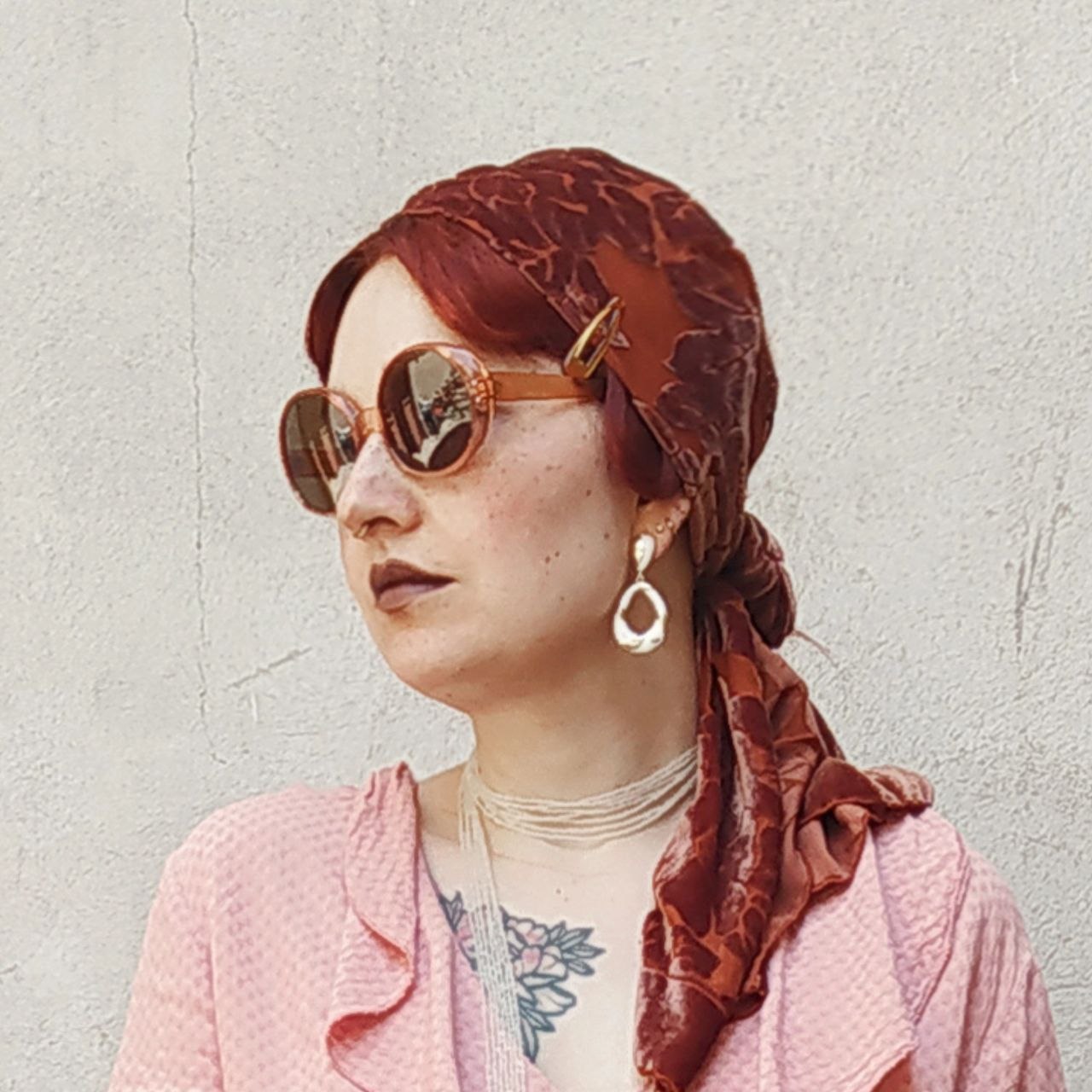
On this page, you will find a selection of projects by Anna Rabbit.
Below you can see most of the artwork shown at Anna Rabbit’s exhibit, co-organized by MuHer and Association of Friends of the Academy of Fine Arts at the Historical Art Studio of Olga Boznańska in Kraków – August ’26
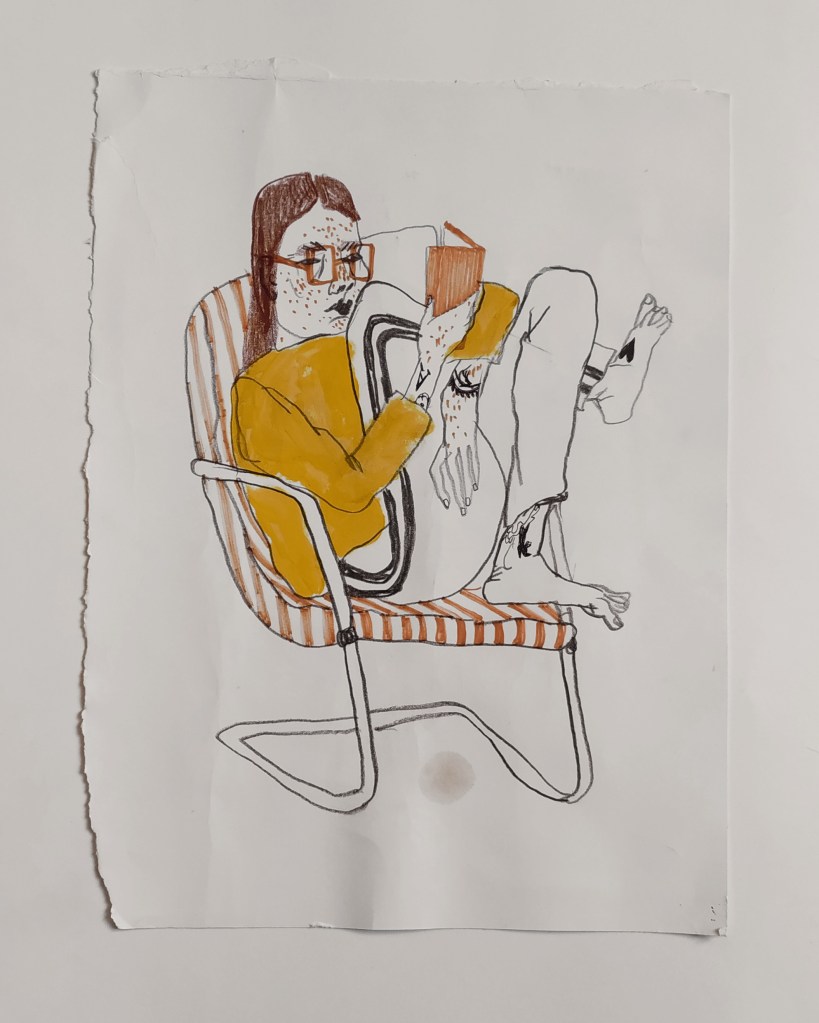
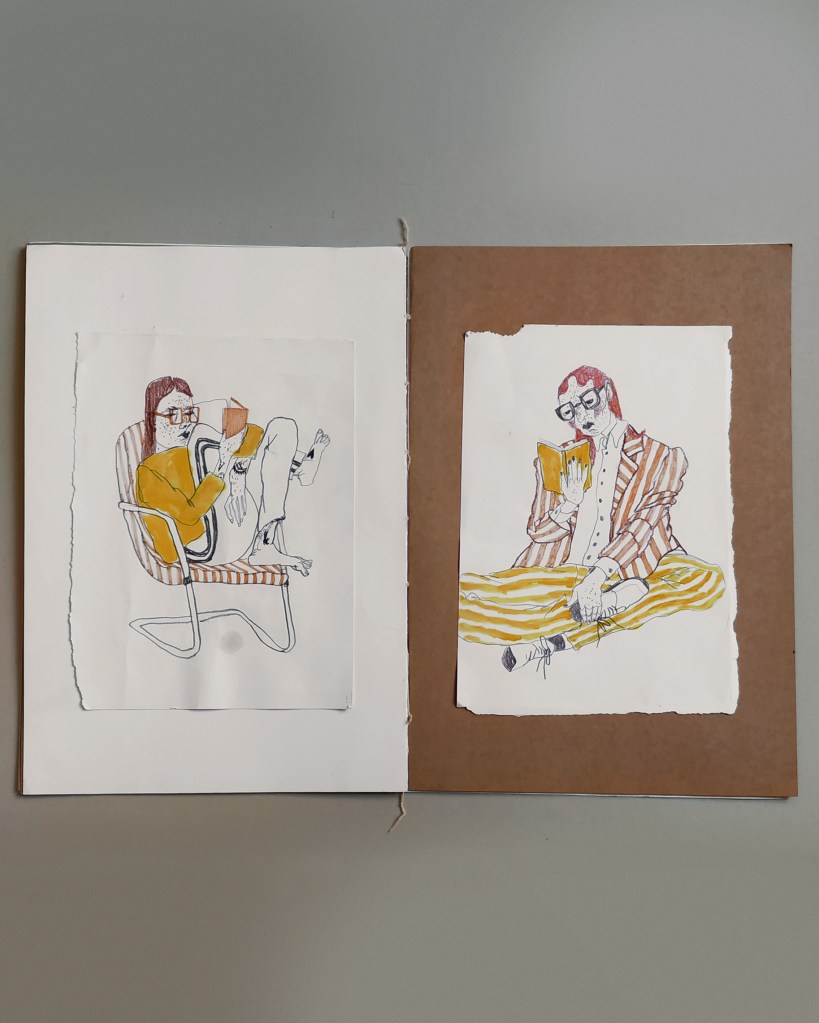
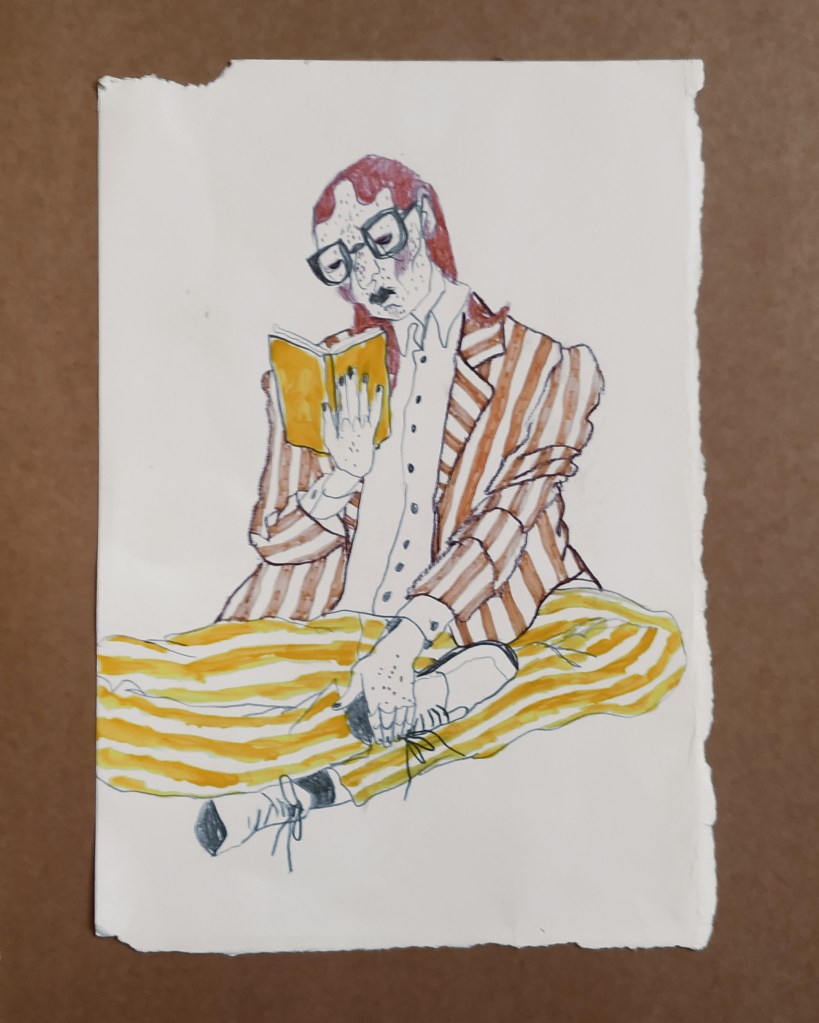
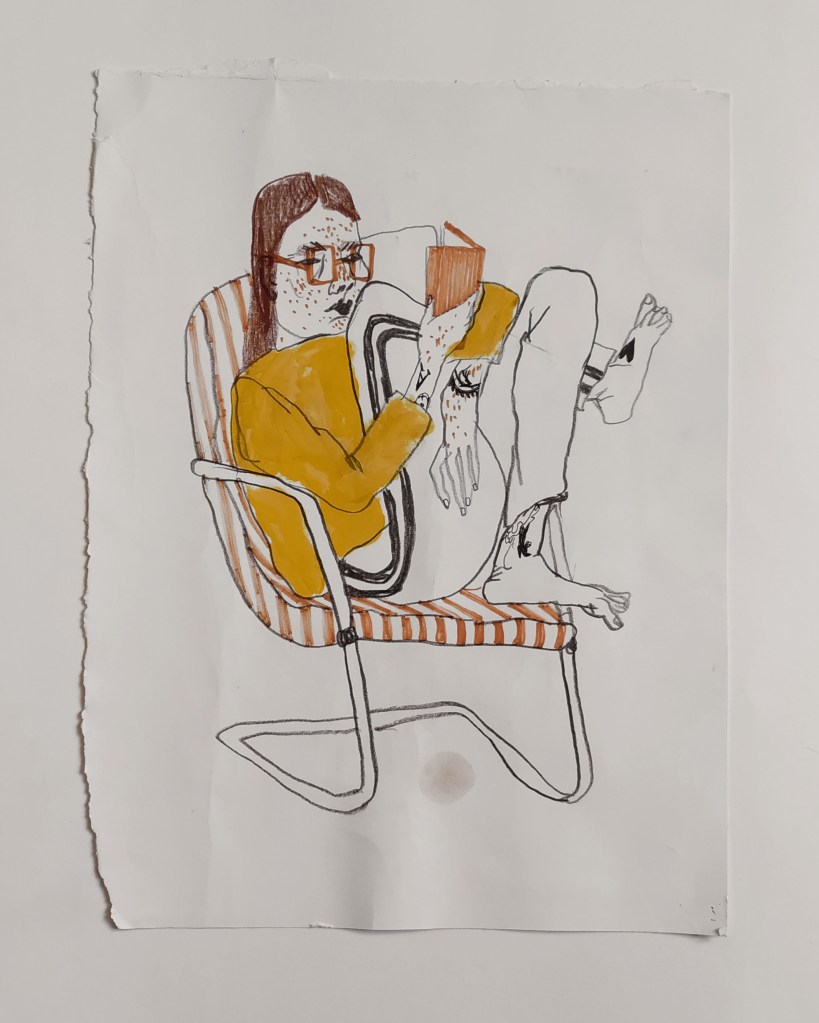
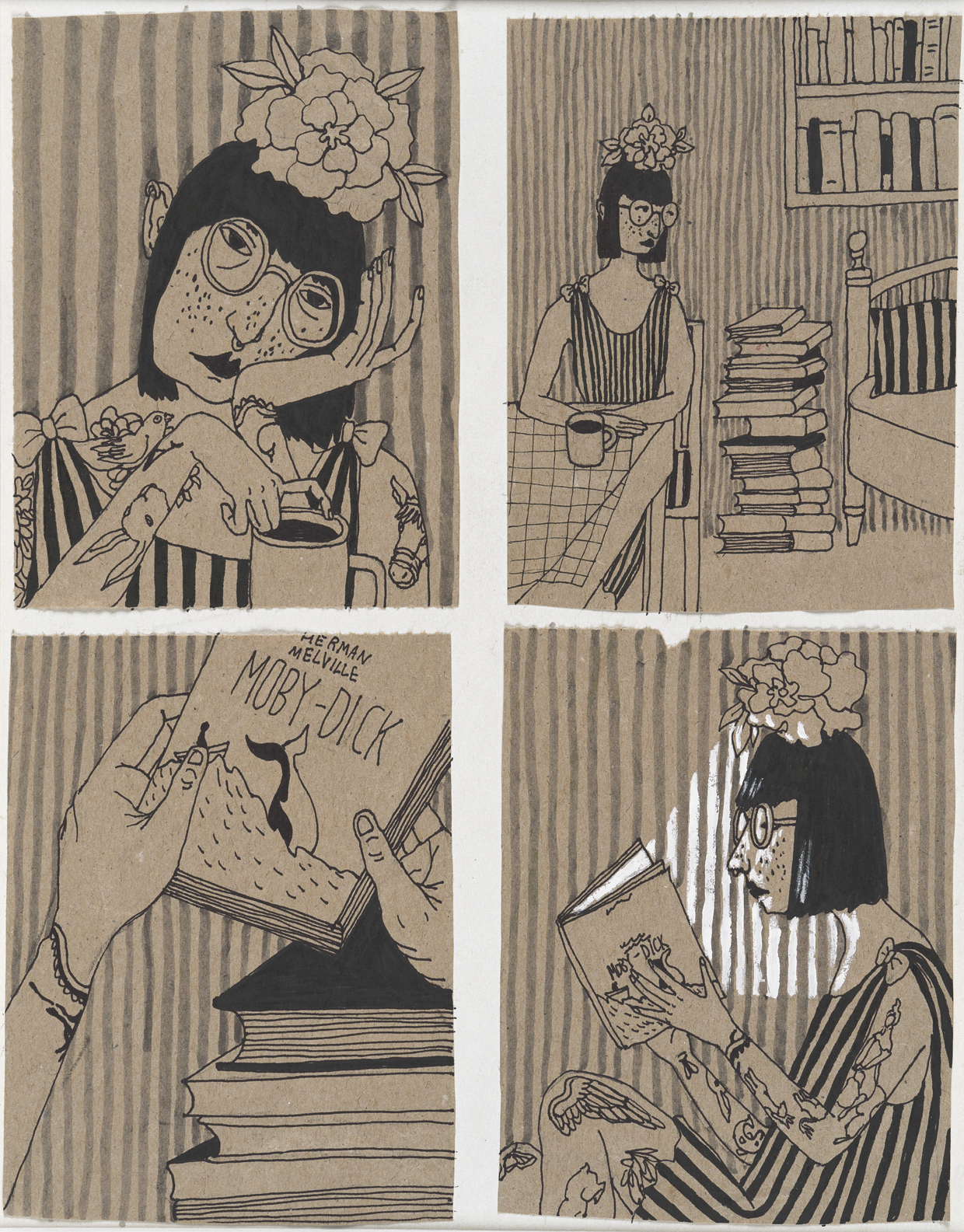
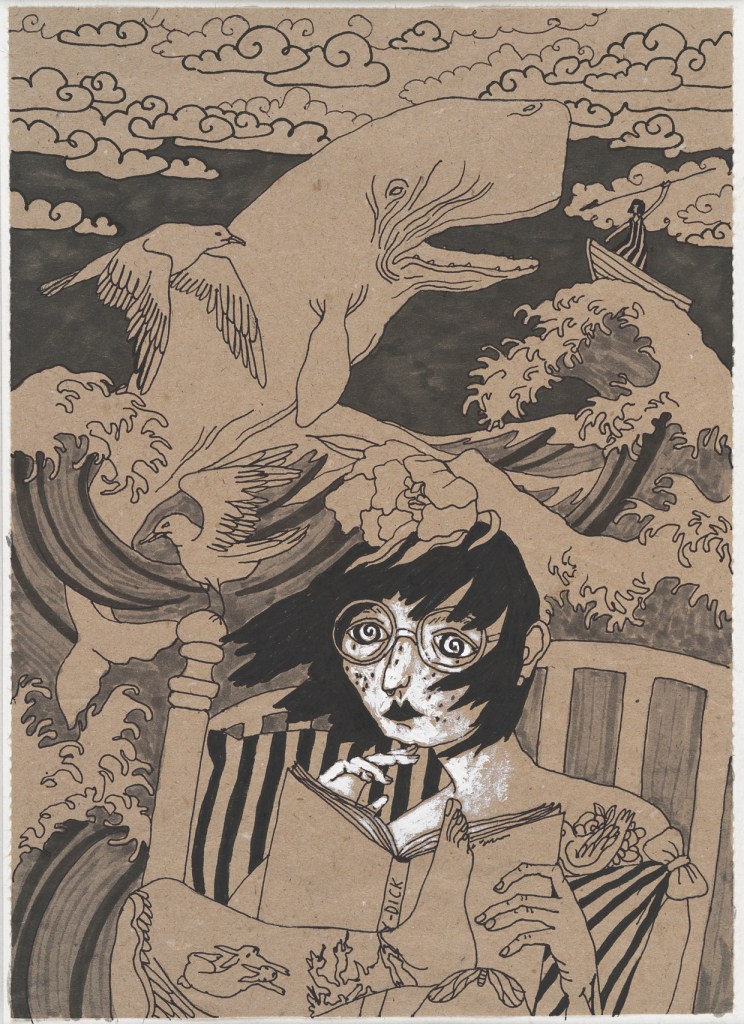
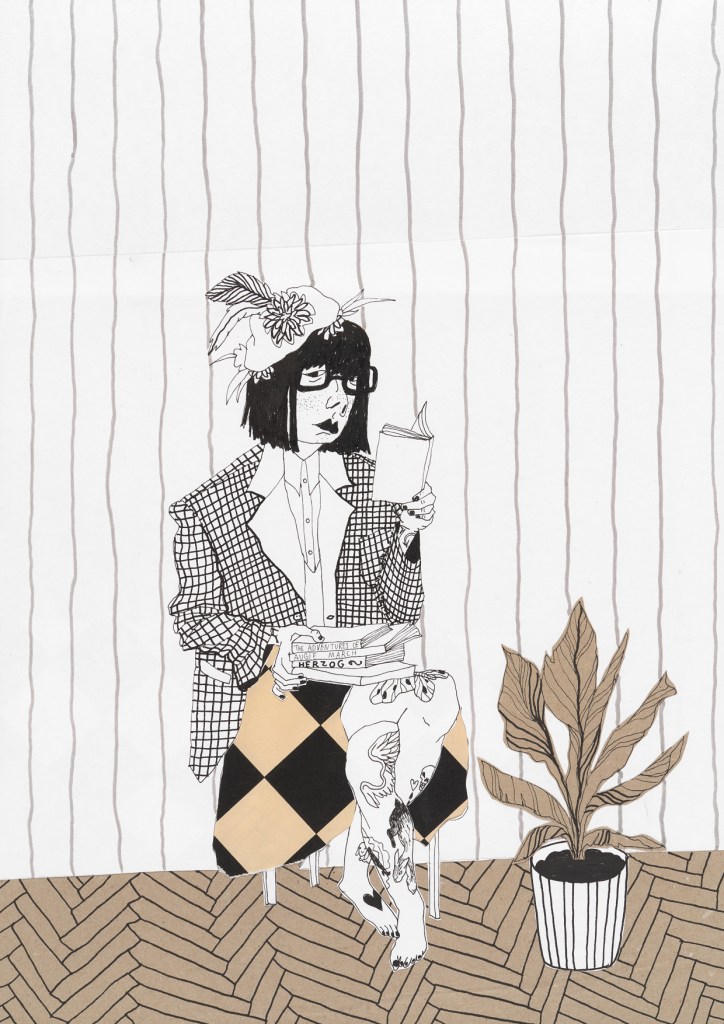
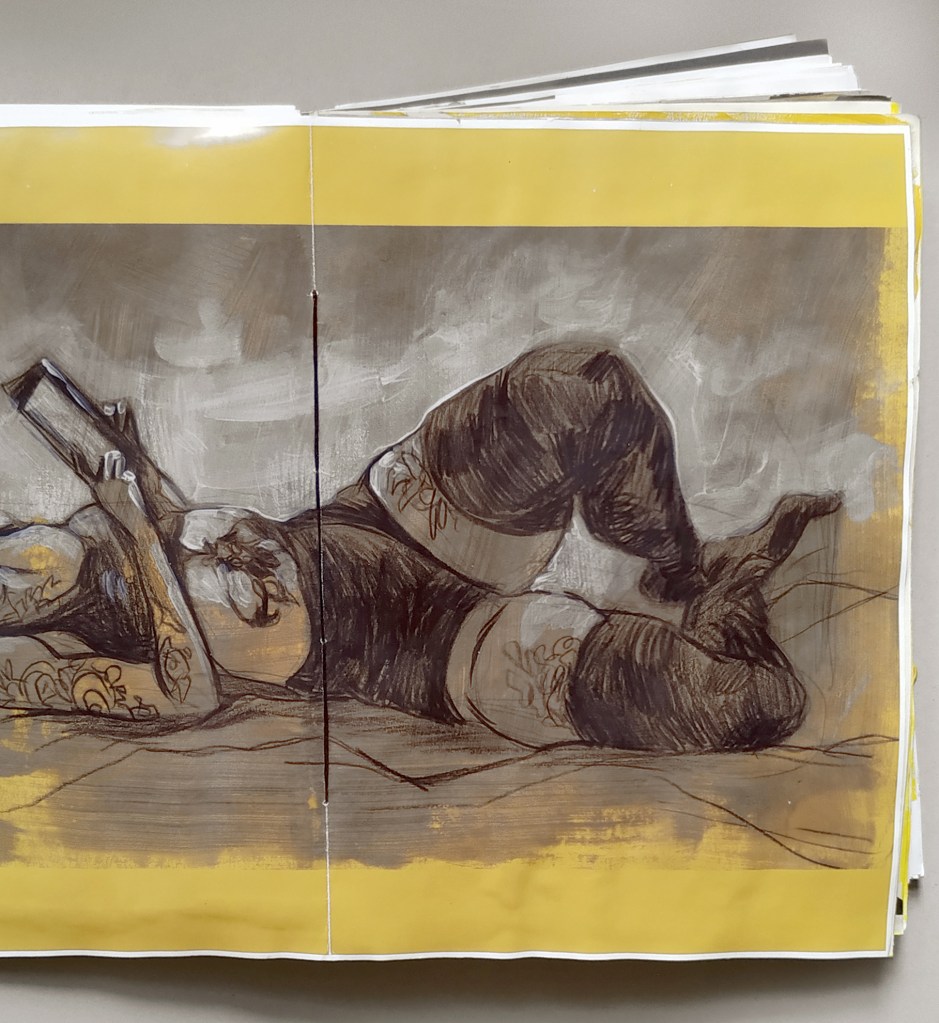
Sketches of me reading, made especially for this exhibition, in a large sketchbook.
Szkice przedstawiające mnie podczas czytania, wykonane specjalnie na tę wystawę, w dużym szkicowniku.
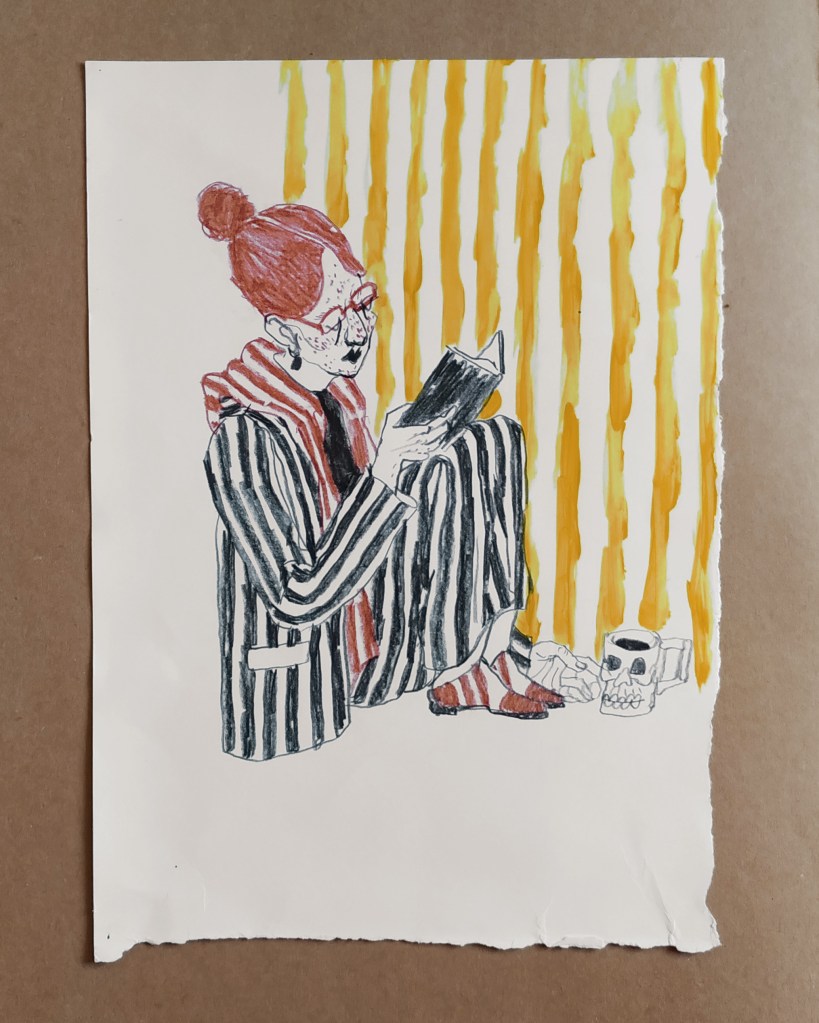
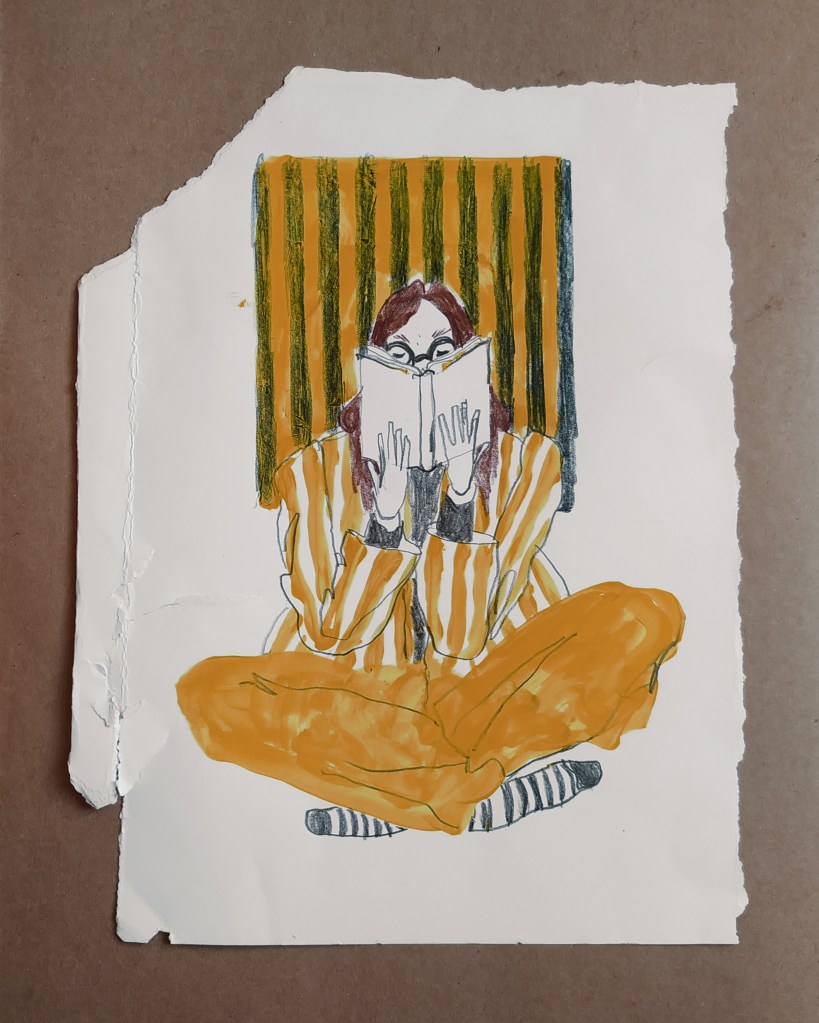
The Wonderful Wizard of Oz (series)
Czarnoksiężnik z Krainy Oz (serja prac)
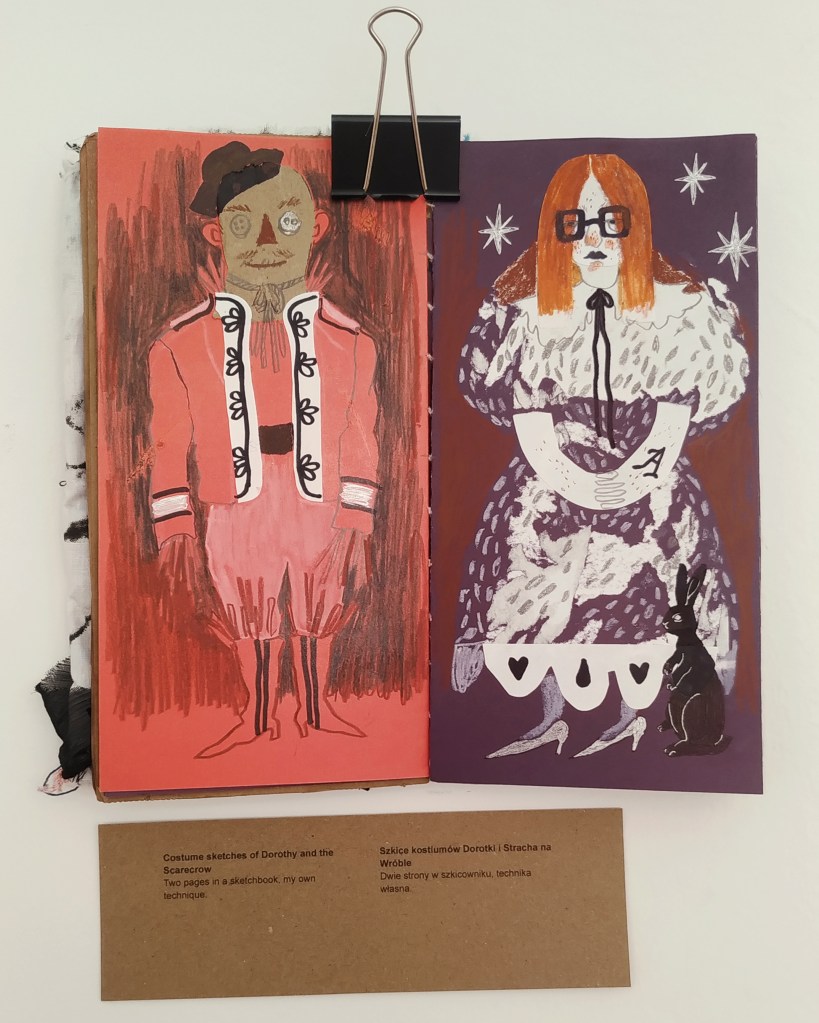
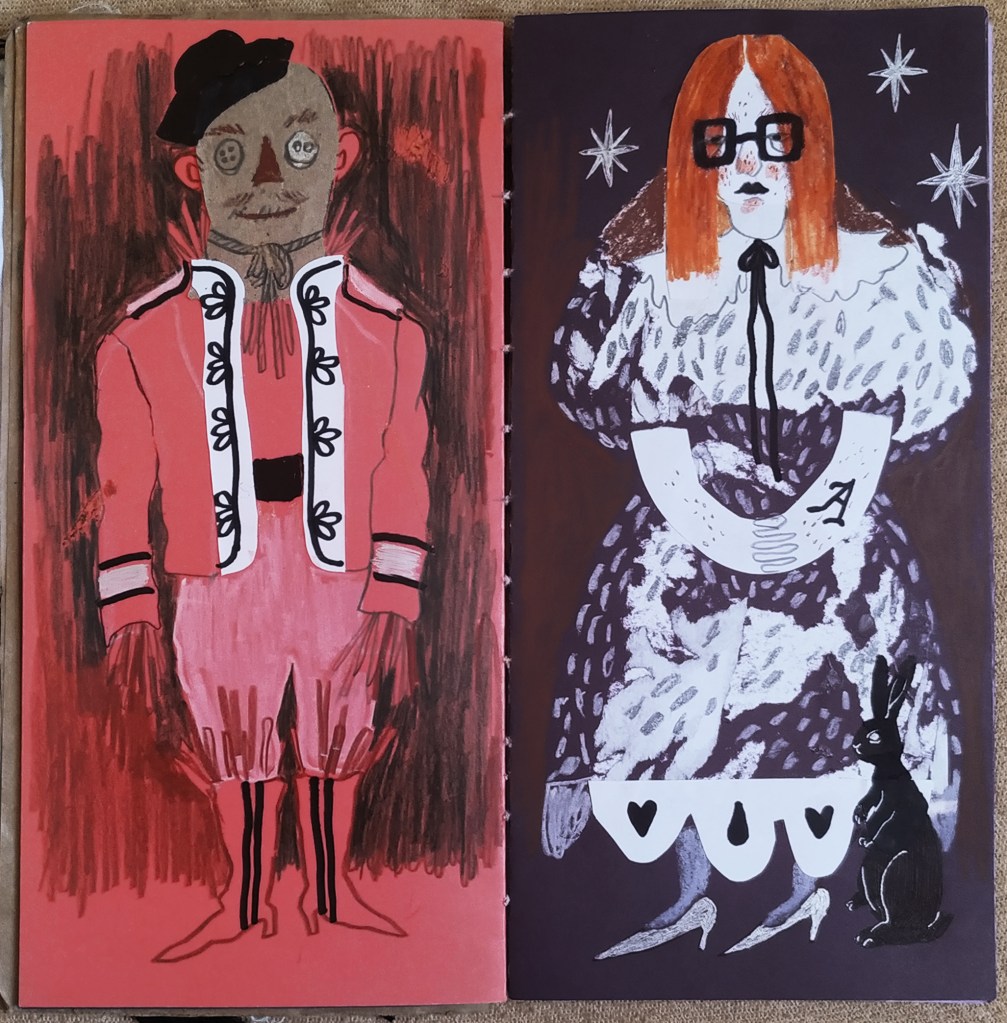
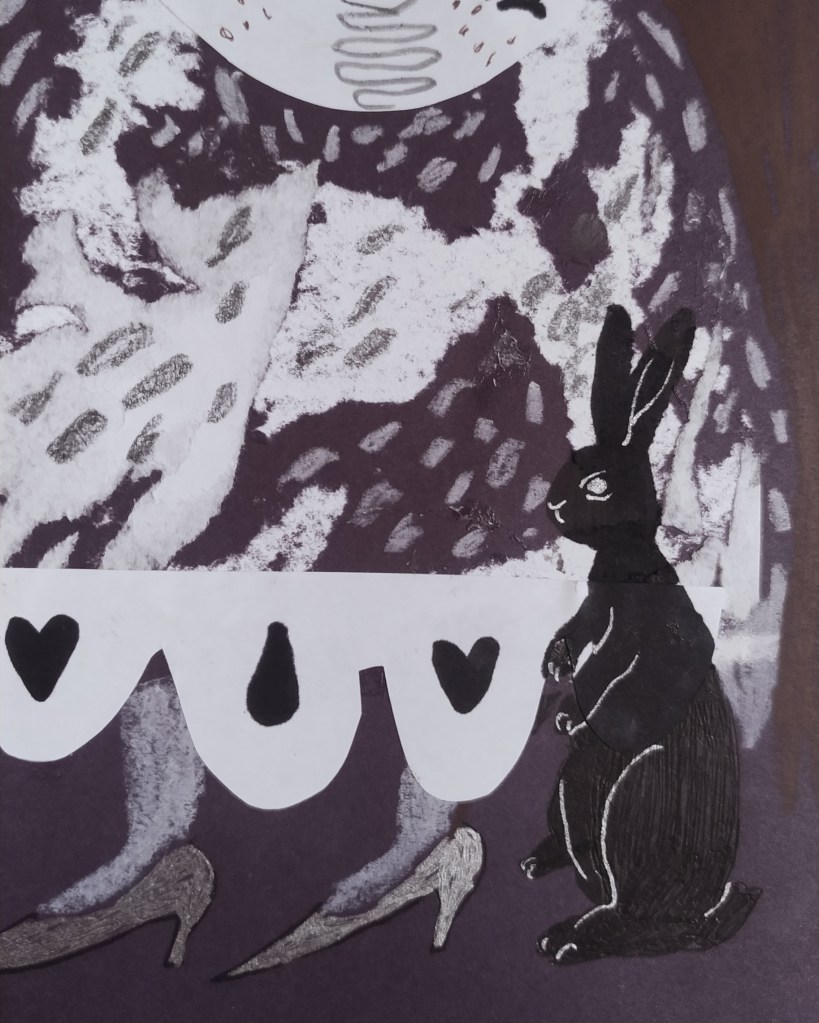
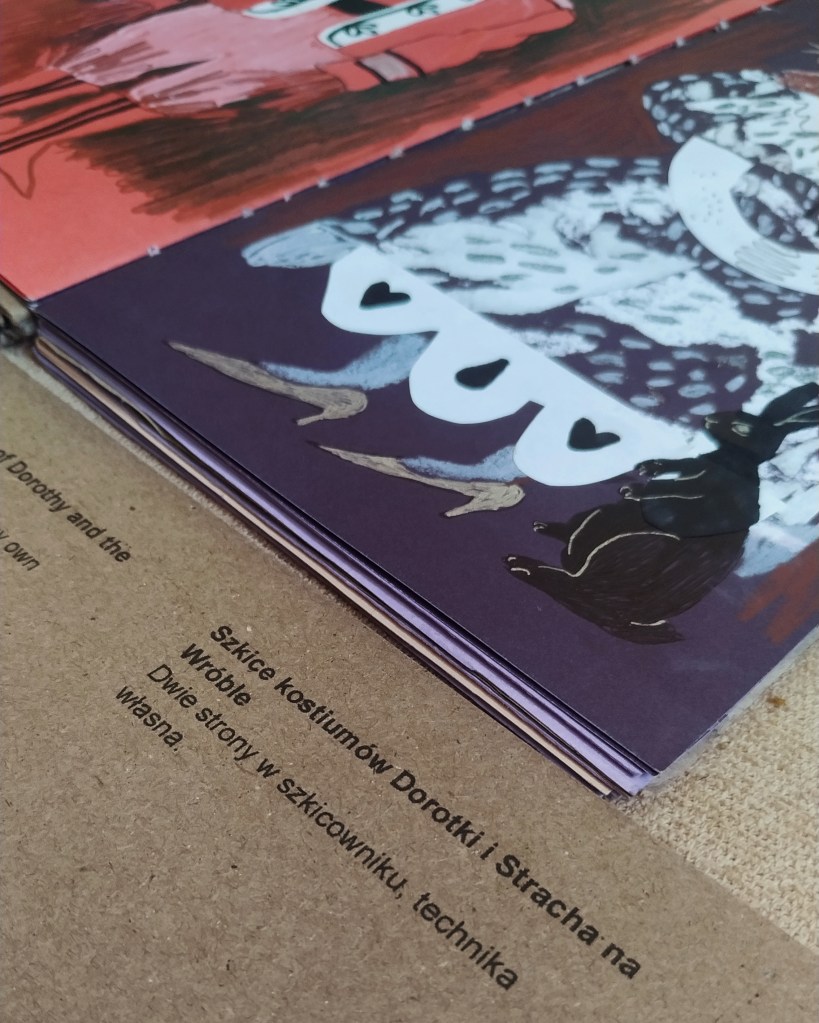
Costume sketches of Dorothy and the Scarecrow
Two pages in a sketchbook, my own technique.
Szkice kostiumów Dorotki i Stracha na Wróble
Dwie strony w szkicowniku, technika własna.
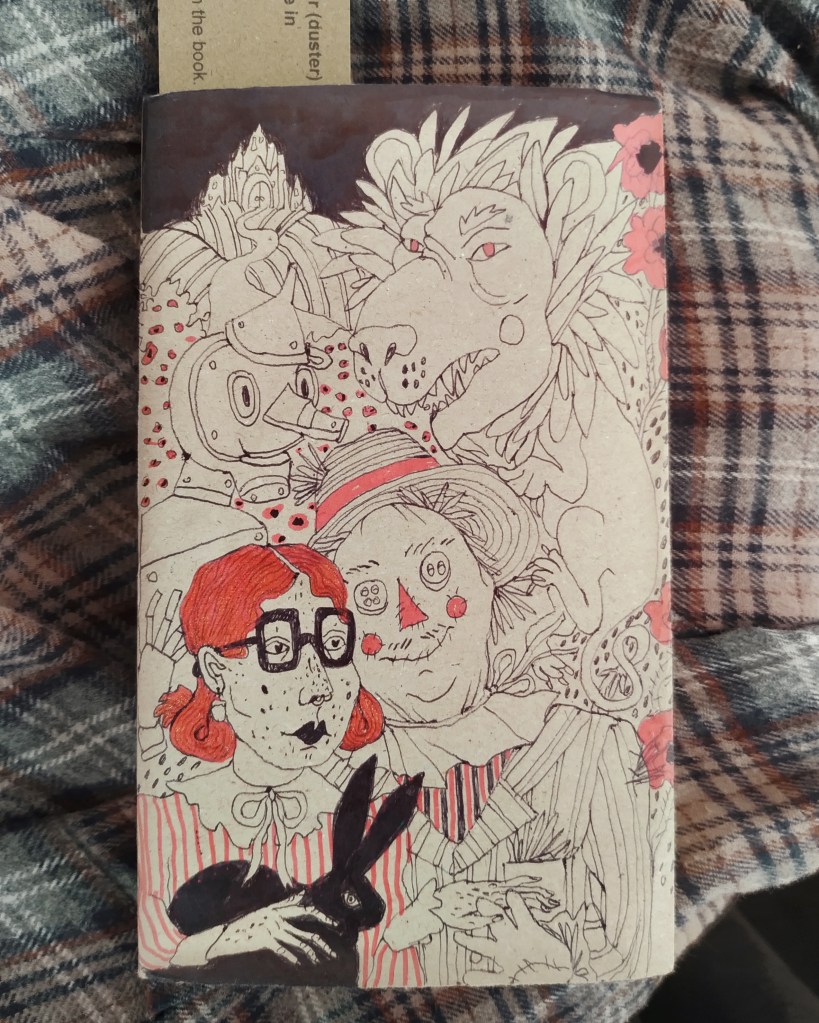
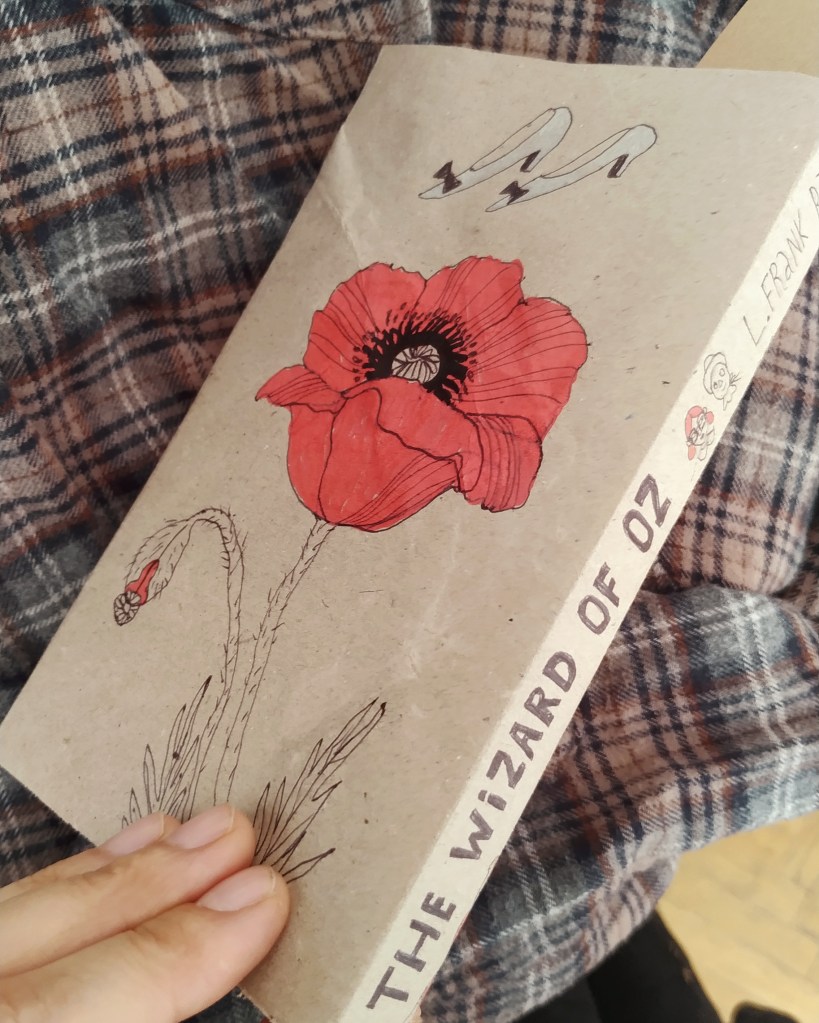
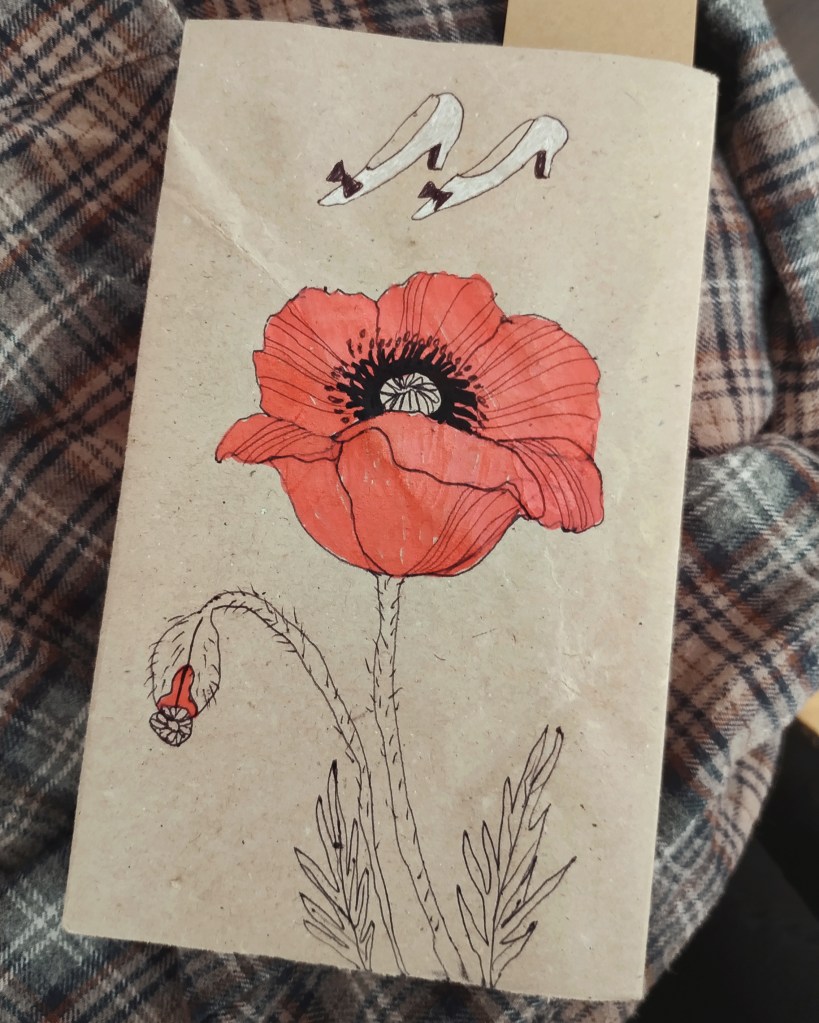
The Wizard of Oz, book cover (duster) + the book itself as an exercise in marginalia
Recycled paper, pens.
Czarnoksiężnik z Krainy Oz, okładka książki (obwoluta) + sama książka jako ćwiczenie z marginaliów
Papier z recyklingu, długopisy.
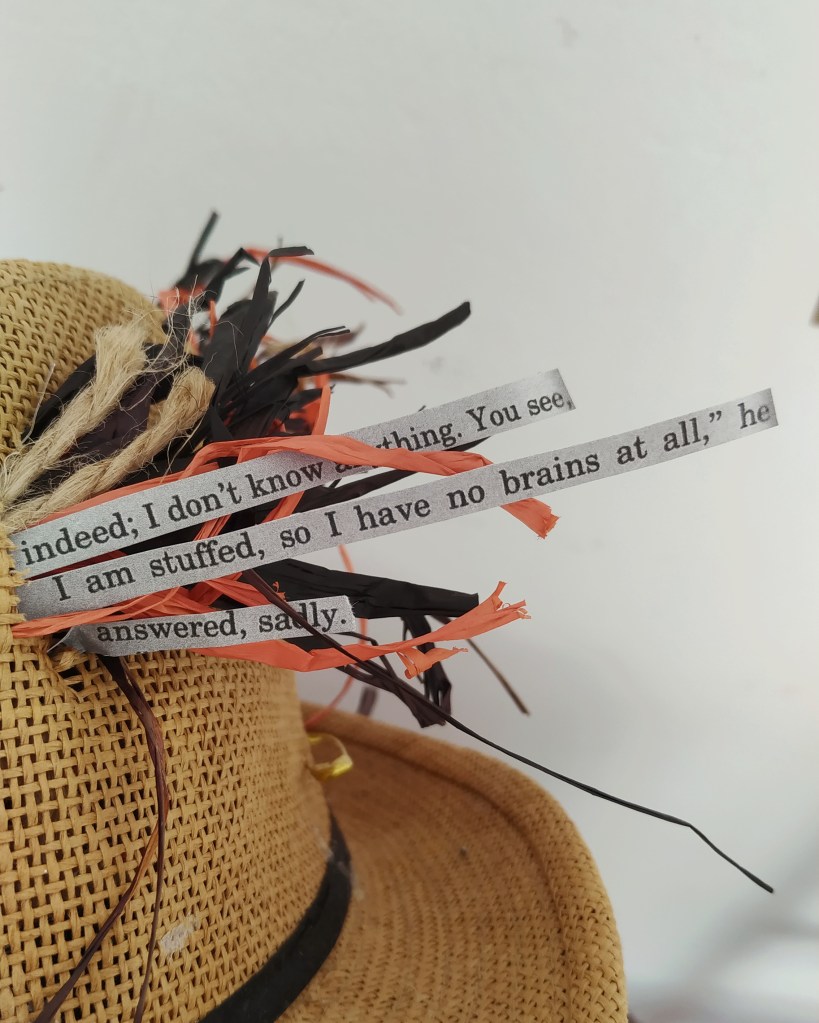
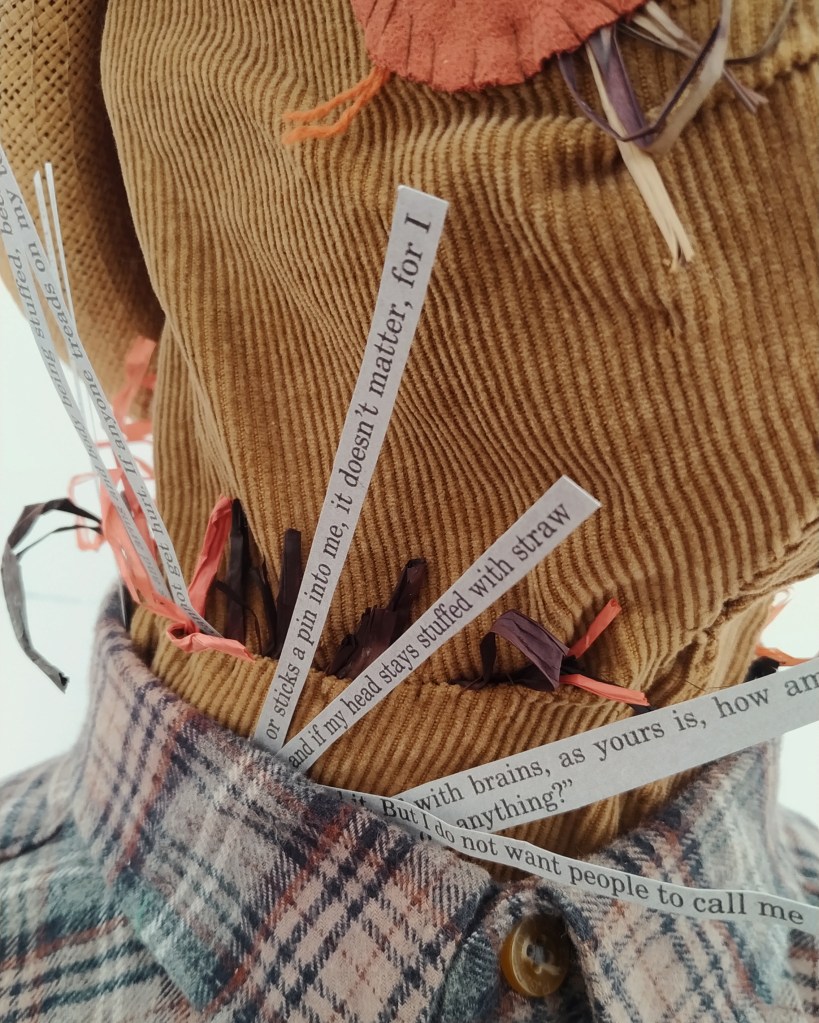
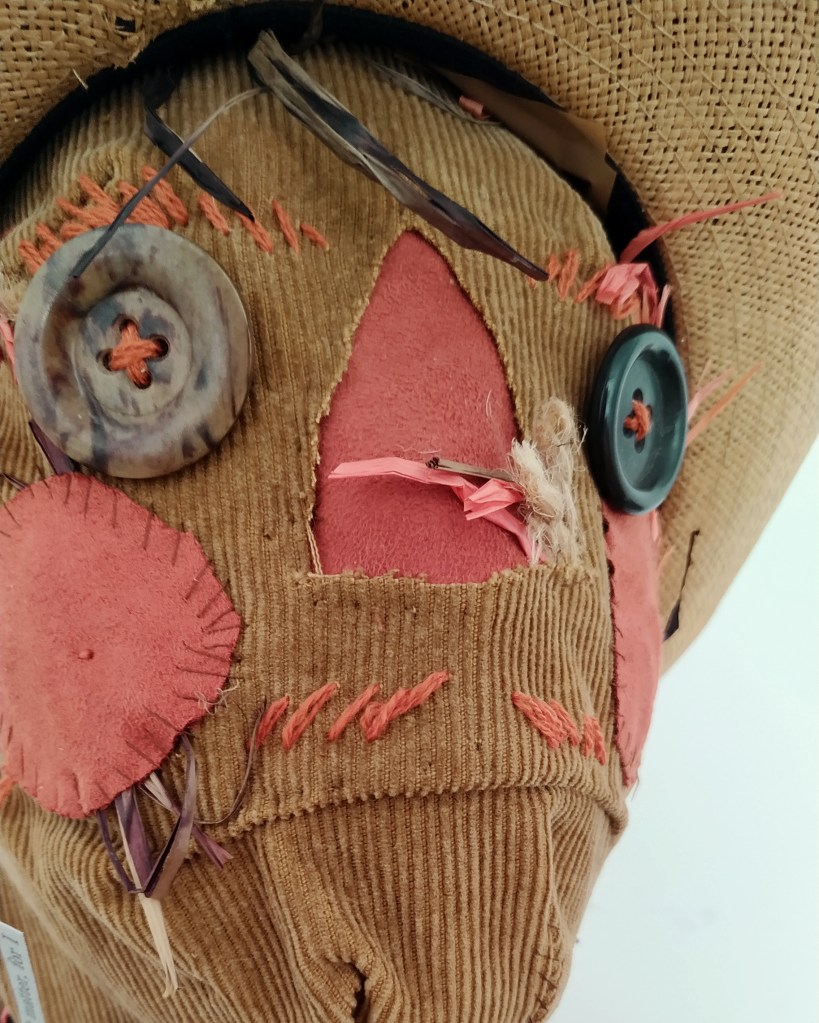
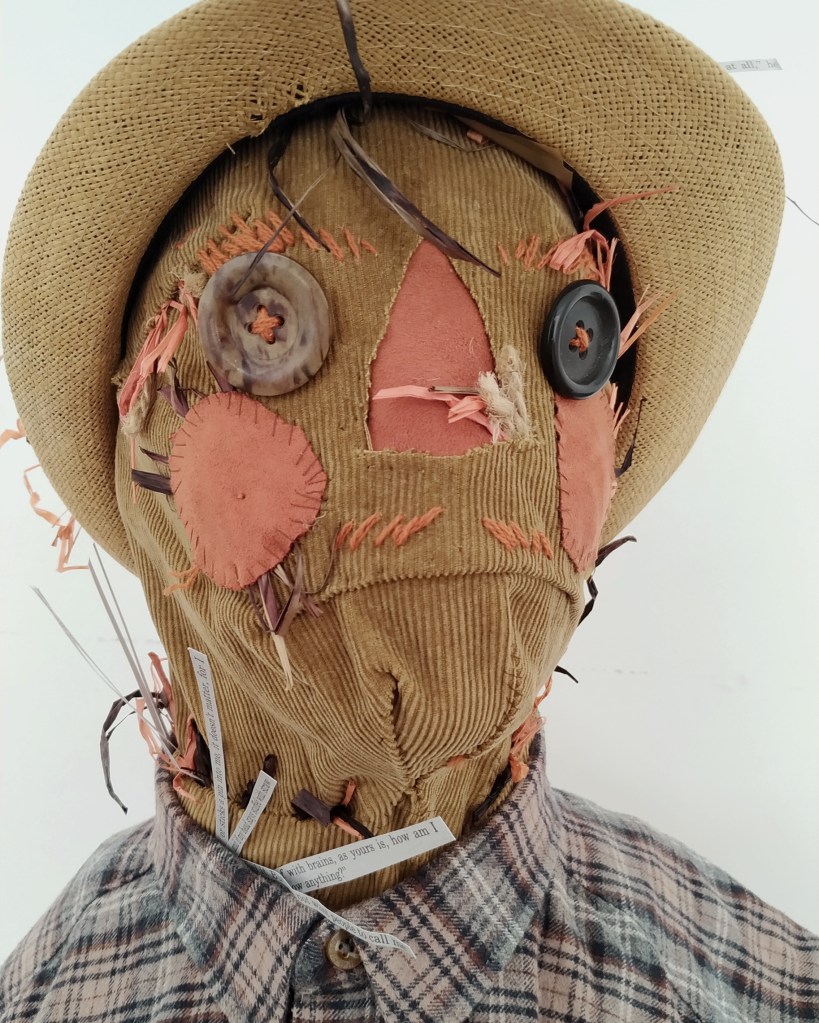
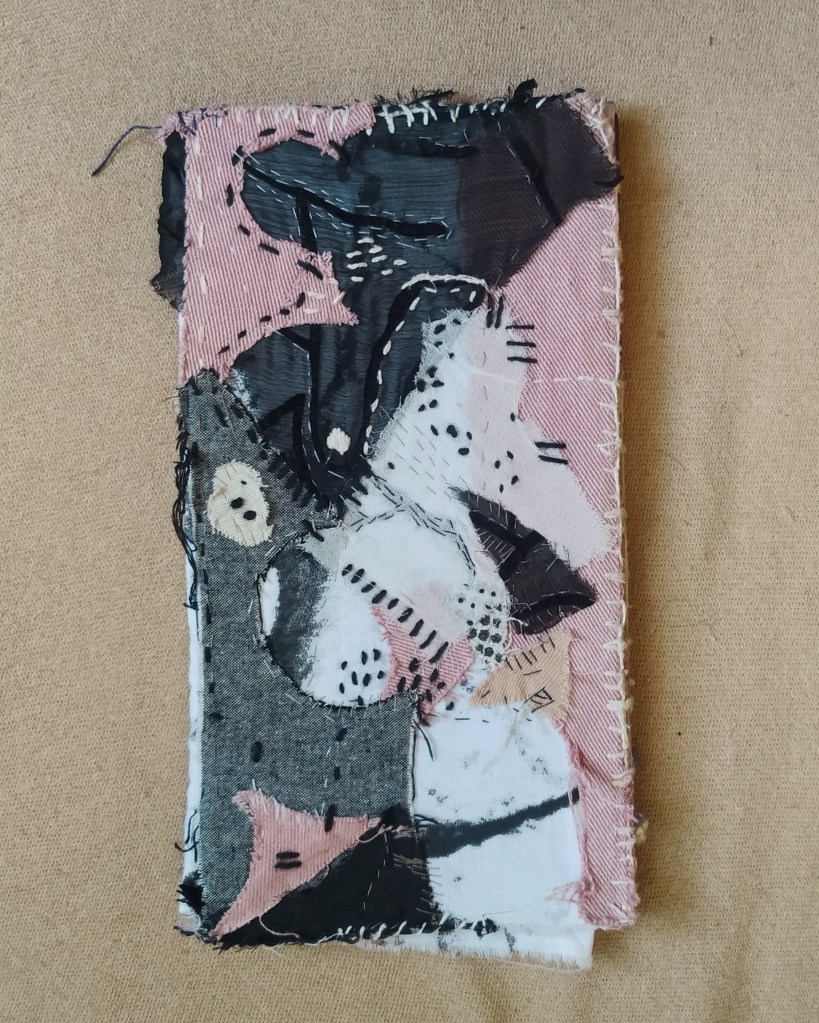
Soft sculpture “Portrait of the Scarecrow”
Textile waste, paper.
This is an experiment in three-dimensional illustration, and possibly comics, since it also incorporates text.
Rzeźba miękka „Portret Stracha na Wróble”
Odpady tekstylne, papier.
Jest to eksperyment z ilustracją trójwymiarową, a być może również z komiksem, ponieważ praca zawiera także tekst.
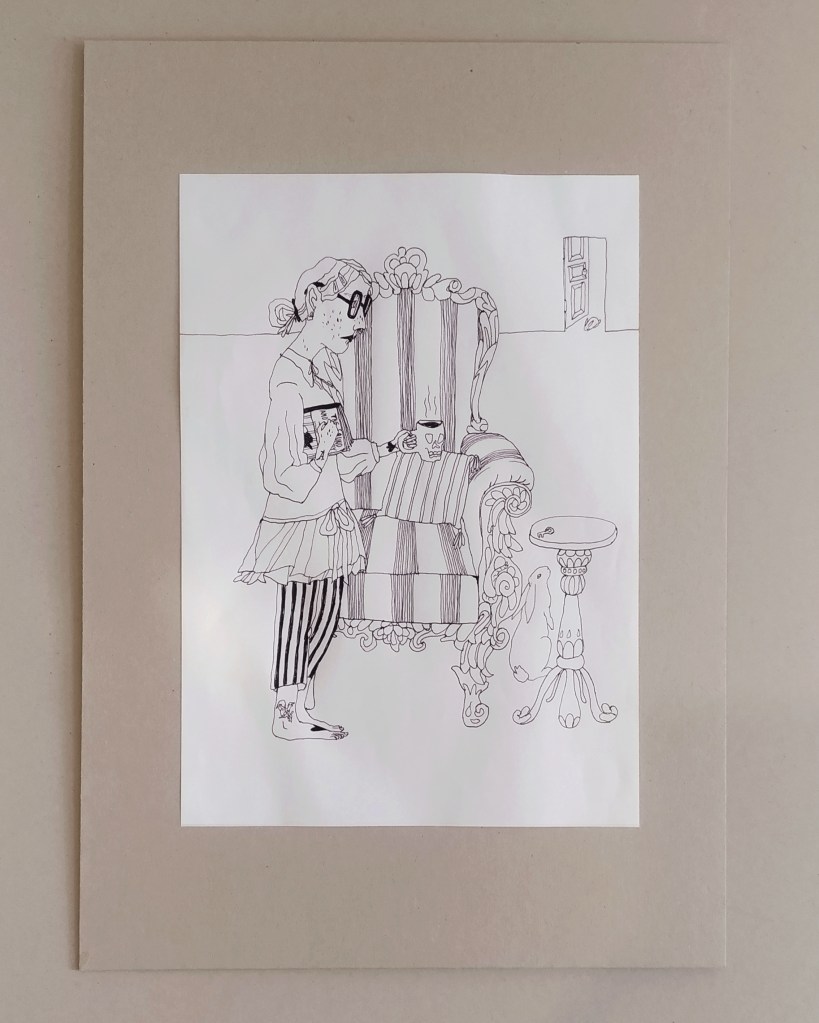
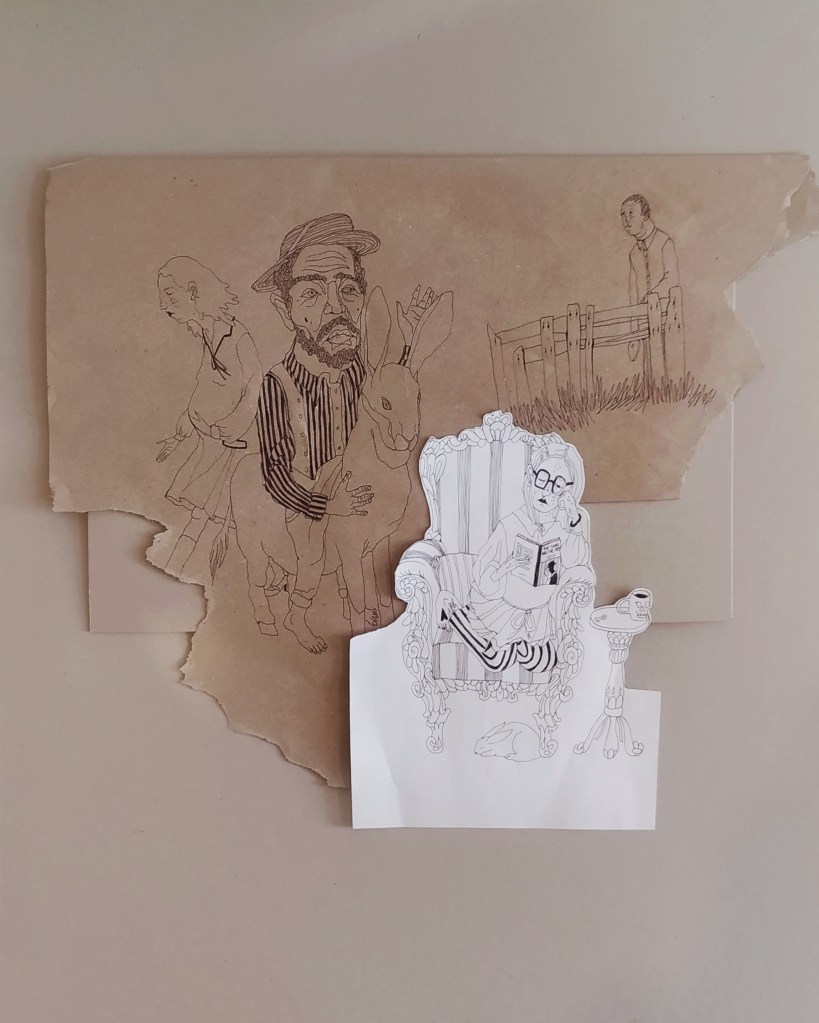
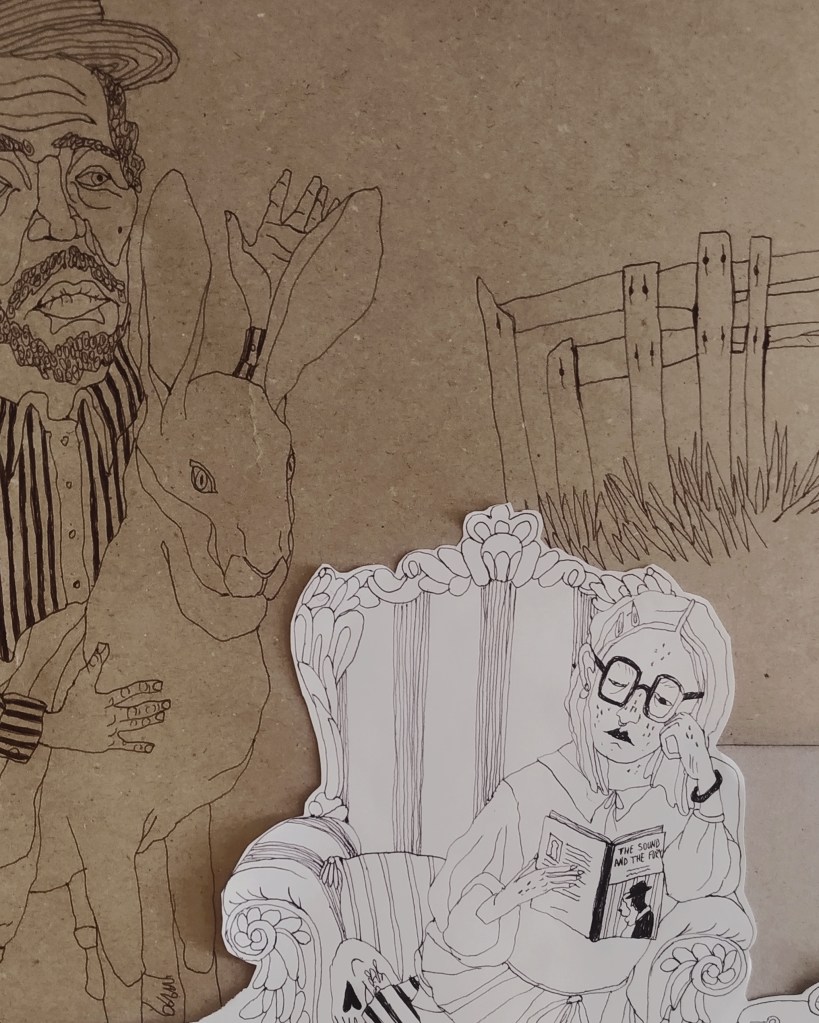
Reading “The Sound and the Fury”
Diptych, A3 and A3+
The room disappears, the world expands.
Czytając „Wściekłość i wrzask”
Dyptyk, A3 i A3+
Pokój znika, świat się rozszerza.
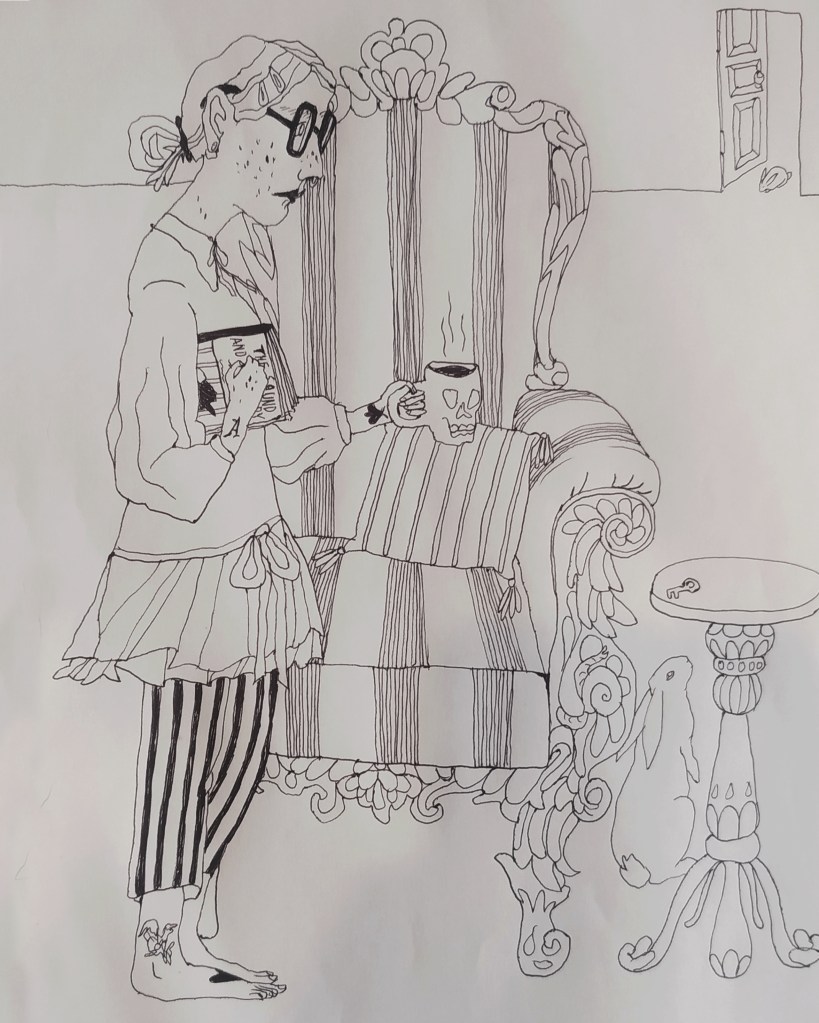
Rysunek – autoportret podczas czytania w domu
50 × 70 cm
Drawing – self-portrait reading in my apartment
50 × 70 cm
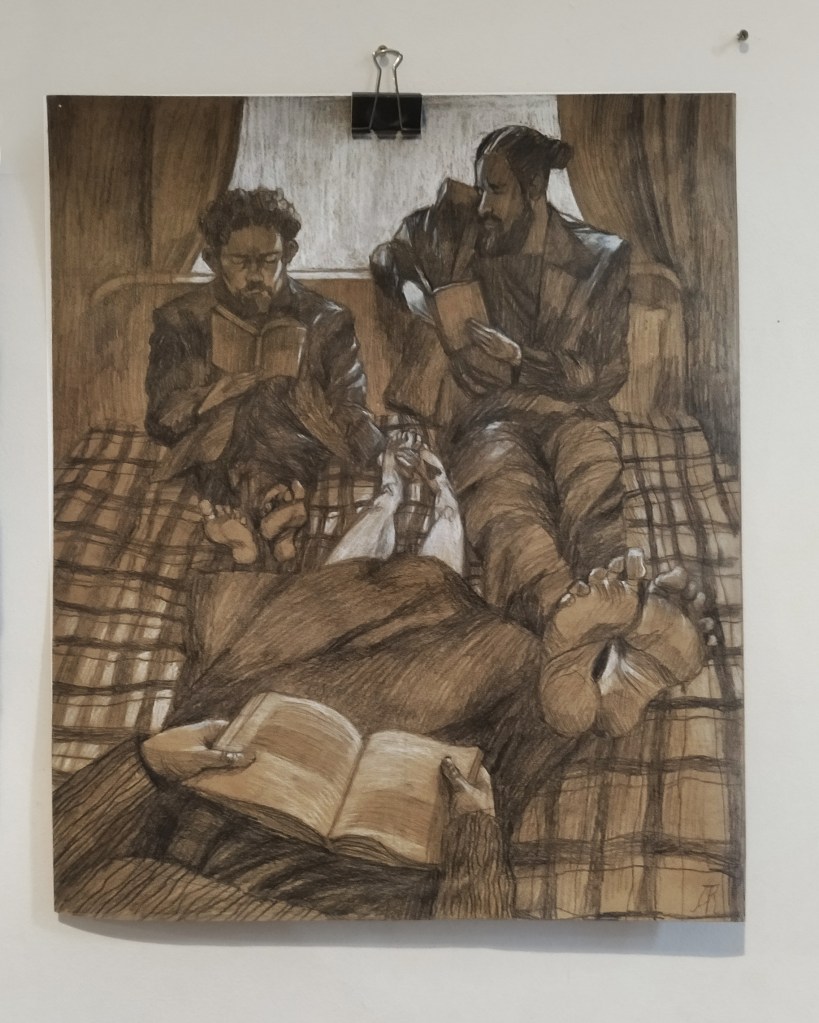
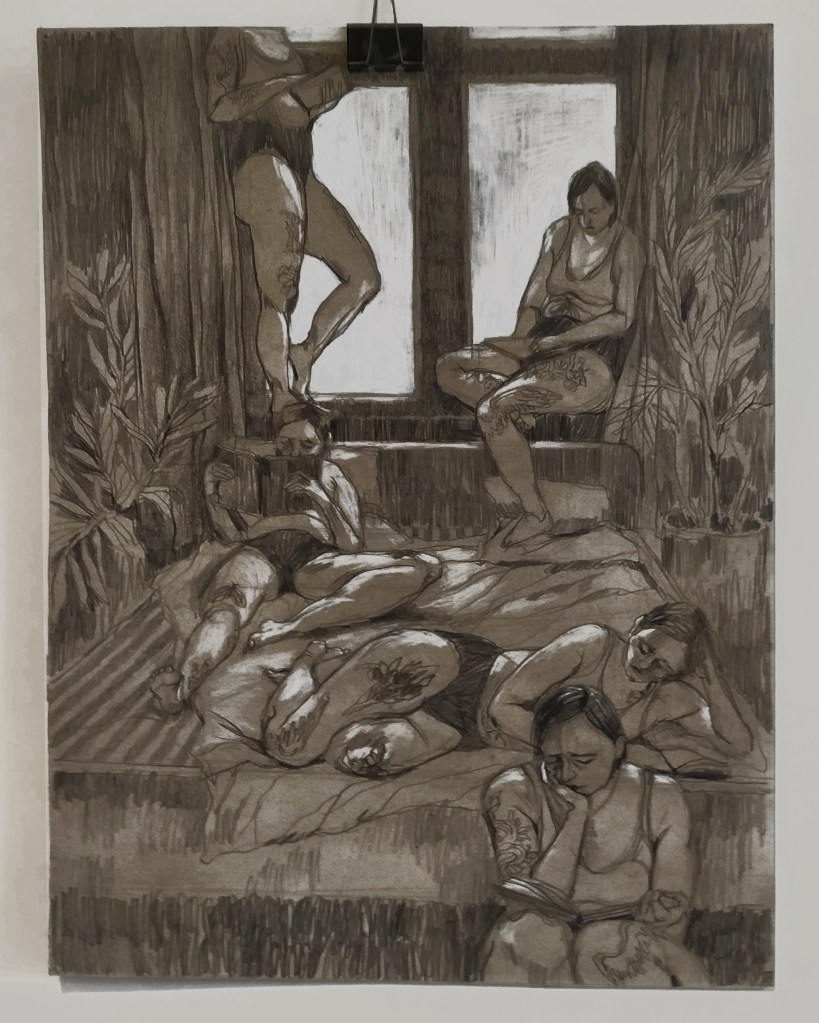
Drawing – Reading Together
40 × 50 cm
Rysunek – Czytając razem
40 × 50 cm
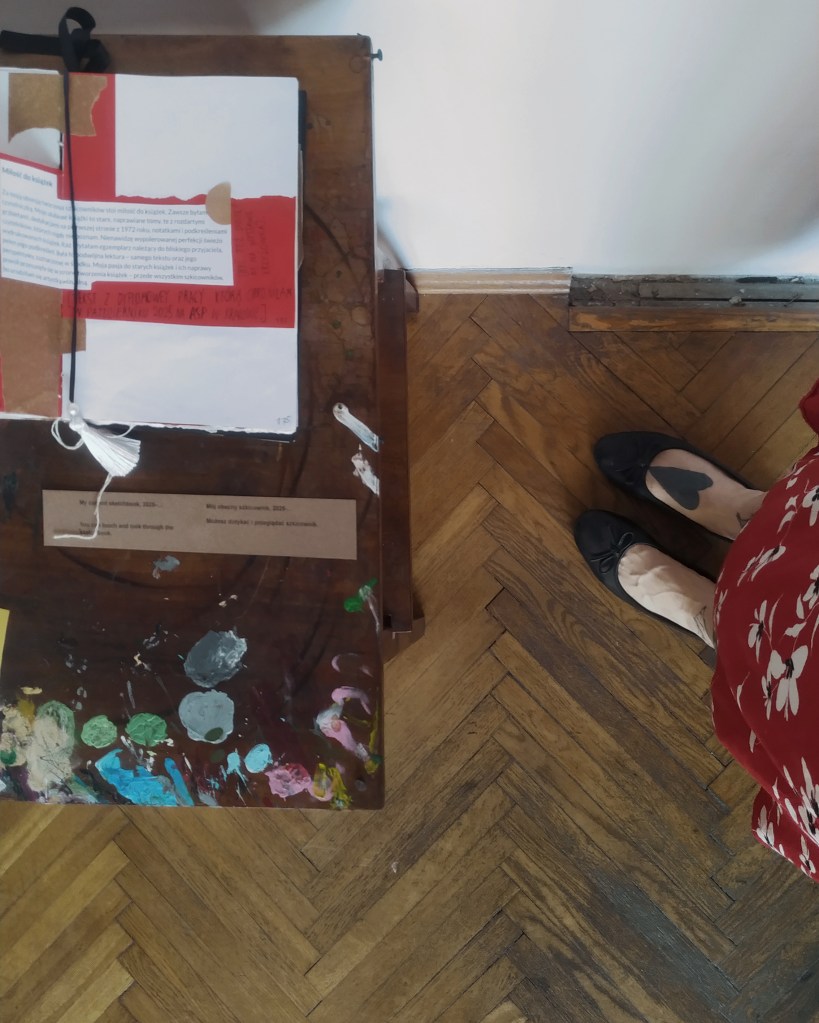
My current sketchbook, 2025–…
Mój obecny szkicownik, 2025-…
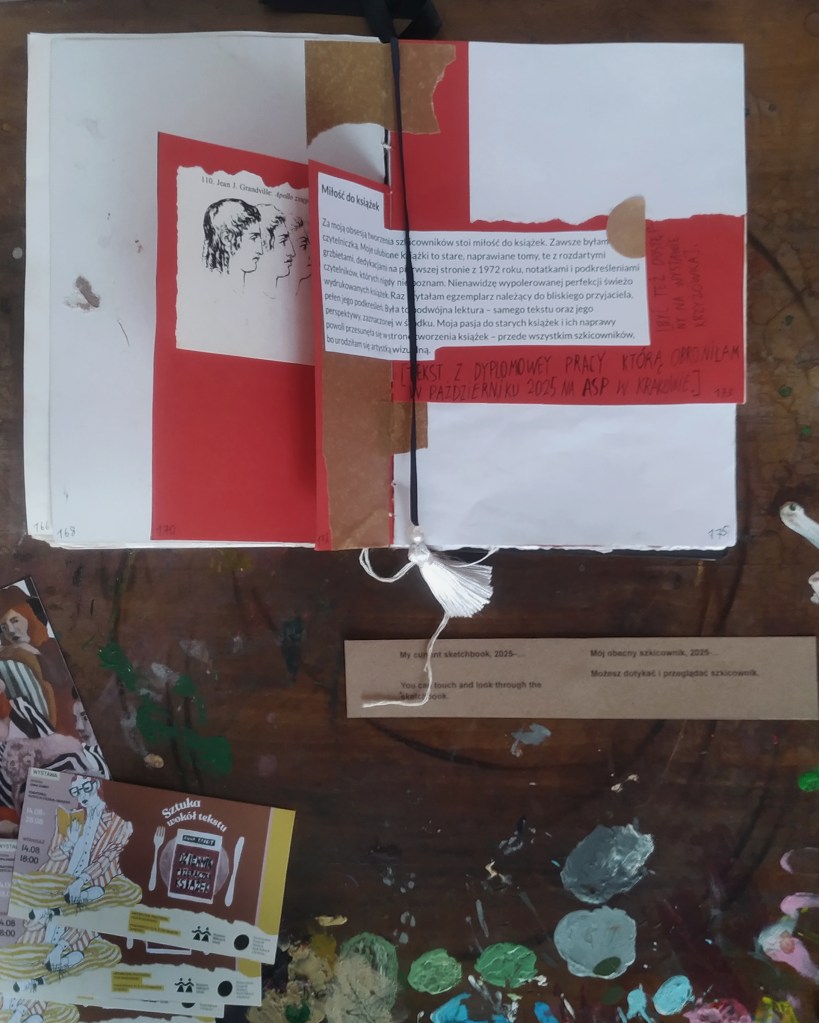
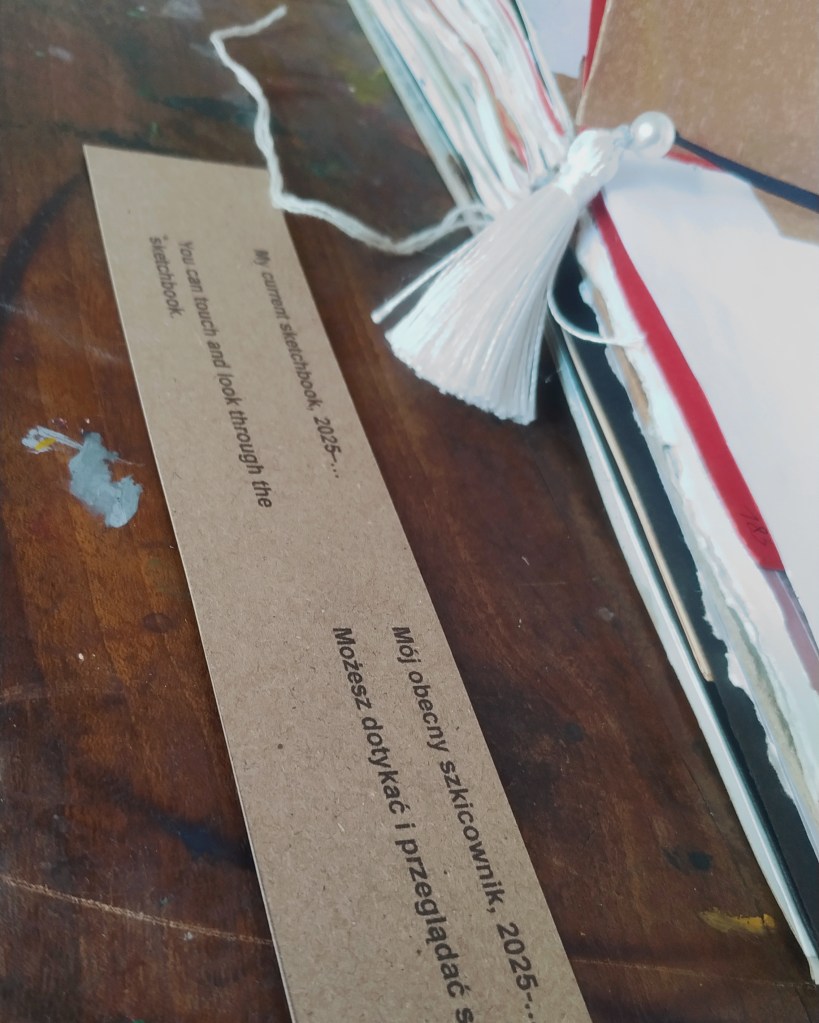
The is no video of this sketchbook yet because it’s not finished, but I think it will be very soon.
This sketchbook, more then any other I have ever made, is more of a scrap book. There are a lot of drawings and illustrations but also a lot of quotes and flayers from the exhibits I visited, tickets (train and to events), pages from magazines…
it is also thicker then most of my art books so far.
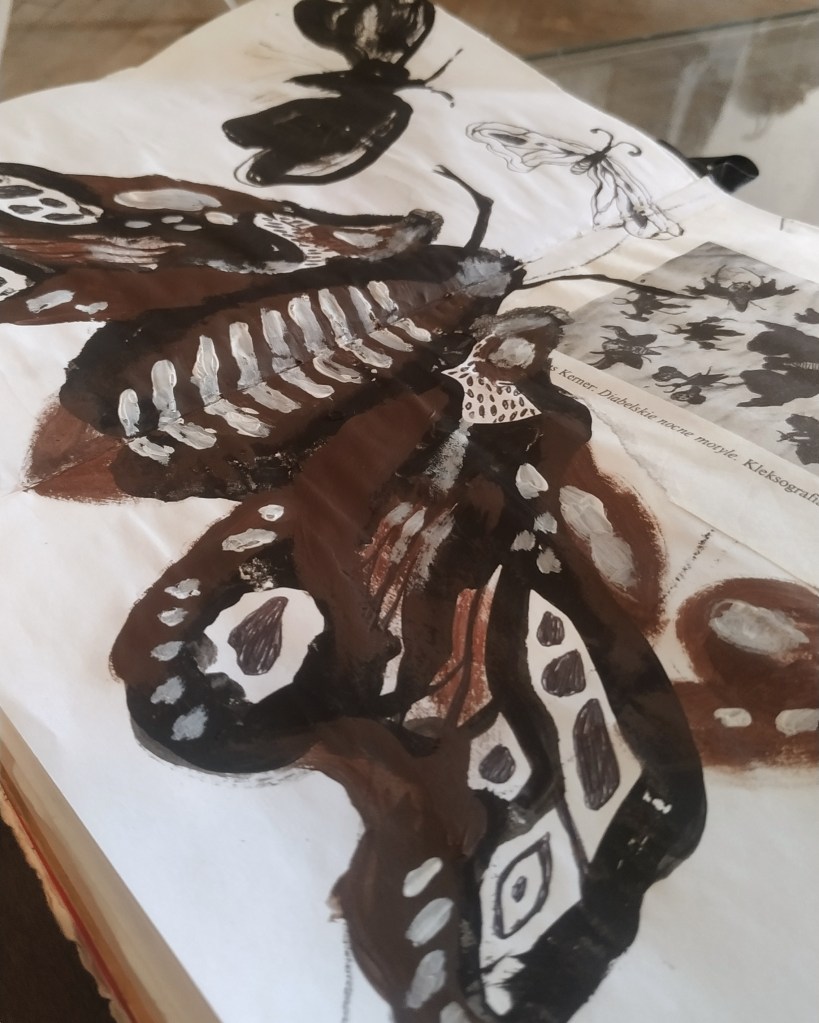
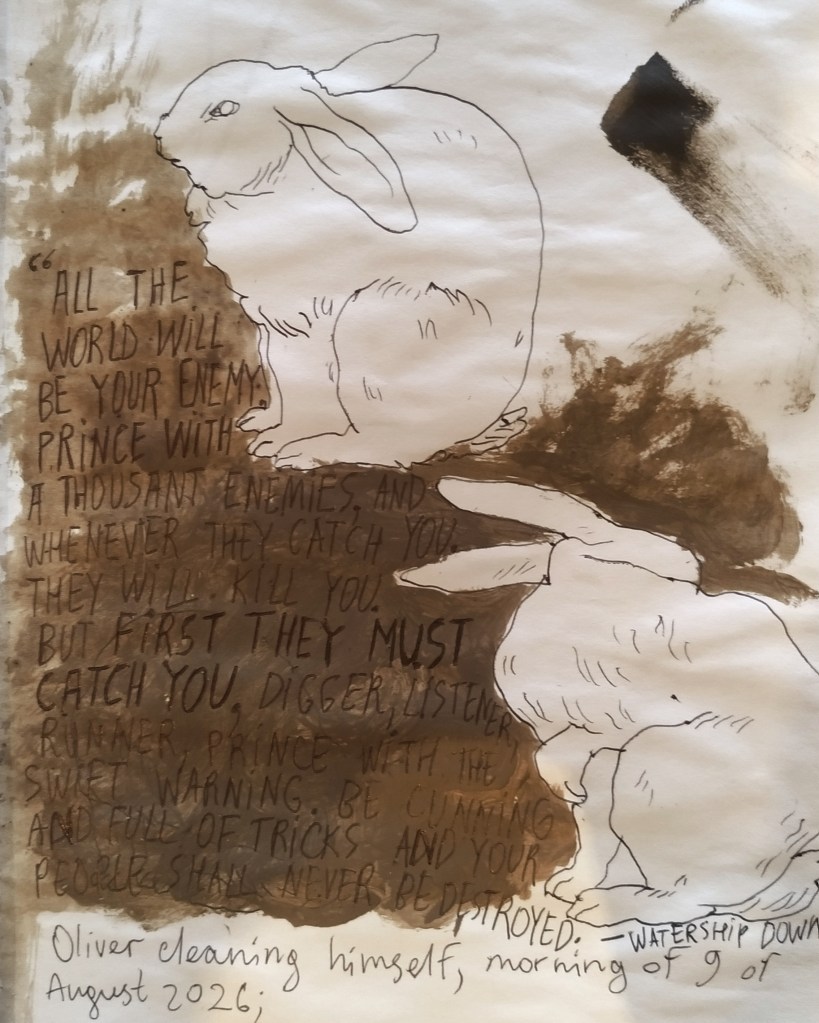
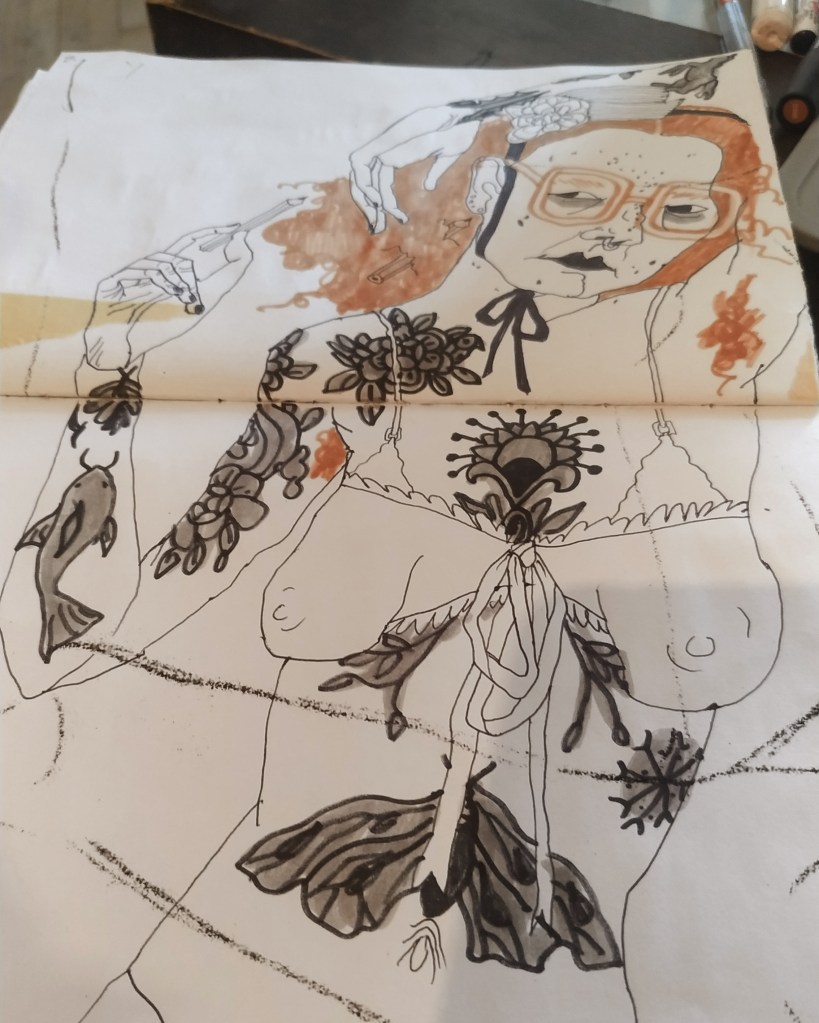
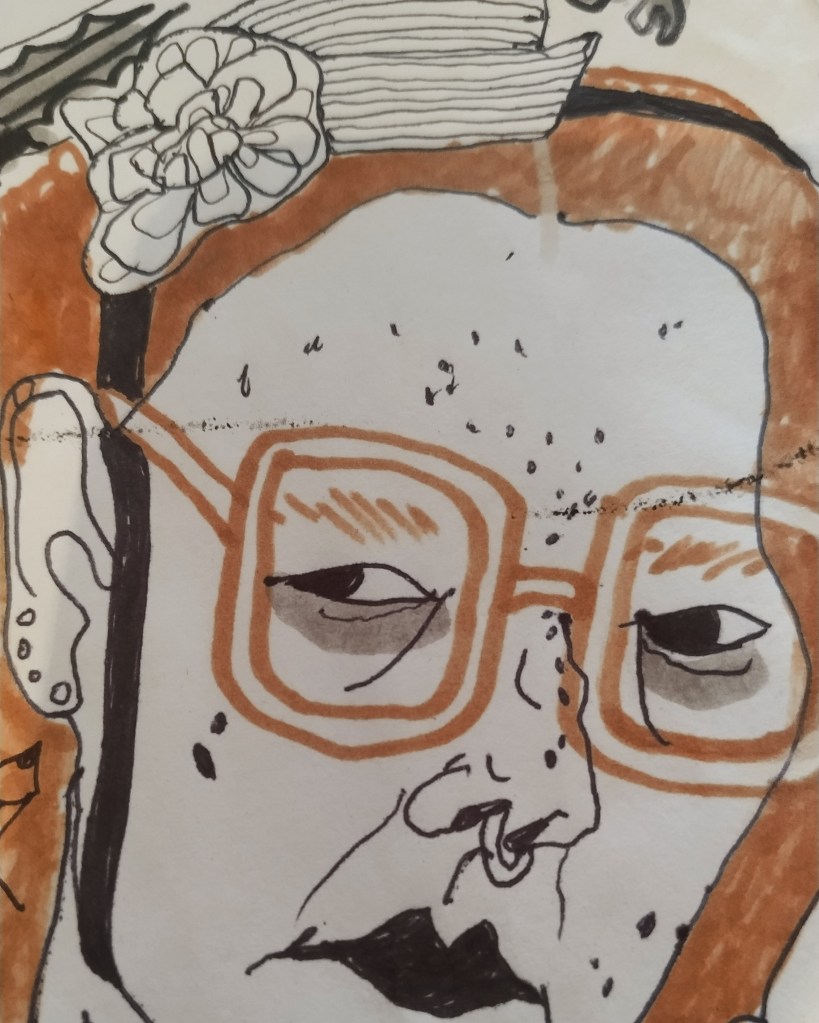
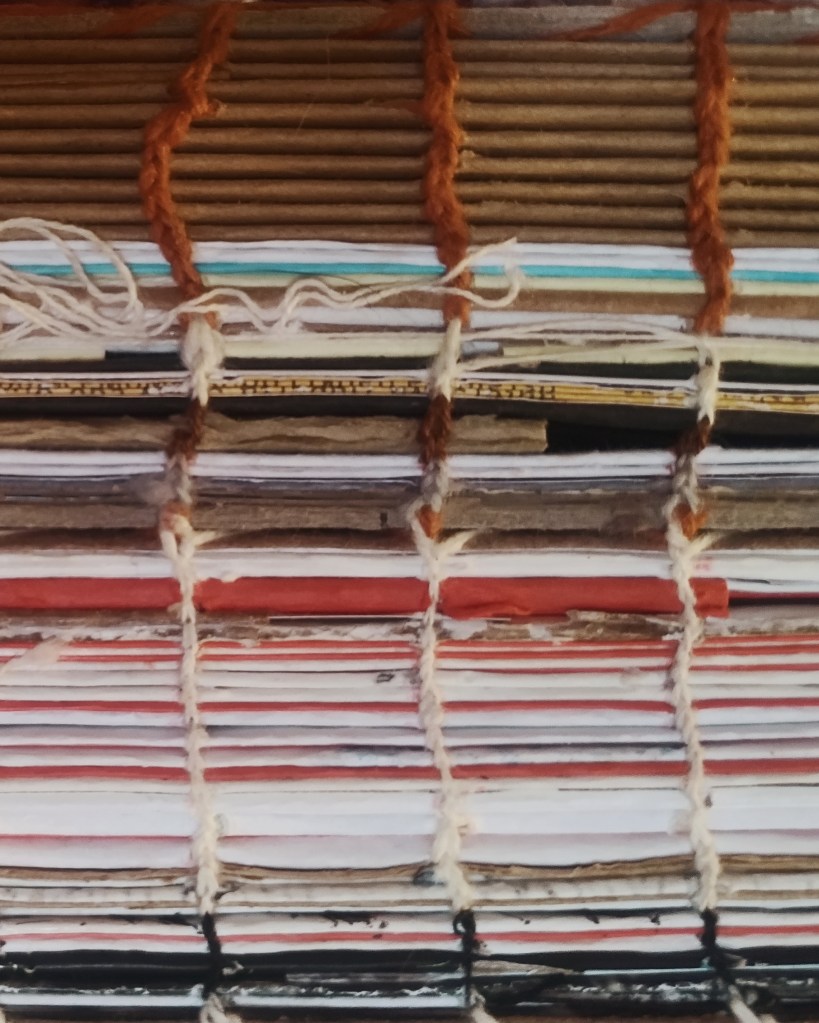
P.S. If you want to look through this (and many others) artbooks of mine, you will have an opportunity very soon (11th of October) at the event at Bunkier Sztuki Art Gallery.
Everyone is welcomed! Sign up here.
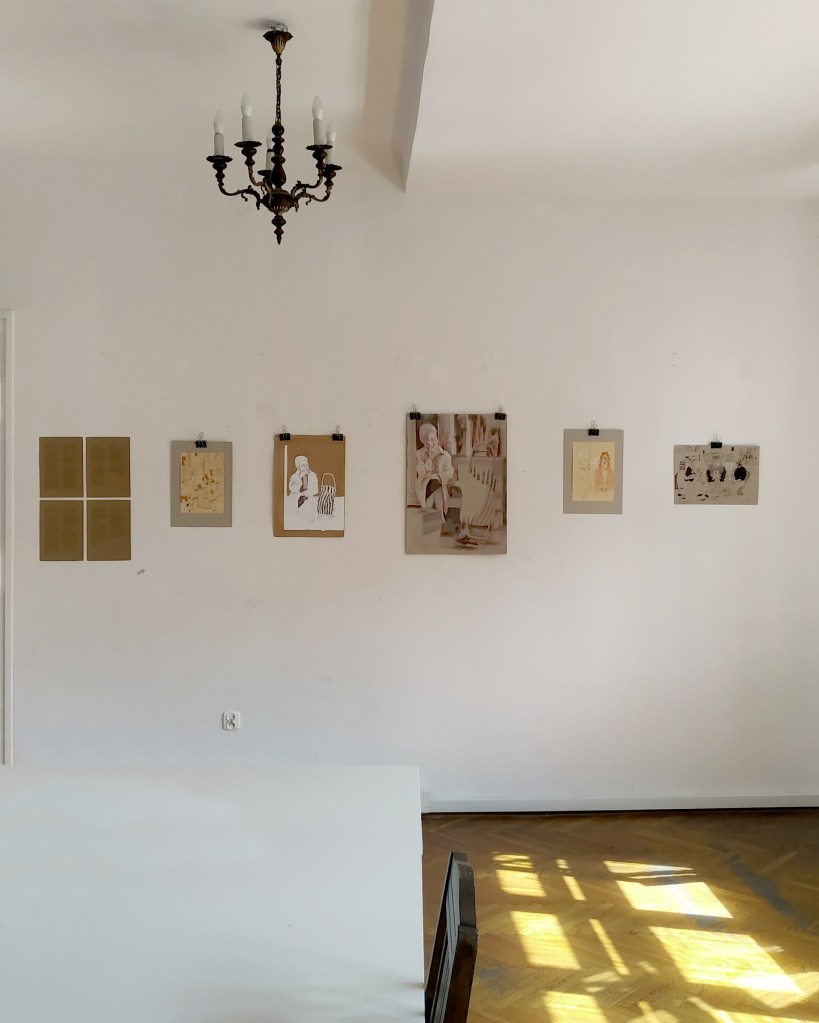
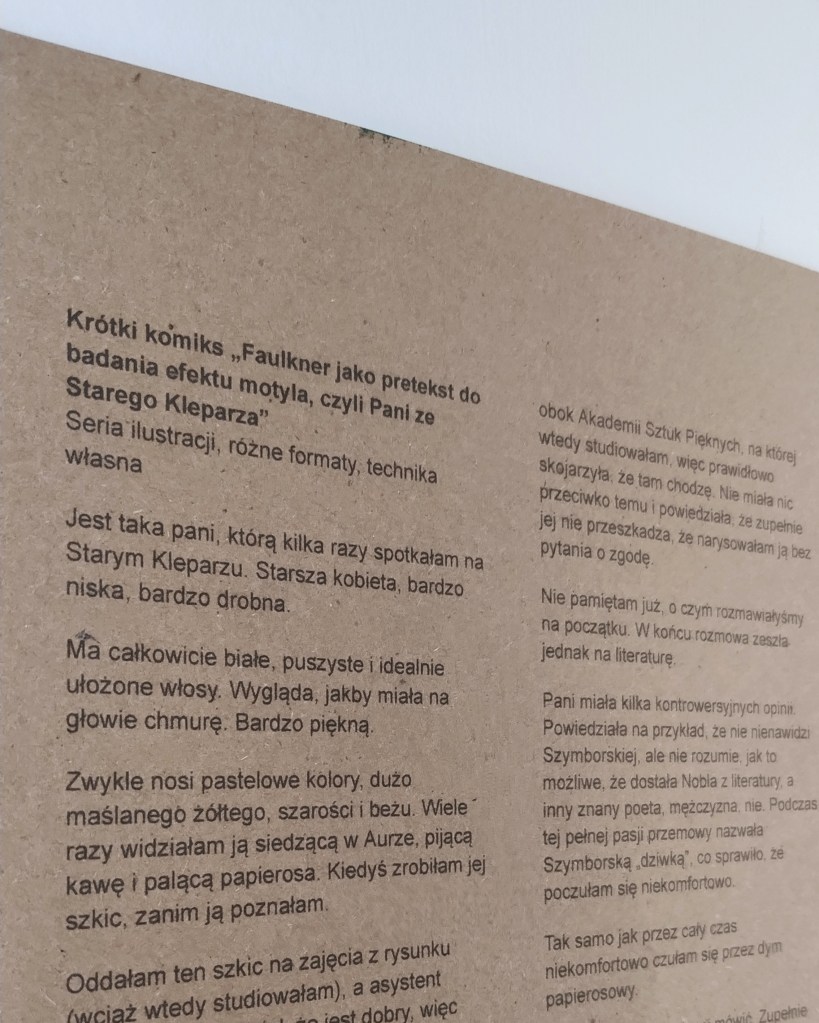
Short comic: “Faulkner as an Excuse to Study the Butterfly Effect, aka The Lady from the Start of Kleparz”
Krótki komiks „Faulkner jako pretekst do badania efektu motyla, czyli Pani ze Starego Kleparza”
Series of illustrations, various formats, own technique
Seria ilustracji, różne formaty, technika własna
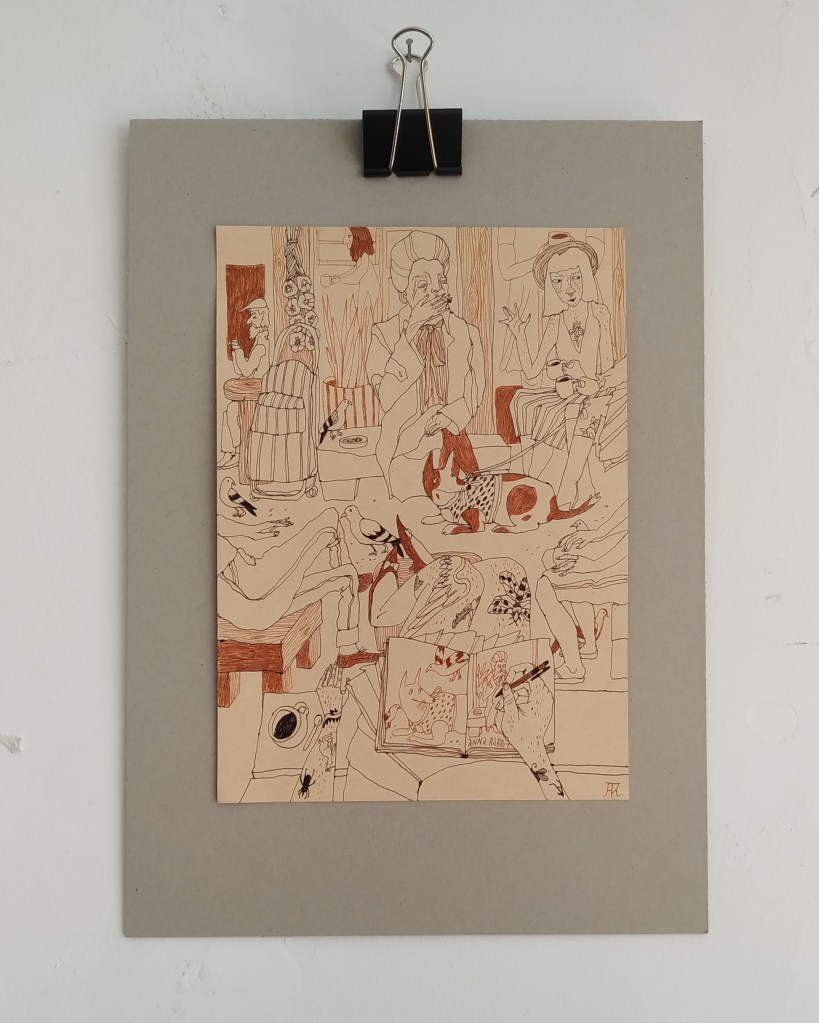
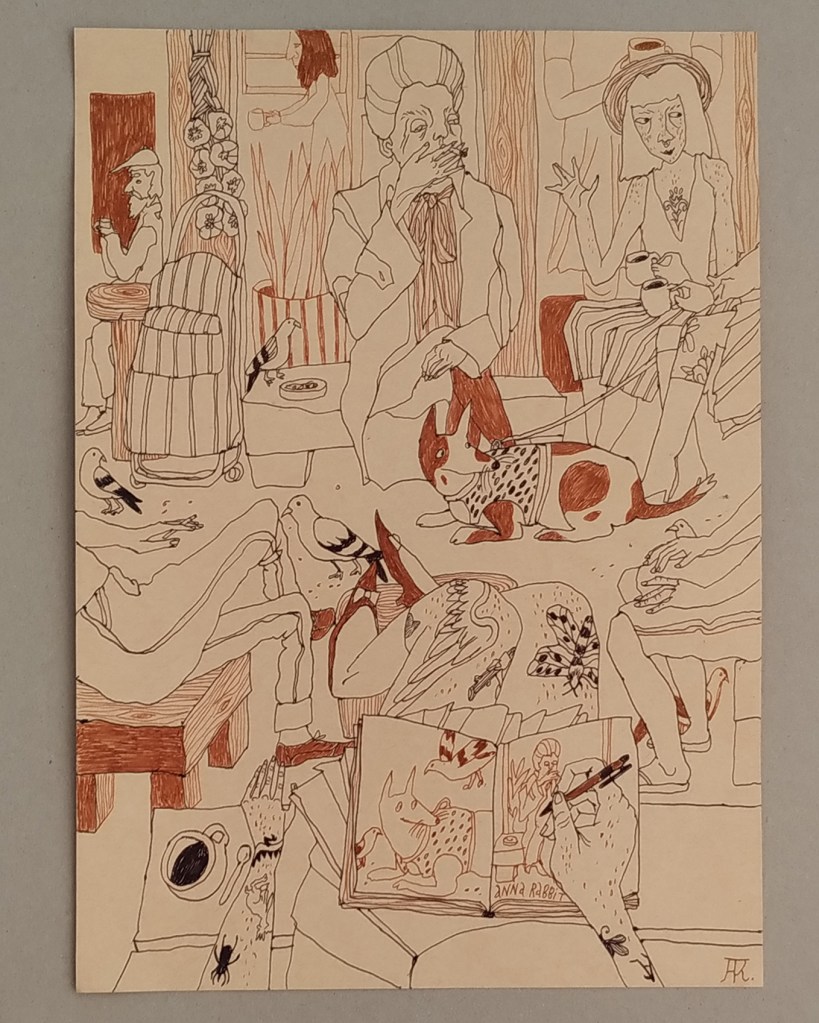
There is this lady I met at the start of Kleparz a couple of times, an older woman, very short and very petite.
Her hair is completely white, puffy, and perfectly put together. She looks as if she has a cloud on her head. Very beautiful.
She usually wears pastel colours, a lot of butter yellow, grey and beige. I saw her many times sitting at Aura Café, drinking coffee and smoking. Once I made a sketch of her before I met her.
Jest taka pani, którą kilka razy spotkałam na Starym Kleparzu. Starsza kobieta, bardzo niska, bardzo drobna.
Ma całkowicie białe, puszyste i idealnie ułożone włosy. Wygląda, jakby miała na głowie chmurę. Bardzo piękną.
Zwykle nosi pastelowe kolory, dużo maślanego żółtego, szarości i beżu. Wiele razy widziałam ją siedzącą w Aurze, pijącą kawę i palącą papierosa. Kiedyś zrobiłam jej szkic, zanim ją poznałam.
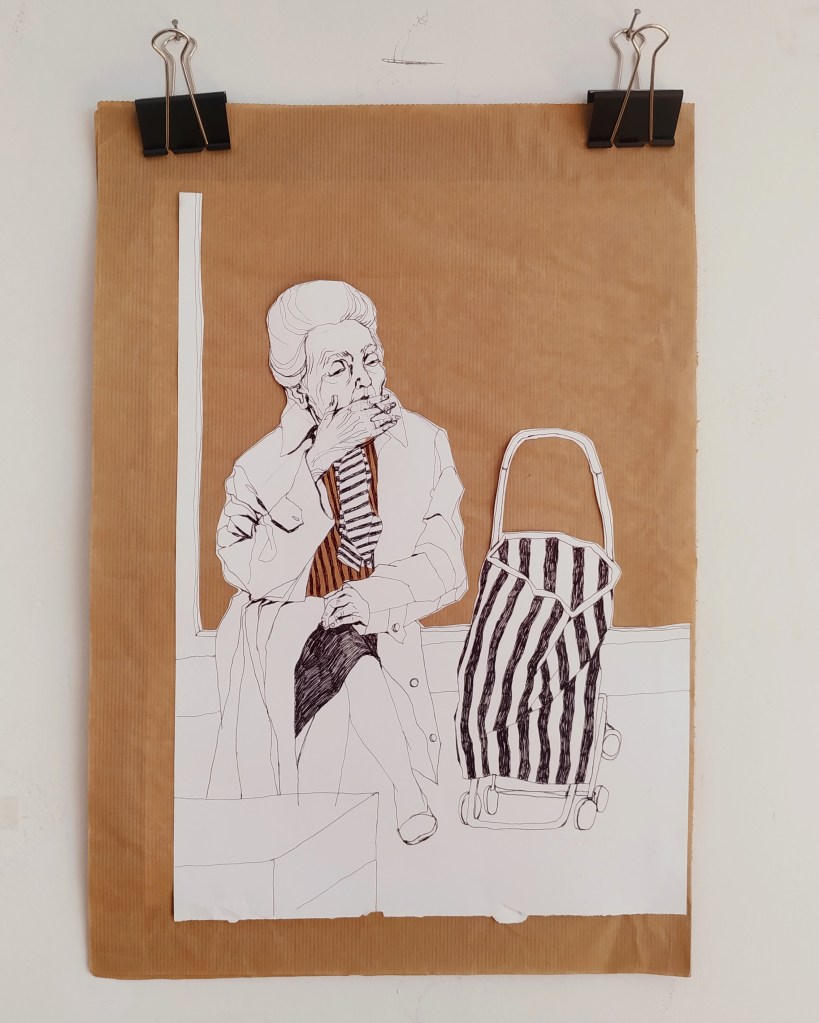
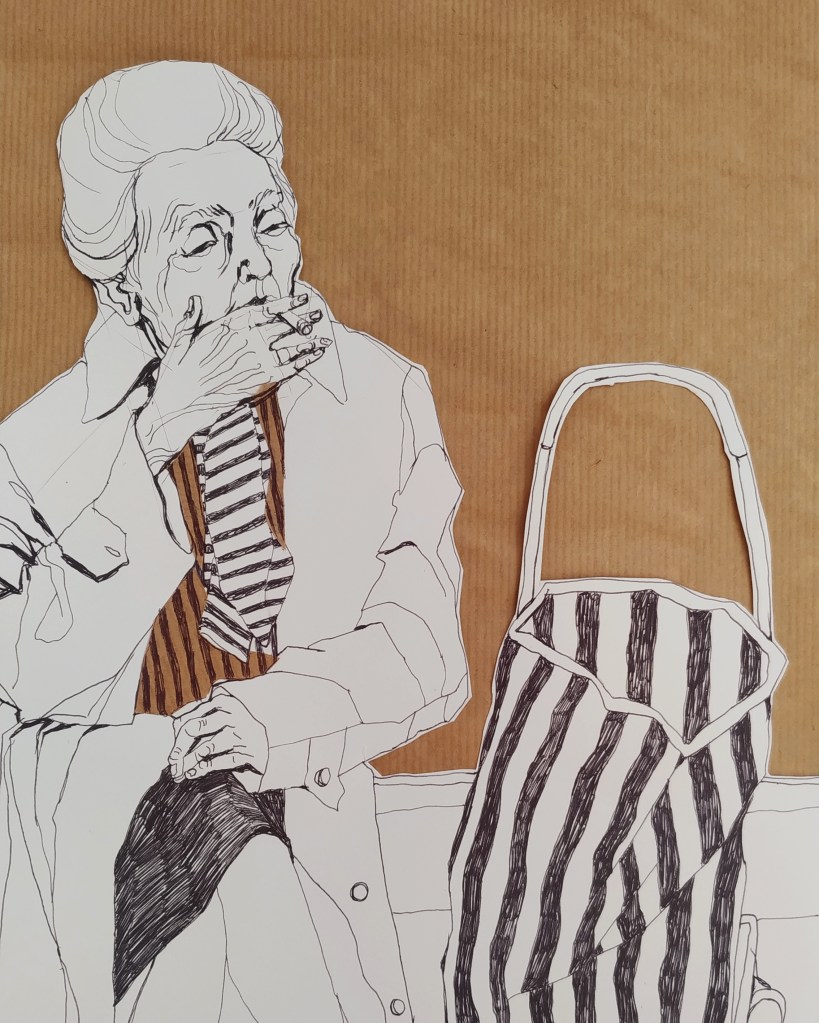
I turned the sketch in for a drawing class (I was still going to university at the time), and the professor’s assistant said it was good, so I made a bigger drawing of it and then also painted just her face, with her delicate, bird-like hand holding a cigarette.
After that, I felt strange not knowing her. I felt a little bit like a pervert — drawing and painting a person whom I had never met and whose permission I had never asked for. As if I were watching her with some malicious intent.
Oddałam ten szkic na zajęcia z rysunku (wciąż wtedy studiowałam), a asystent profesora powiedział, że jest dobry, więc zrobiłam na jego podstawie większy rysunek, a potem namalowałam też tylko jej twarz, z jej delikatną, ptasią dłonią trzymającą papierosa.
Potem dziwnie się czułam, nie znając jej. Czułam się trochę jak perwers — rysowałam i malowałam osobę, której nigdy nie poznałam i nie zapytałam o zgodę. Jakbym obserwowała ją z jakimś złym zamiarem.
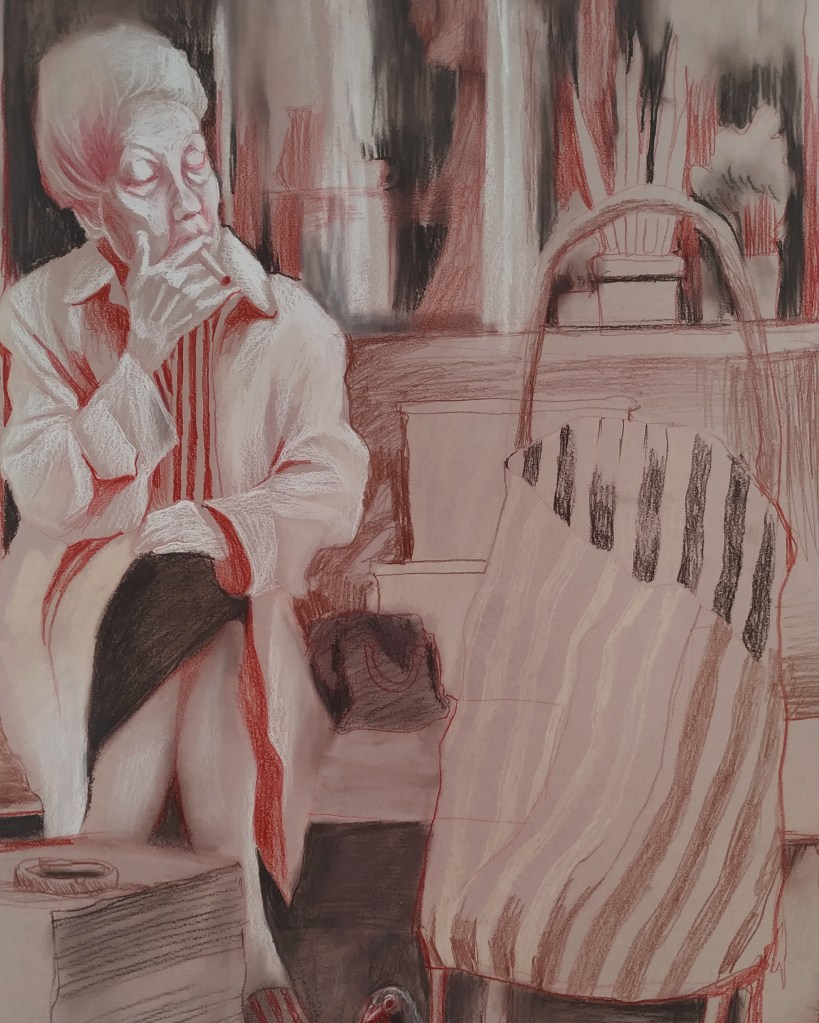
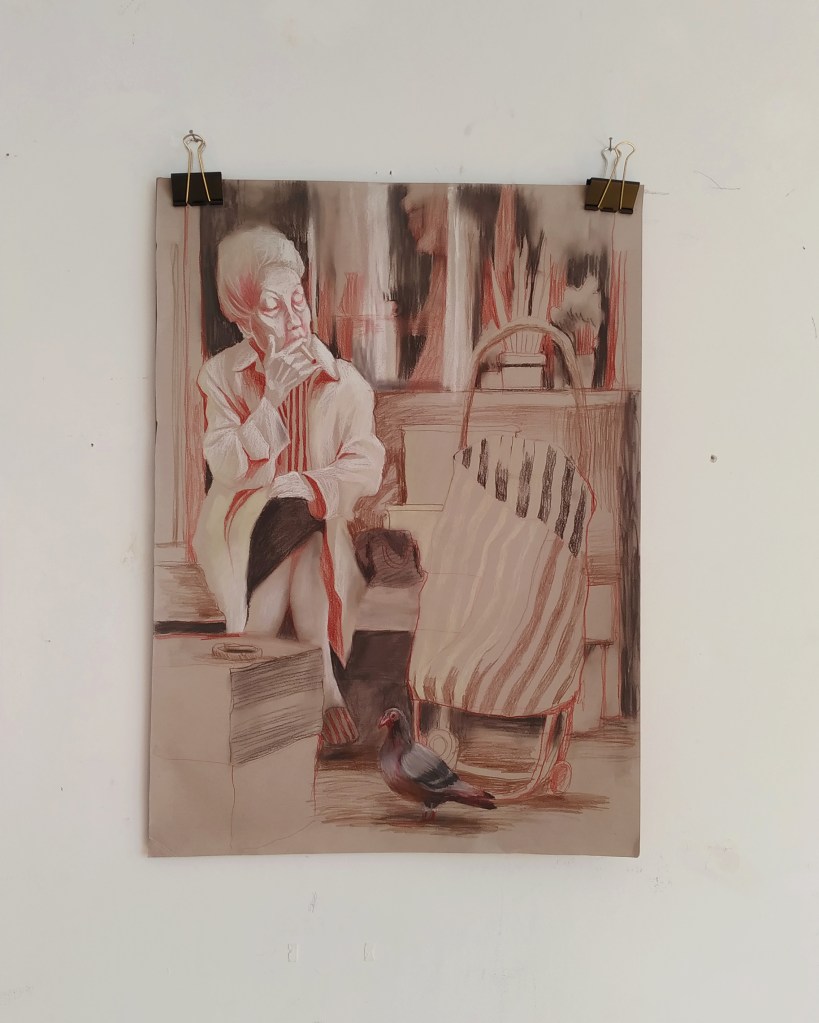
The next time I saw her smoking and having her coffee at Aura, I asked her if I could sit next to her, even though I hate sitting next to someone who smokes. I asked her if I could sit next to her even though there were many other places available.
I told her that I saw her here sometimes and at the start of Kleparz in general, and that I had made a sketch of her once. The place is just by the Academy of Fine Arts that I was attending at the time, so she correctly assumed that I was studying there. She didn’t mind any of that and said it was totally fine that I had drawn her without permission.
I don’t remember now what we talked about at first. However, the conversation eventually shifted to literature.
The lady had some controversial opinions. She said, for example, that she didn’t hate Szymborska, but she didn’t understand how come she got a Nobel Prize in Literature while another famous male poet didn’t. She called Szymborska dziwka during this passionate speech, which made me uncomfortable.
The same way her cigarette smoke made me uncomfortable the whole time.
She didn’t really let me talk. She had zero interest in hearing what I had to say. I mostly listened.
Następnym razem, kiedy zobaczyłam ją palącą papierosa i pijącą kawę w Aurze, zapytałam, czy mogę się do niej dosiąść, mimo że nie znoszę siedzieć obok osób palących. Zapytałam ją, mimo że było mnóstwo innych wolnych miejsc.
Powiedziałam jej, że widuję ją czasem tutaj i w ogóle na Starym Kleparzu, i że kiedyś zrobiłam jej szkic. Lokal znajduje się tuż obok Akademii Sztuk Pięknych, na której wtedy studiowałam, więc prawidłowo skojarzyła, że tam chodzę. Nie miała nic przeciwko temu i powiedziała, że zupełnie jej nie przeszkadza, że narysowałam ją bez pytania o zgodę.
Nie pamiętam już, o czym rozmawiałyśmy na początku. W końcu rozmowa zeszła jednak na literaturę.
Pani miała kilka kontrowersyjnych opinii. Powiedziała na przykład, że nie nienawidzi Szymborskiej, ale nie rozumie, jak to możliwe, że dostała Nobla z literatury, a inny znany poeta, mężczyzna, nie. Podczas tej pełnej pasji przemowy nazwała Szymborską „dziwką”, co sprawiło, że poczułam się niekomfortowo.
Tak samo jak przez cały czas niekomfortowo czułam się przez dym papierosowy.
Nie bardzo pozwalała mi mówić. Zupełnie nie interesowało jej, co ja mam do powiedzenia. Głównie słuchałam.
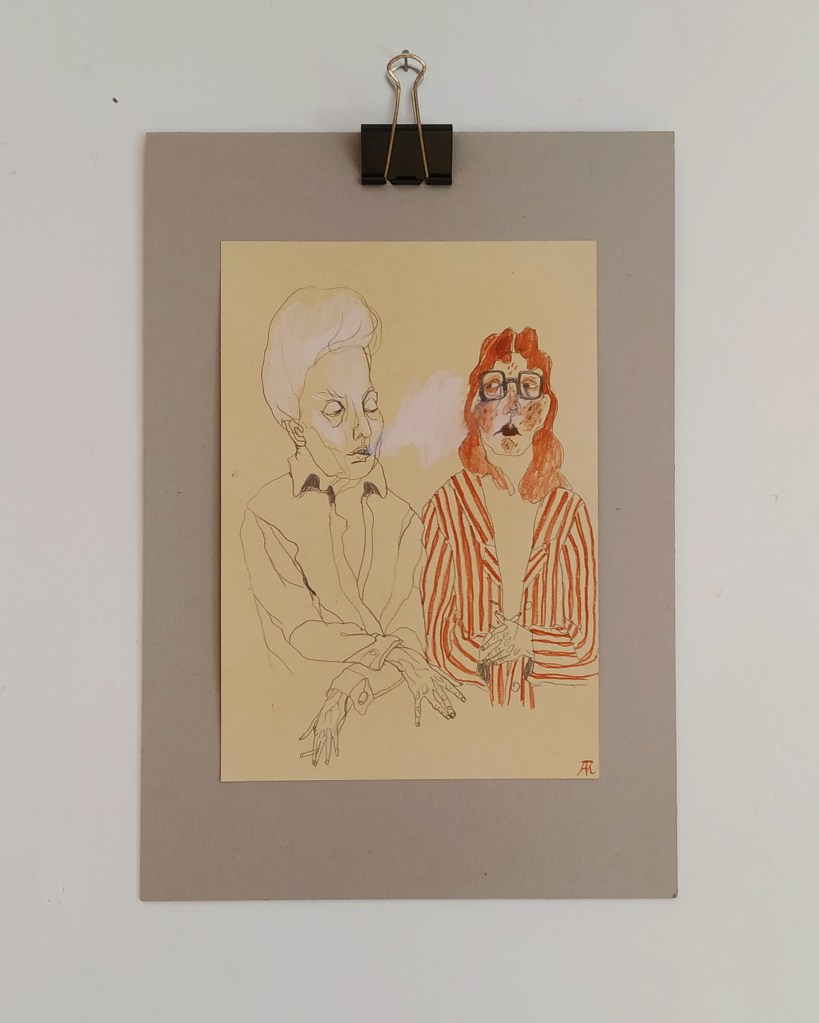
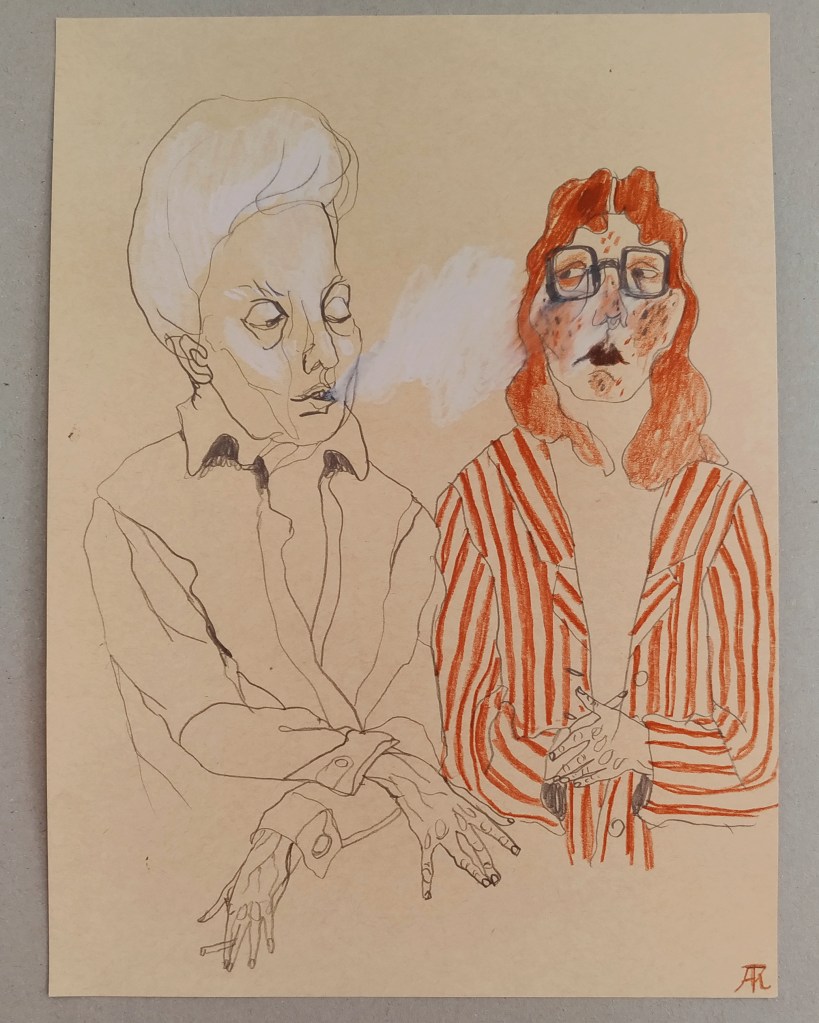
She talked and talked and talked. I gave up even on making normal “hm” and “aha” sounds, the normal signals of listening that I learned to perform when talking to normal people. She didn’t need that. The stories flowed out of her freely, with no interruptions.
I was not a conversation partner but merely an excuse.
The cigarette smoke was suffocating me.
Then she mentioned that her favourite literature was English-language literature. She said she had been an English teacher at a university her whole life.
I could have guessed that. Not the subject she taught, of course, but that she was a teacher. She was too comfortable talking to a complete stranger, too confident that what she had to say had value, too sure that I must be interested in whatever she wanted to share.
Only teachers are like that.
I am definitely like that.
Mówiła i mówiła, i mówiła. W końcu zrezygnowałam nawet z normalnych „hm” i „aha”, tych zwyczajowych sygnałów słuchania, których nauczyłam się używać podczas rozmów z normalnymi ludźmi. Ona ich nie potrzebowała. Historie wypływały z niej swobodnie, bez żadnych przerw.
Nie byłam partnerką do rozmowy, tylko pretekstem.
Dym papierosowy mnie dusił.
Wtedy wspomniała, że jej ulubioną literaturą jest literatura anglojęzyczna. Powiedziała, że przez całe życie była nauczycielką angielskiego na uniwersytecie.
Mogłam się tego domyślić. Nie tego, czego uczyła, oczywiście, ale tego, że była nauczycielką. Była zbyt swobodna w rozmowie z zupełnie obcą osobą, zbyt pewna, że to, co ma do powiedzenia, ma wartość, zbyt przekonana, że muszę być zainteresowana wszystkim, czym chce się podzielić.
Tylko nauczyciele tacy są.
Ja zdecydowanie taka jestem.
She said Faulkner was a genius. She said, what a master of Southern literature.
She said that if she could suggest only one book to someone — only one book she would call her absolute favourite, and be remembered for this recommendation until the end of time — it would be Absalom, Absalom! by Faulkner.
Those were strong words. And coming from a person who clearly knew a thing or two about literature, they got me interested in the book immediately.
I had never read any Faulkner before this whatsoever.
I had also never suggested a book I hadn’t read before to a book club. It was a risky thing to do.
Powiedziała, że Faulkner był geniuszem. Że był mistrzem literatury Południa.
Powiedziała, że gdyby mogła polecić komuś tylko jedną książkę — tylko jedną książkę, którą nazwałaby swoim absolutnym faworytem i za której polecenie chciałaby być pamiętana do końca świata — byłoby to Absalom, Absalom! Faulknera.
To były mocne słowa. A ponieważ pochodziły od osoby, która najwyraźniej znała się na literaturze, od razu zainteresowałam się książką.
Wcześniej w ogóle nie czytałam Faulknera.
Nigdy też nie poleciłam klubowi książki książki, której wcześniej sama nie przeczytałam. Było to ryzykowne.
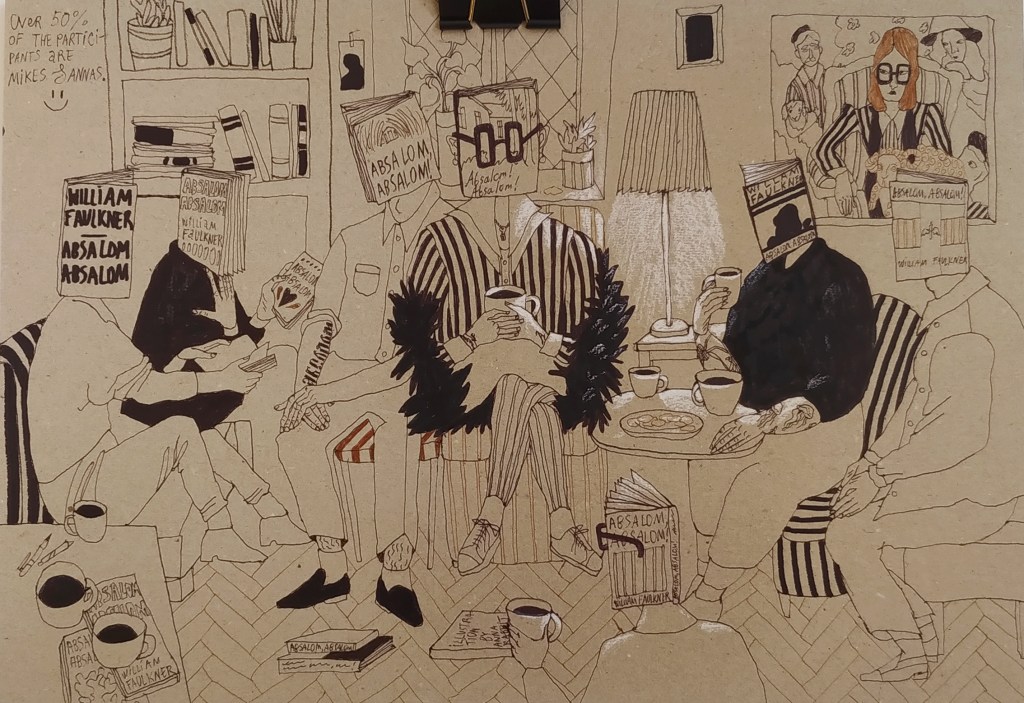
Book club
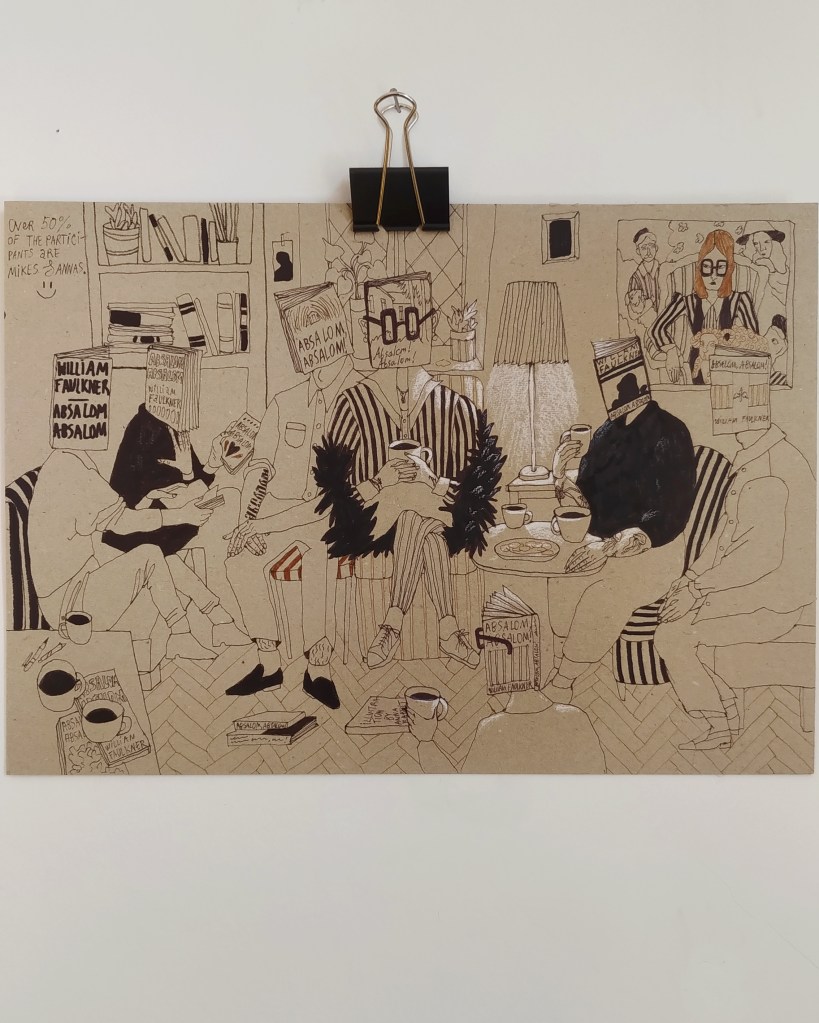
And so, inevitably, the meeting of the book club for Absalom, Absalom! by Faulkner arrived.
Random fact: over 50% of the people at the meeting were Annas and Mikes.
Random fact number 2: it took place in a gallery where my previous exhibition had taken place. Iryna, beautiful soul, made very good fancy coffee for everyone.
The conversation was amazing. I swear, sometimes the conversations in our book club are better than the book itself.
Klub książki
I tak nieuchronnie nadszedł dzień spotkania klubu książki poświęconego Absalom, Absalom! Faulknera.
Ciekawostka: ponad 50% osób na spotkaniu stanowiły Anny i Mike’i.
Ciekawostka numer 2: spotkanie odbyło się w galerii, w której w tym czasie prezentowana była moja poprzednia wystawa. Iryna, piękna dusza, zrobiła dla wszystkich bardzo dobrą, wymyślną kawę.
Rozmowa była niesamowita. Przysięgam, czasami rozmowy w naszym klubie książki są lepsze niż sama książka.
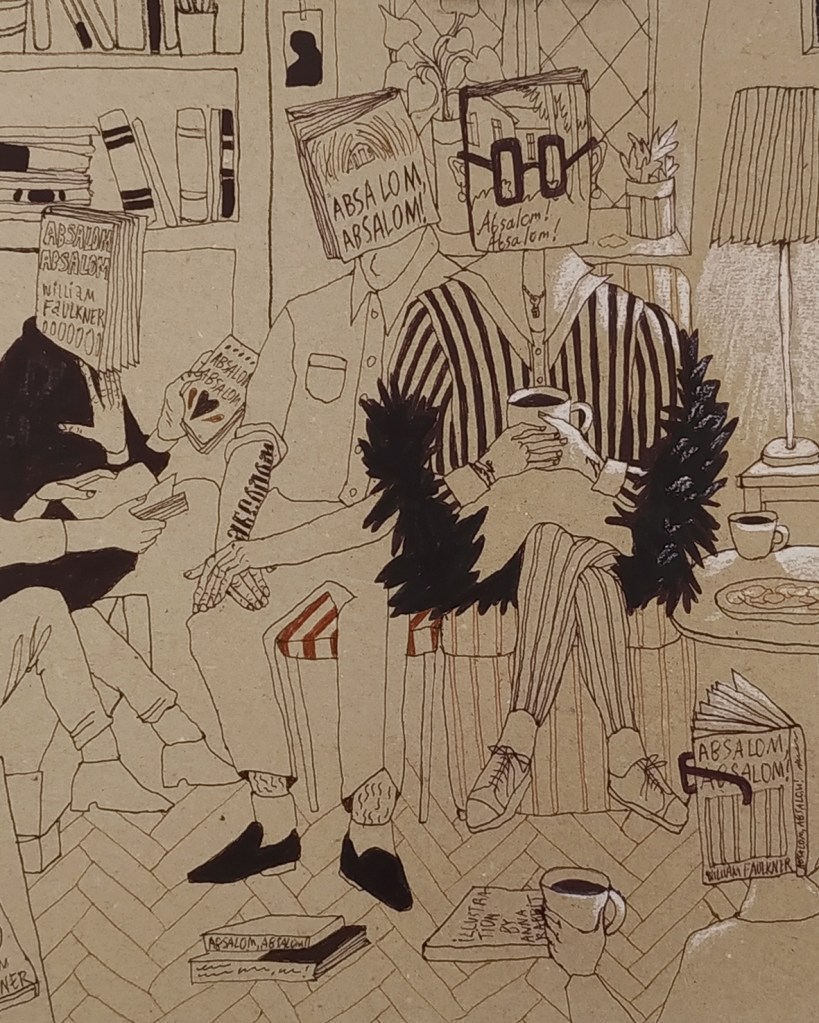
Not this time, though, because the book was amazing.
Do you know that feeling when a book is so good you shake while reading it?
Do you know that feeling of being only thirty percent through but already knowing that this is going to become a regular reread?
Do you know that feeling of dissolving completely into someone else’s thoughts, into someone else’s prose?
Nie tym razem jednak, bo książka była niesamowita.
Znacie to uczucie, kiedy książka jest tak dobra, że trzęsiecie się podczas czytania?
Znacie to uczucie, kiedy jesteście dopiero w trzydziestu procentach lektury, a już wiecie, że będziecie do niej regularnie wracać?
Znacie to uczucie całkowitego rozpłynięcia się w cudzych myślach, w cudzej prozie?
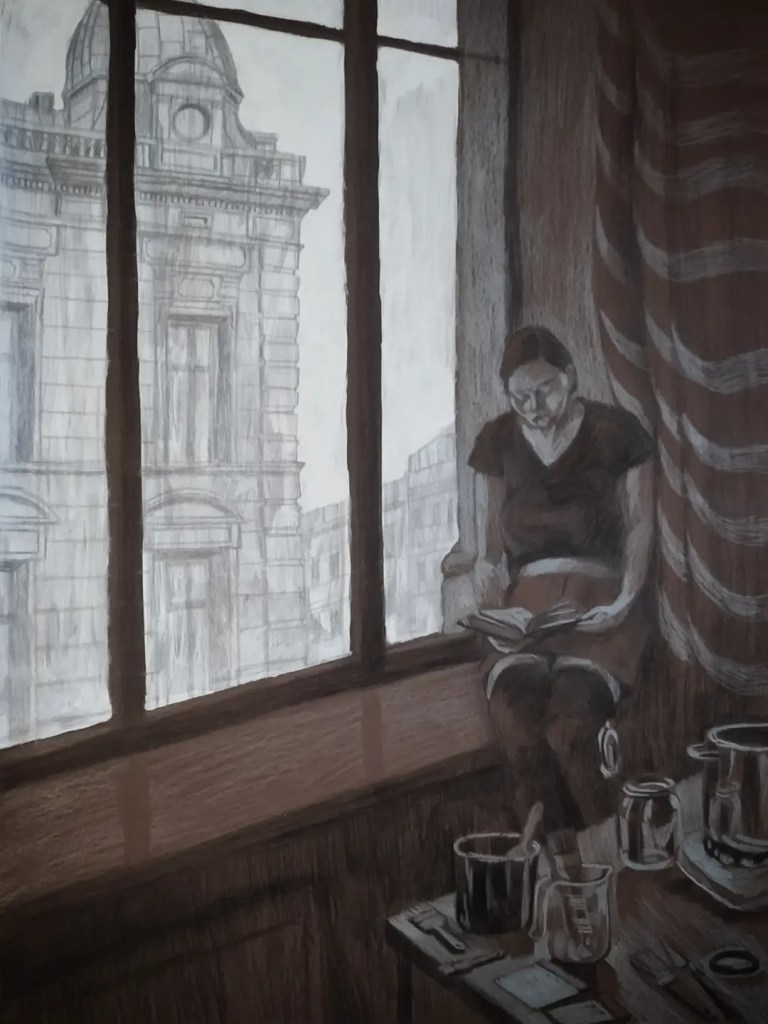
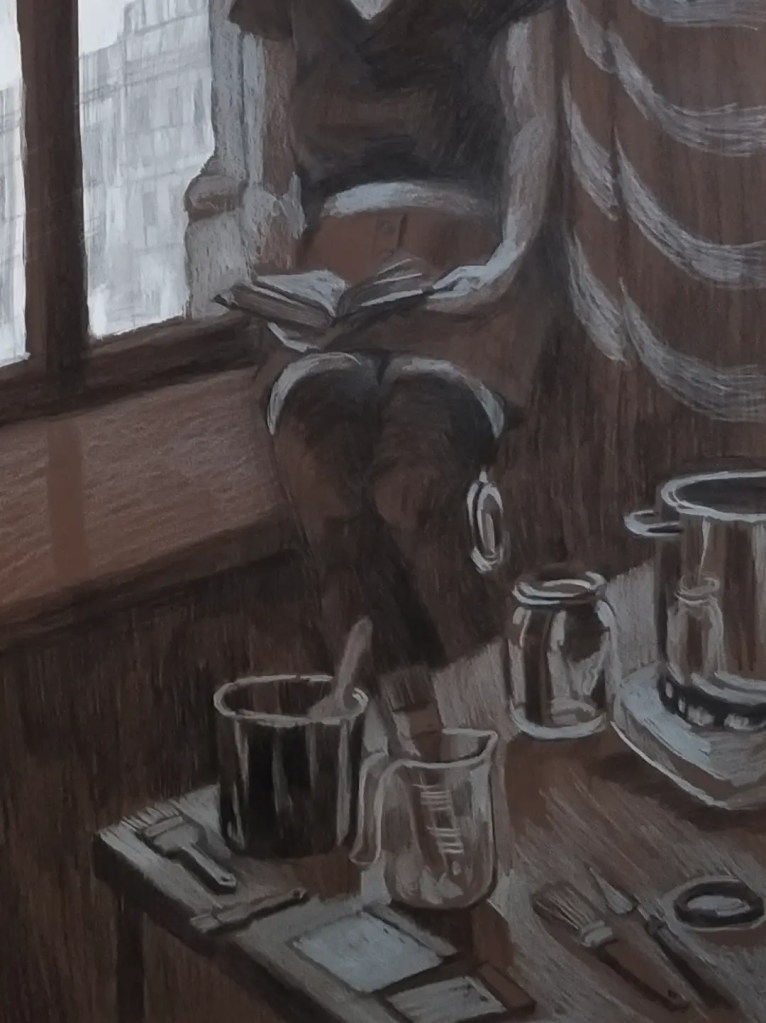
Drawing – self-portrait reading in the room where I had my painting technology classes
50 × 70 cm
Rysunek – autoportret podczas czytania w pokoju, w którym miałam zajęcia z technologii malarstwa
50 × 70 cm
Attention! A small break from sharing works from Anna Rabbit’s exhibition at Olga Boznańska’s Art Studio. This one is from a pop-up exhibition taking place as part of the Kraków Celtic Festival, 4–6 September 2026, at Dworek Białoprądnicki.
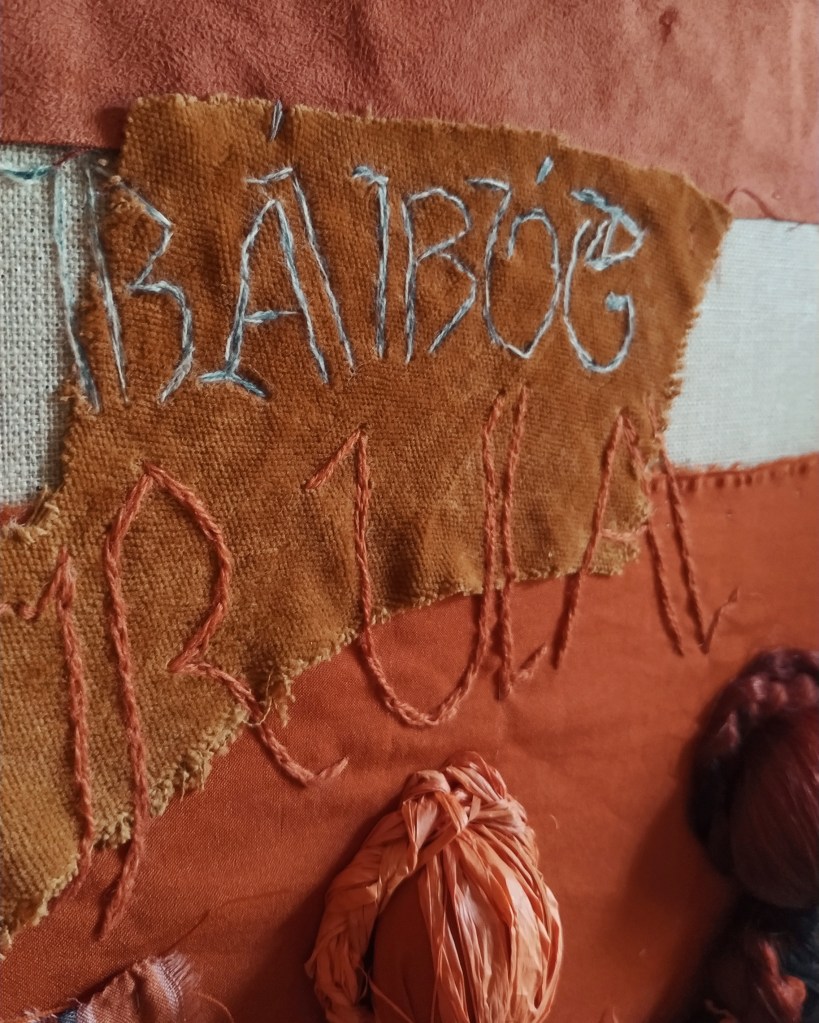
Bábóg Rua
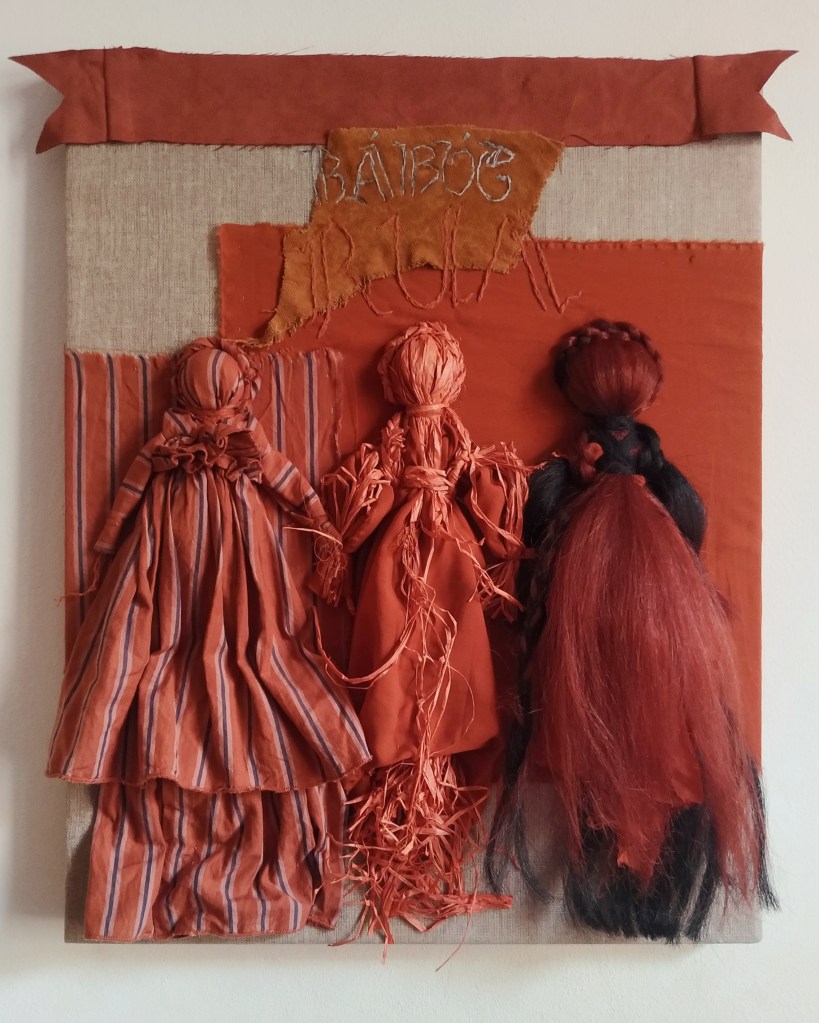
Bábóg Rua
Anna Rabbit
40 × 50 cm
Canvas, textile
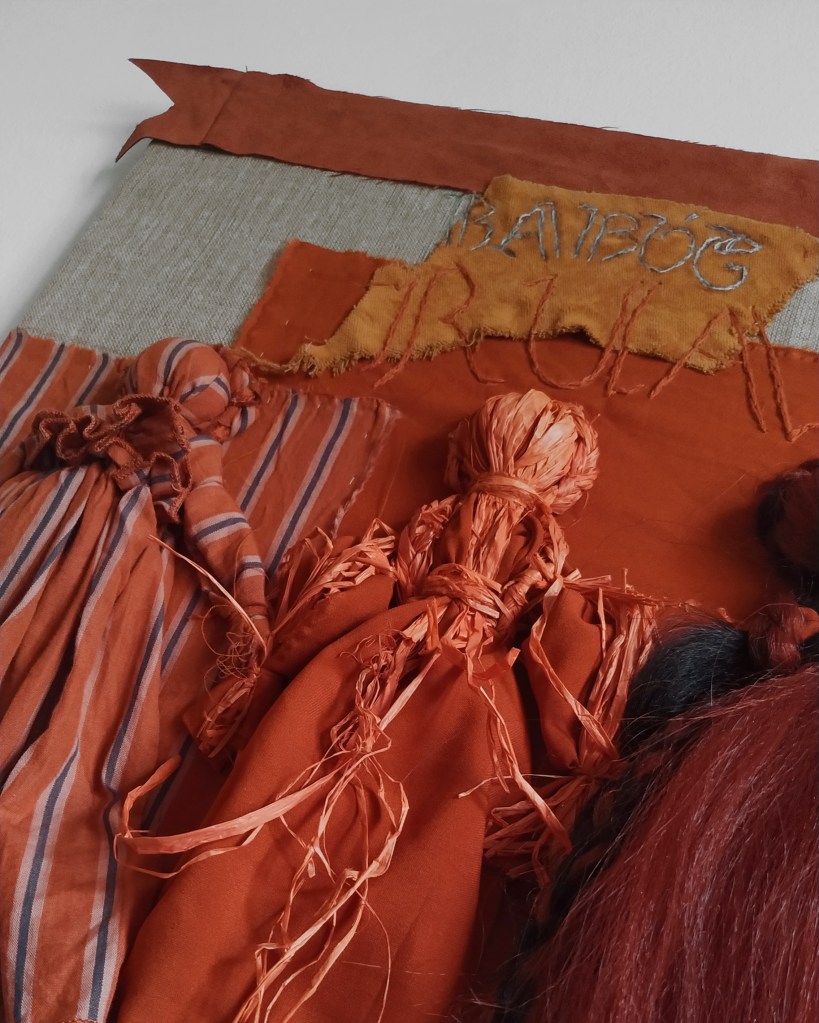
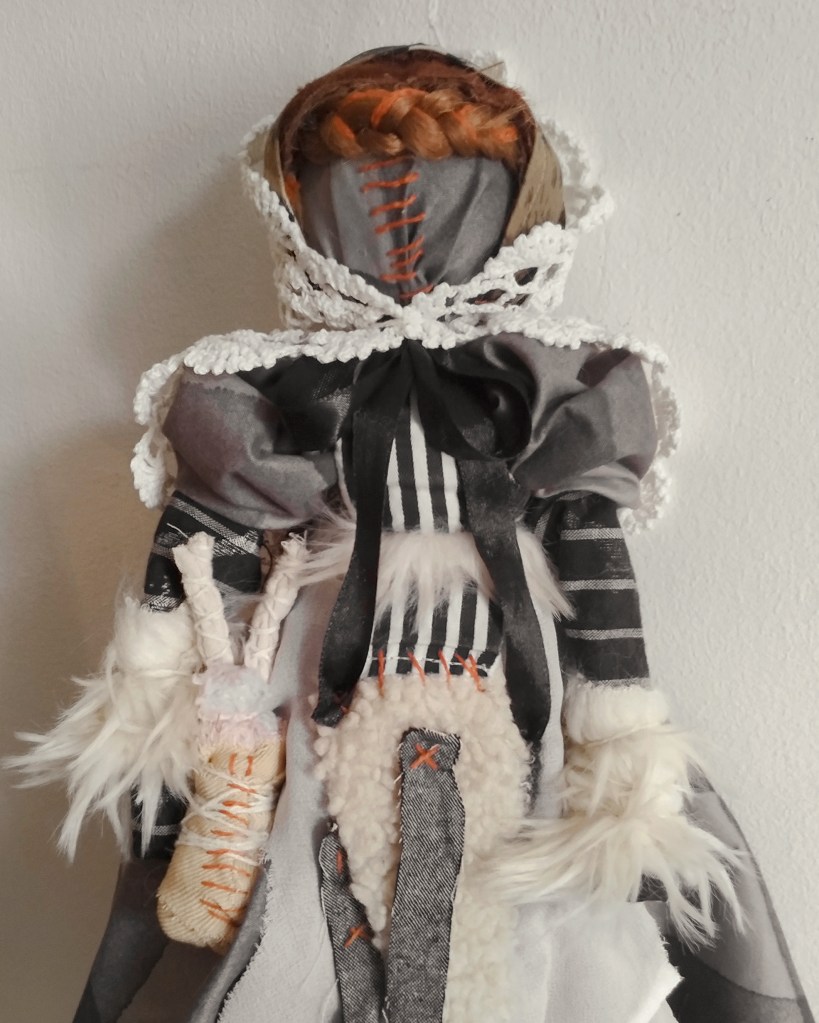
Bábóg Rua is a work about connecting with ancestry and cultural roots while simultaneously putting down roots in the place where one lives. Three orange, folk-inspired dolls attached to the canvas represent three minority languages: Irish, Yiddish, and Silesian.
The central figure represents Irish, a language Anna Rabbit has studied with some success in the past and intends to return to. The doll is made from hay, referencing the Irish Strawboys — disguised wedding guests traditionally dressed in elaborate straw costumes and masks, associated with bringing luck, health, and prosperity to newlyweds.
The figure on the right represents Yiddish, which Anna is currently learning. Yiddish is an important marker of the Jewish diaspora community to which she belongs. The doll is made from synthetic hair, inside which Anna has concealed a strand of her grandmother’s real black hair, tied with a ribbon. The hair shifts from black to red, symbolising the connection between Anna and her grandmother and the continuity of identity between generations. Hair also carries a particular historical significance in relation to Jewish women: hair was among the personal traces left behind by victims of the Holocaust and is still preserved and displayed at the Auschwitz-Birkenau State Museum (among others).
The figure on the left represents Silesian, a minority language with which Anna has not yet had a personal connection, but which is significant to the region where she lives. The striped fabric refers to traditional Silesian dress, particularly its characteristic striped skirts. Rabbit plans to explore Silesian language and culture more deeply as a way of developing a stronger connection with the land she currently inhabits.
For Anna, minority languages offer a way of approaching culture through something more than communication. Rather than prioritising languages for their practical or professional value, she is drawn to languages whose communities and cultural traditions require greater attention and preservation. Learning a minority language becomes, in this sense, a way of learning about and caring for fading cultures.
Bábóg Rua
Anna Rabbit
40 × 50 cm
Płótno, tkanina
Bábóg Rua to praca o nawiązywaniu więzi z przodkami i kulturowymi korzeniami, a jednocześnie o zapuszczaniu korzeni w miejscu, w którym się żyje. Trzy pomarańczowe, inspirowane folklorem lalki umieszczone na płótnie reprezentują trzy języki mniejszościowe: irlandzki, jidysz i śląski.
Centralna postać reprezentuje język irlandzki — język, którego Anna Rabbit uczyła się w przeszłości z pewnymi sukcesami i do którego zamierza powrócić. Lalka wykonana jest z siana i nawiązuje do irlandzkiej tradycji Strawboys — przebranych gości weselnych, którzy tradycyjnie noszą wyszukane kostiumy ze słomy i maski, mające przynosić nowożeńcom szczęście, zdrowie i pomyślność.
Postać po prawej stronie reprezentuje jidysz, którego Anna obecnie się uczy. Jidysz jest ważnym wyznacznikiem przynależności do żydowskiej społeczności diaspory, której jest częścią. Lalka wykonana jest ze sztucznych włosów, wewnątrz których Anna ukryła pasmo prawdziwych, czarnych włosów swojej babci, przewiązane wstążką. Włosy przechodzą od czerni do czerwieni, symbolizując więź między Anną a jej babcią oraz ciągłość tożsamości pomiędzy pokoleniami. Włosy mają również szczególne znaczenie historyczne w kontekście żydowskich kobiet: należały do osobistych śladów pozostawionych przez ofiary Holokaustu i do dziś są przechowywane oraz eksponowane między innymi w Państwowym Muzeum Auschwitz-Birkenau.
Postać po lewej stronie reprezentuje język śląski — język mniejszościowy, z którym Anna nie ma jeszcze osobistej więzi, ale który ma znaczenie dla regionu, w którym mieszka. Wykorzystana w lalce pasiasta tkanina nawiązuje do tradycyjnego stroju śląskiego, w szczególności do charakterystycznych pasiastych spódnic. Rabbit planuje głębiej poznać język i kulturę śląską, traktując to jako sposób na zbudowanie silniejszej więzi z ziemią, na której obecnie żyje.
Dla Anny języki mniejszościowe są sposobem poznawania kultury, który wykracza poza samą komunikację. Zamiast skupiać się na językach ze względu na ich praktyczną czy zawodową wartość, przyciągają ją te, których społeczności i tradycje kulturowe potrzebują większej uwagi i ochrony. Nauka języka mniejszościowego staje się w tym sensie sposobem poznawania i otaczania troską kultur, które zanikają.
The end of the break!
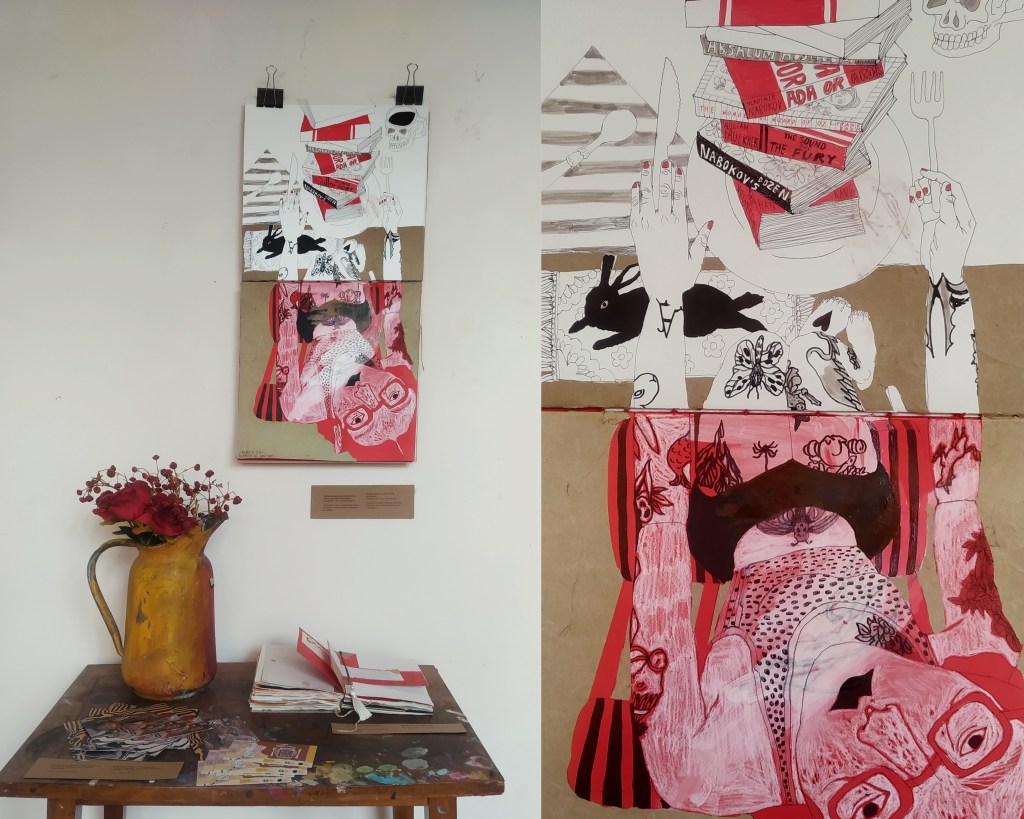
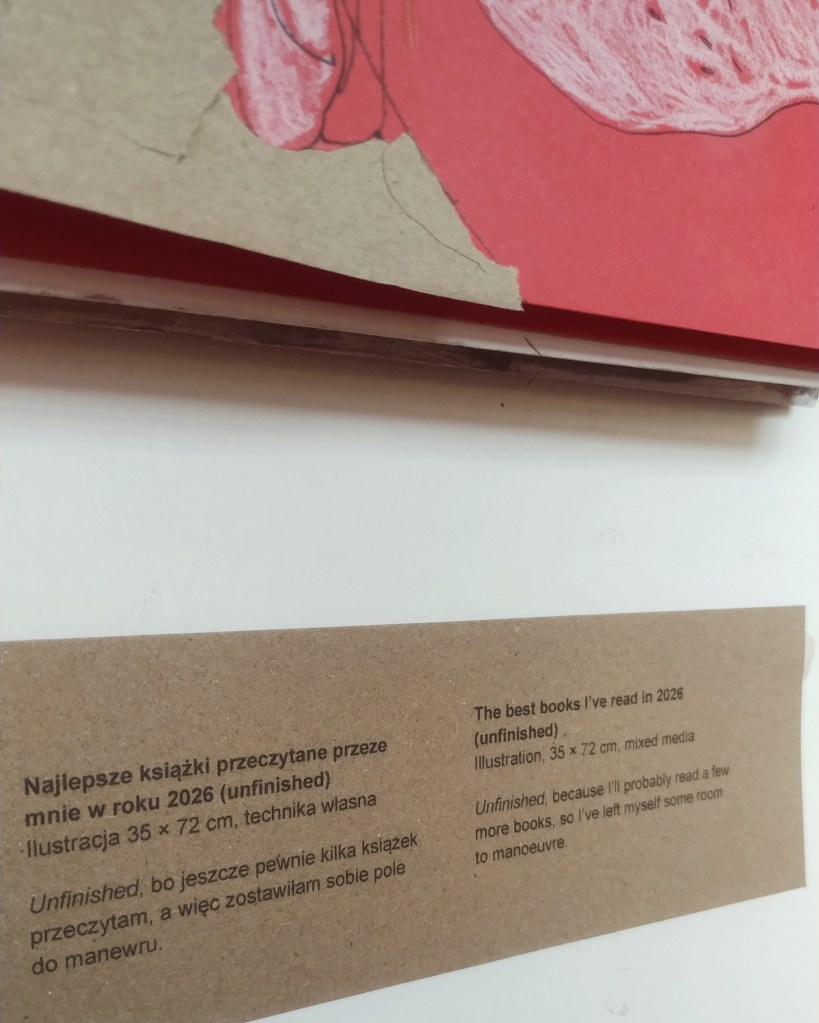
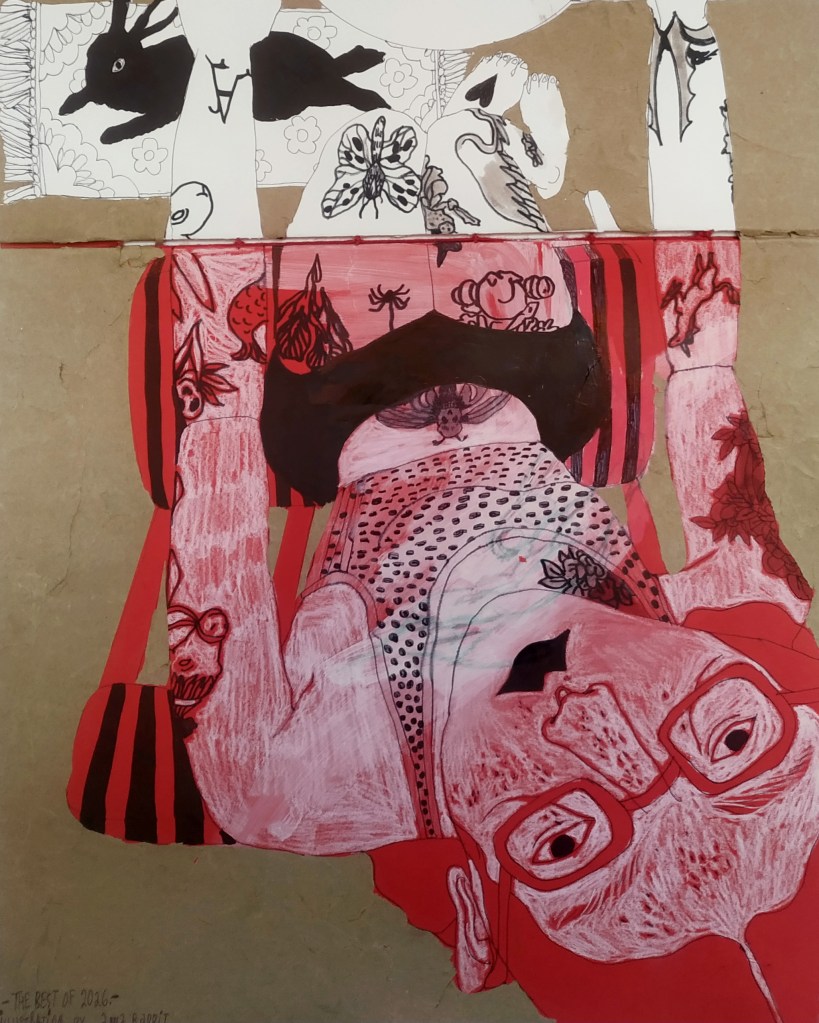
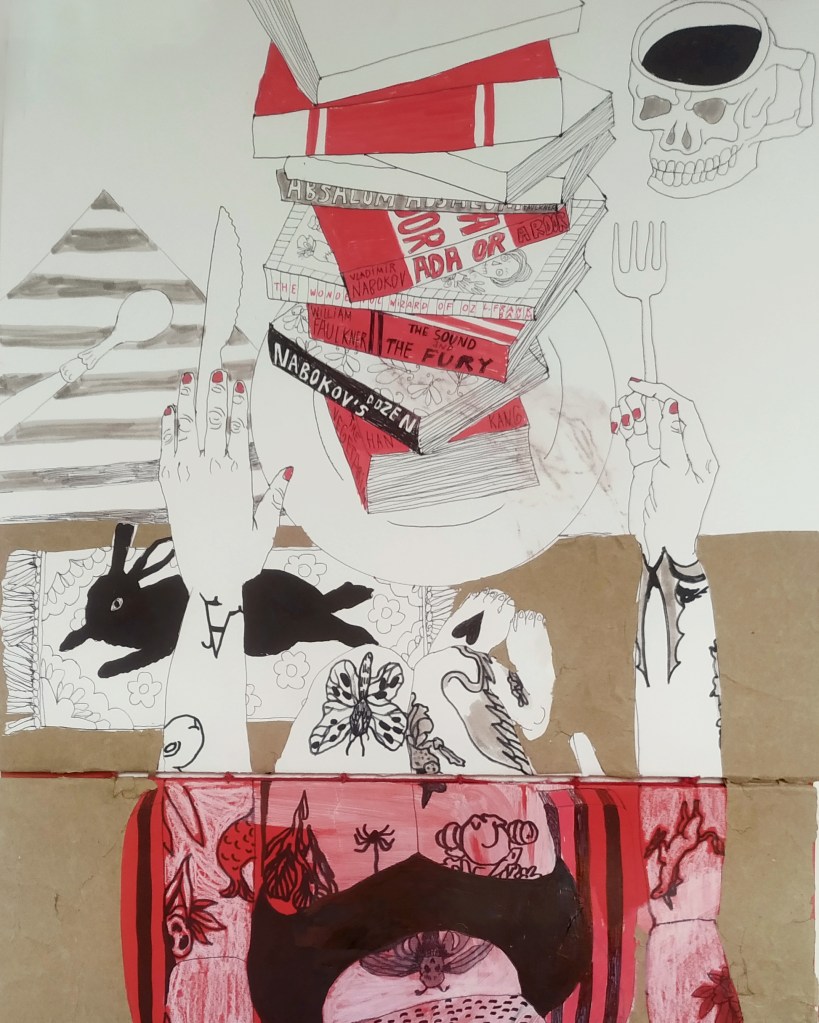
Najlepsze książki przeczytane przeze mnie w roku 2026 (unfinished)
Ilustracja 35 × 72 cm, technika własna
Unfinished, bo jeszcze pewnie kilka książek przeczytam, a więc zostawiłam sobie pole do manewru.
The best books I’ve read in 2026 (unfinished)
Illustration, 35 × 72 cm, mixed media
Unfinished, because I’ll probably read a few more books, so I’ve left myself some room to manoeuvre.
I have never been to Edinburgh -“Travel” sketchbook – page with covers of the books that takes place in Edinburg.
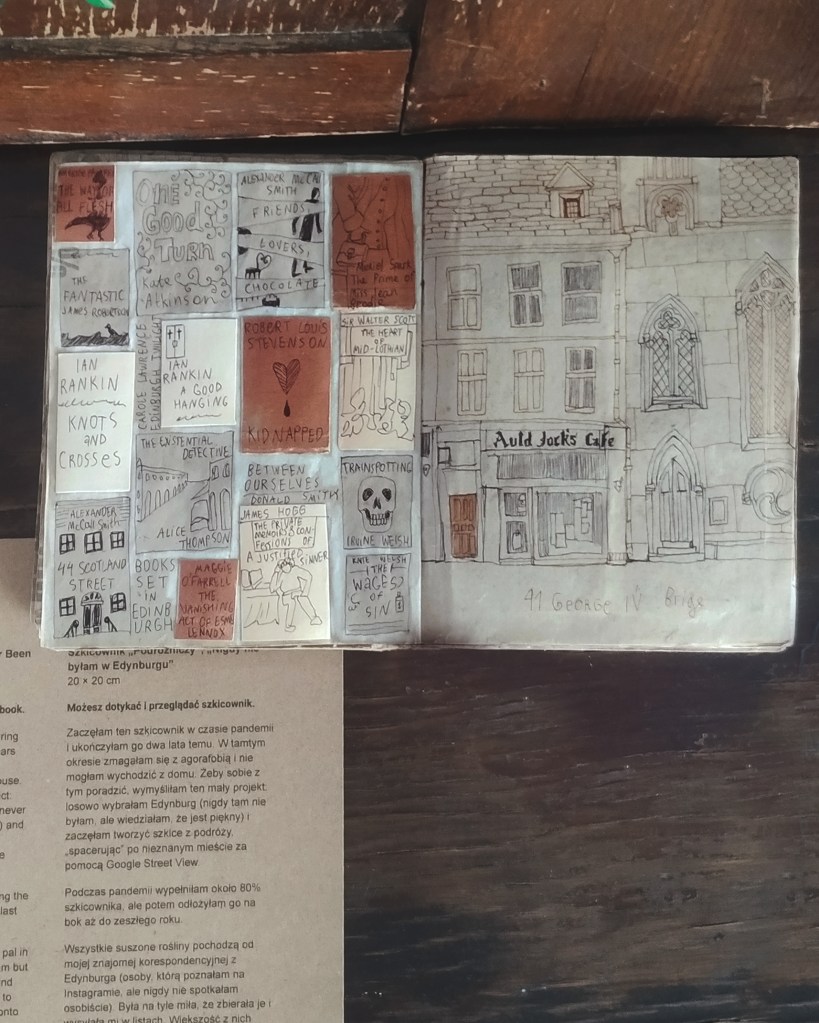
This time since the exhibit is about books and reading I wanted to showcase this page of the sketchbook that has some books covers.
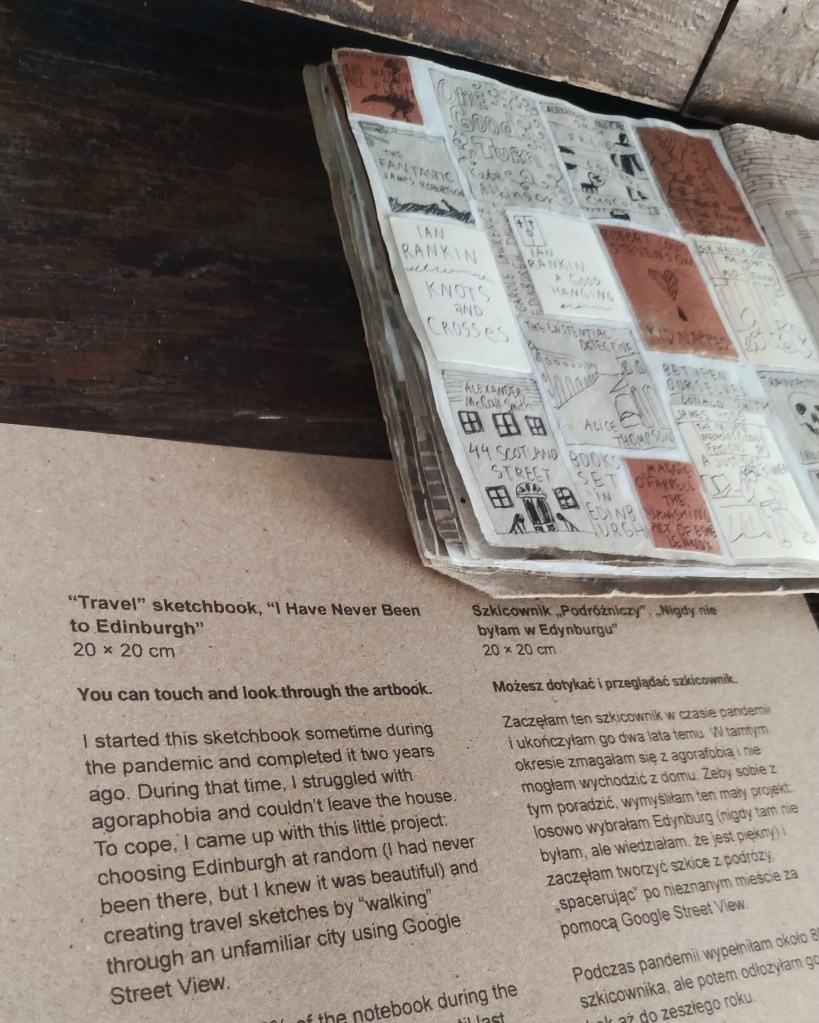
“Travel” sketchbook, “I Have Never Been to Edinburgh”
20 × 20 cm
At the exhibit you can touch and look through the artbook.
I started this sketchbook sometime during the pandemic and completed it two years ago. During that time, I struggled with agoraphobia and couldn’t leave the house. To cope, I came up with this little project: choosing Edinburgh at random (I had never been there, but I knew it was beautiful) and creating travel sketches by “walking” through an unfamiliar city using Google Street View.
I filled about 80% of the notebook during the pandemic, but then abandoned it until last year.
All of the dried plants are from my pen pal in Edinburgh (someone I met on Instagram but have never met in person), who was kind enough to collect them and send them to me in a letter. Most of them are glued onto the pages with drawings of the places where they were originally found.
Some of the sketches were added later at the request of my new friend from Edinburgh, depicting the street he grew up on, his high school, and other personal landmarks.
To this day, I still struggle greatly with the fear of leaving my house, especially when it comes to travelling. I haven’t left the country since 2020.
And I still have never been to Edinburgh.
If you are not in Kraków and unable to visit my exhibit you can still see the whole sketchbook, here:
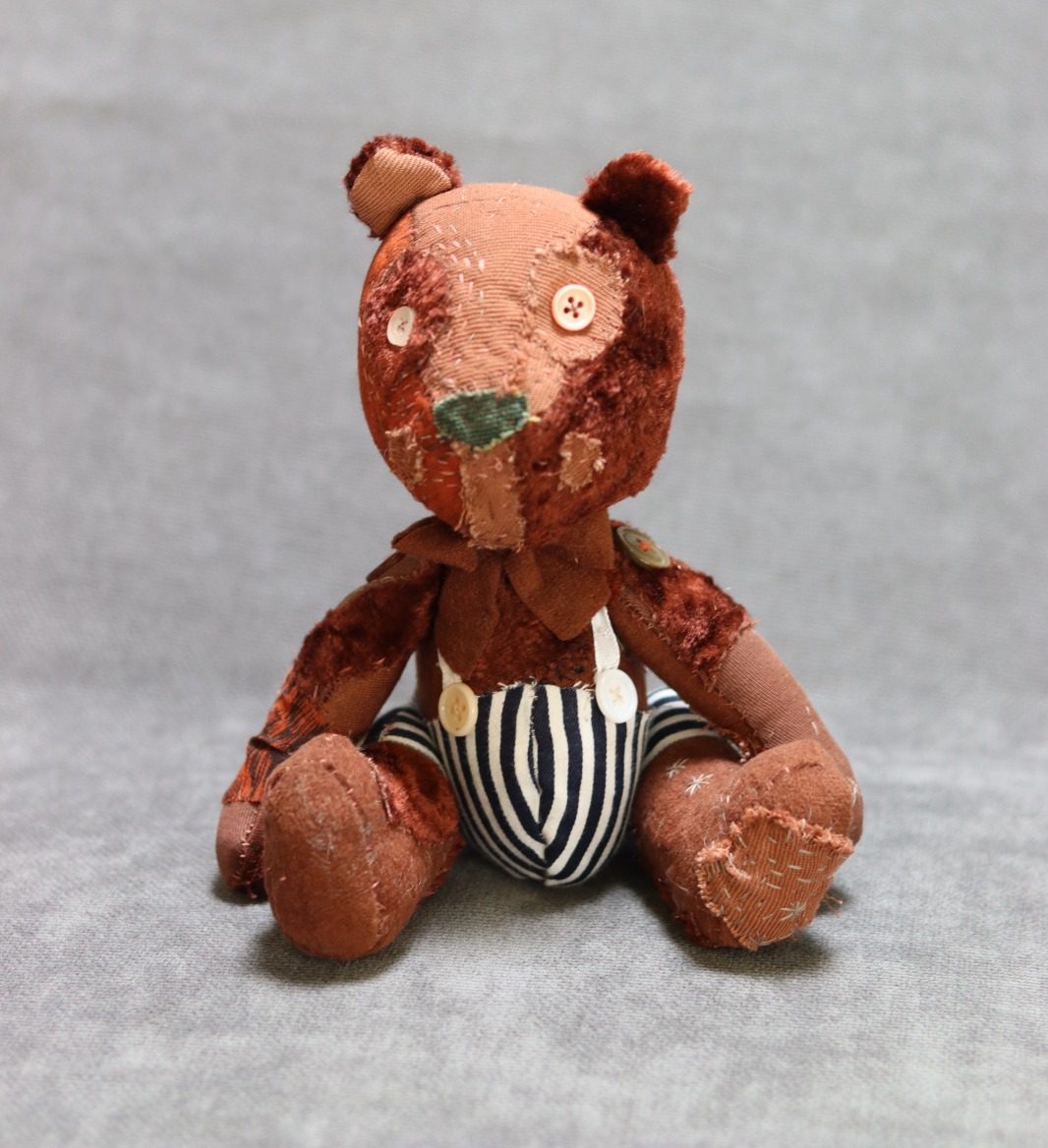
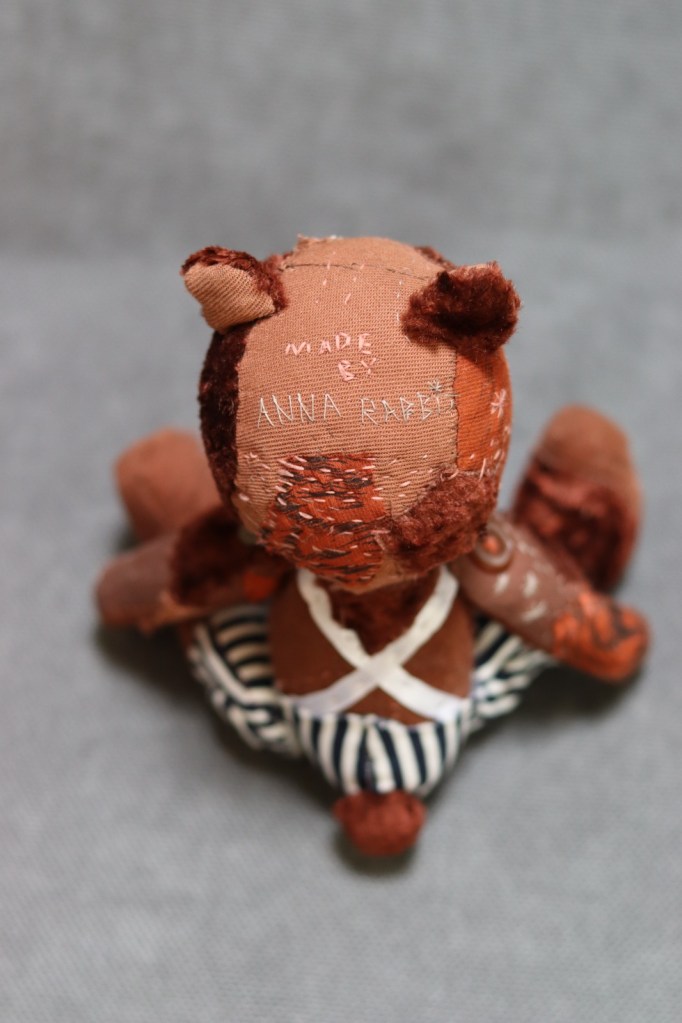
Anna Rabbit, Miś Zero Waste, 2026
zabawka artystyczna / obiekt tekstylny
odpady tekstylne, technika sashiko, guziki, szycie ręczne
Pluszowy miś wykonany z odzyskanych skrawków tkanin nawiązuje do klasycznych wzorów misiów z lat 40. XX wieku. Ruchome kończyny mocowane na guziki przywołują tradycyjne techniki tworzenia zabawek, jednocześnie podkreślając materialność i ręczny charakter obiektu. Elementy japońskiej techniki sashiko — historycznie związanej z naprawą i wzmacnianiem tkanin — stają się tutaj zarówno detalem estetycznym, jak i gestem troski wobec materiału i pamięci, którą w sobie nosi.
Praca wpisuje się w praktykę artystyczną Anny Rabbit, opartą na łączeniu rzemiosła, sztuki tekstylnej i idei ponownego wykorzystania materiałów. Artystka bada relacje między przedmiotem, historią i tożsamością, tworząc obiekty balansujące pomiędzy zabawką, rzeźbą i osobistym archiwum.
Anna Rabbit, Miś Zero Waste (Zero Waste Bear), 2026
art toy / textile object
textile waste, sashiko technique, buttons, hand sewing
A plush bear made from reclaimed fabric scraps references classic teddy bear designs of the 1940s. Its movable limbs, attached with buttons, evoke traditional toy-making techniques while emphasizing the materiality and handcrafted nature of the object. Elements of the Japanese sashiko technique—historically associated with repairing and reinforcing textiles—serve here both as an aesthetic detail and as a gesture of care toward the material and the memories it carries.
The work is part of Anna Rabbit’s artistic practice, which combines craft, textile art, and the principles of material reuse. The artist explores the relationships between objects, history, and identity, creating works that balance between toy, sculpture, and personal archive.
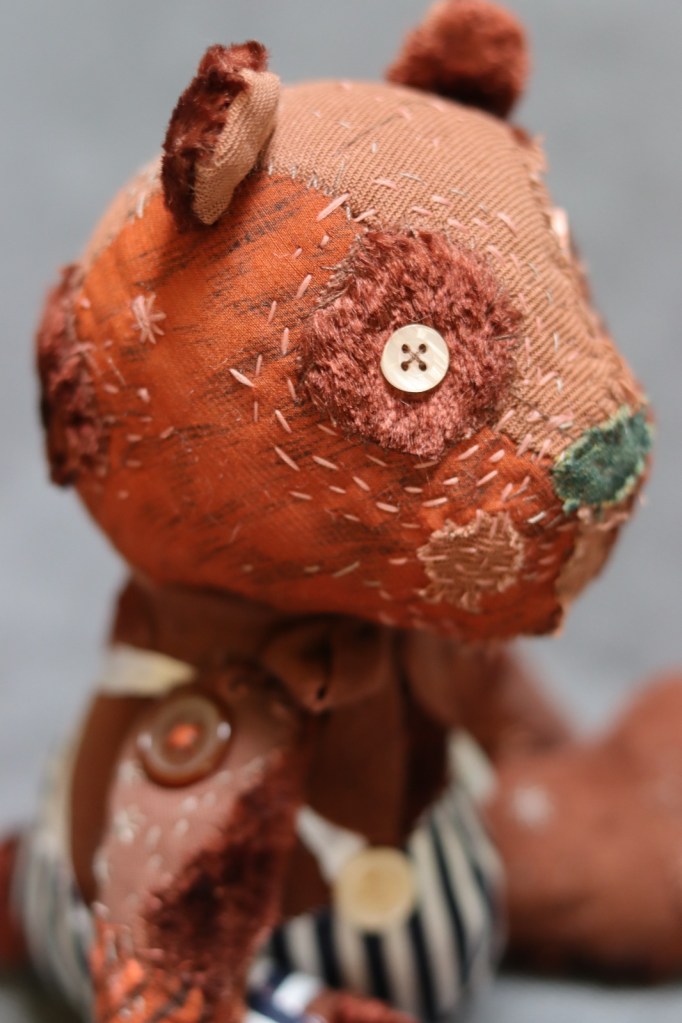
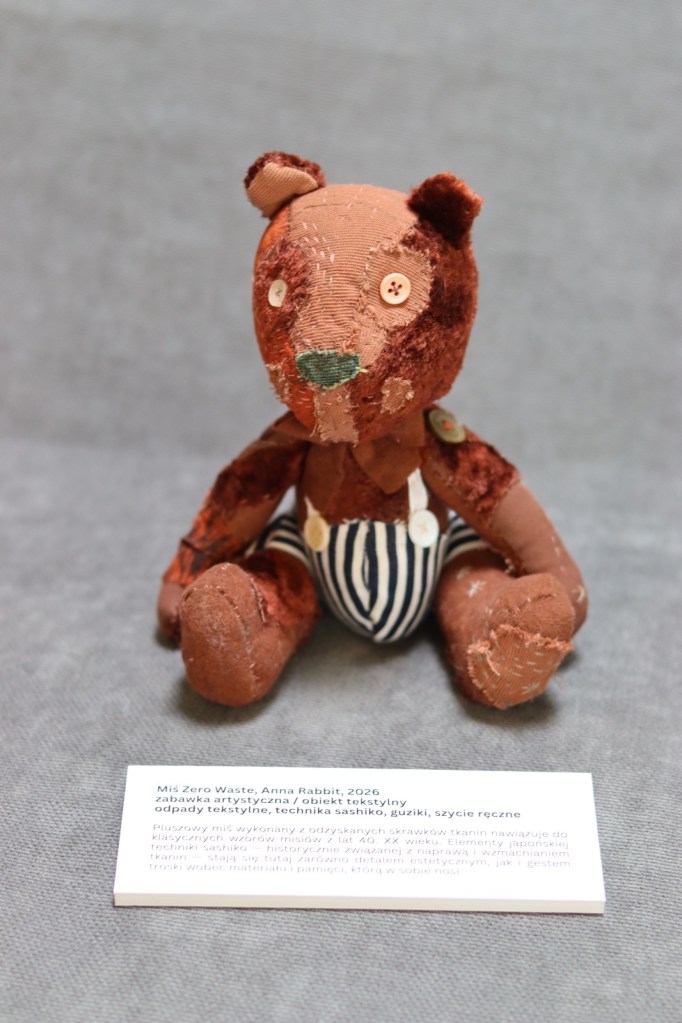
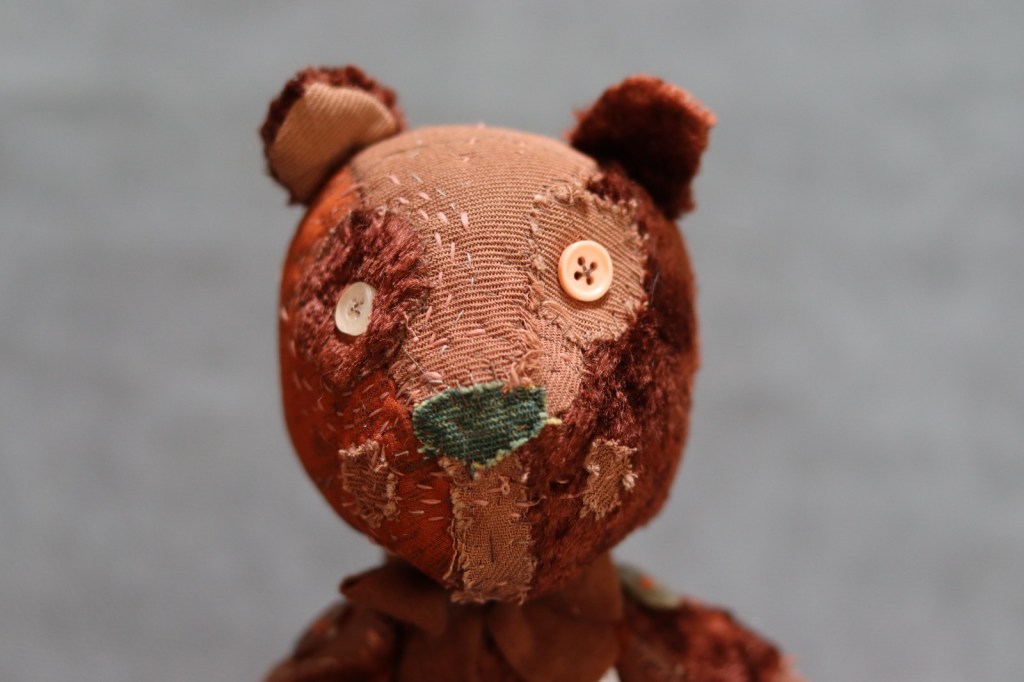
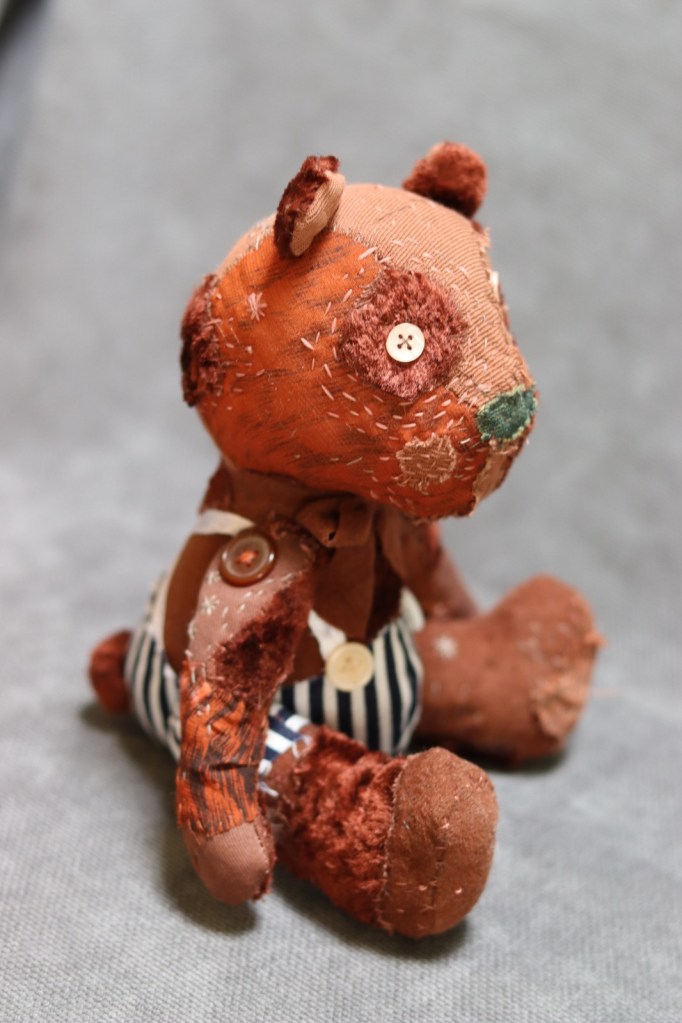
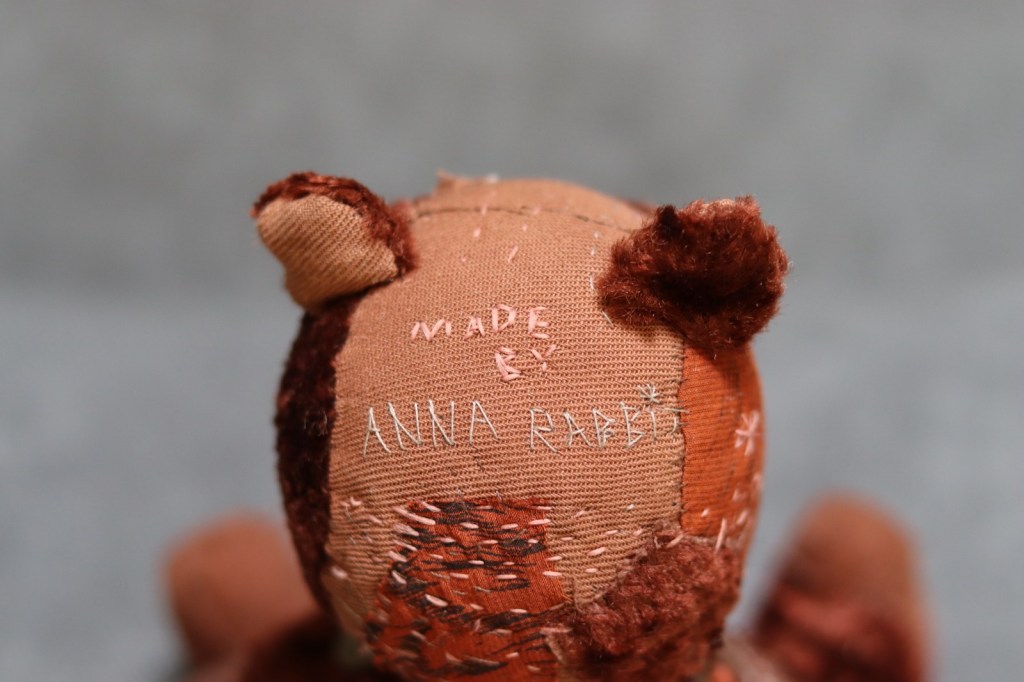
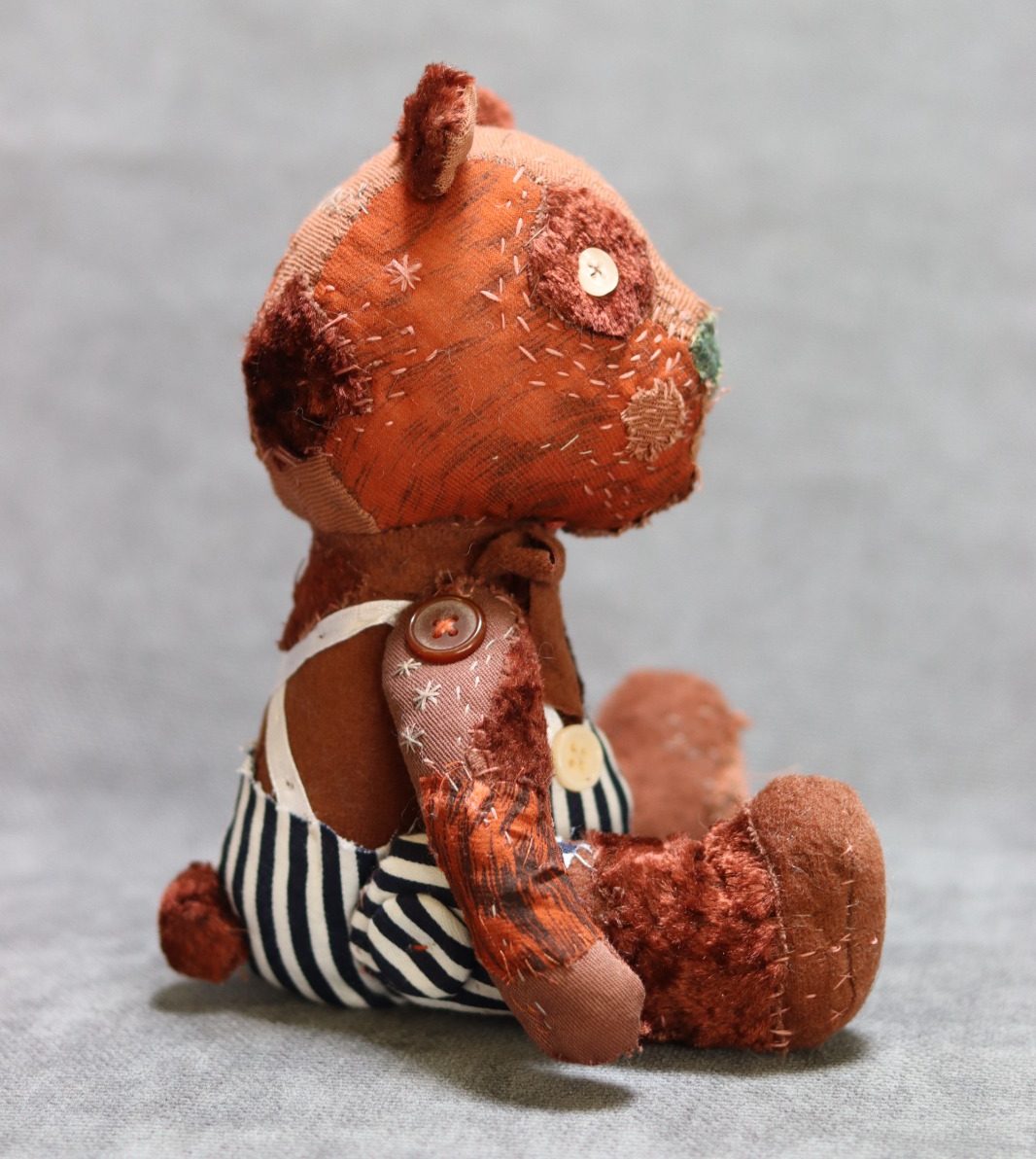
Misia można zobaczyć w Muzeum Zabawek w Krakowie od maja do października 2026 w ramach wystawy ” Bajka o Rodzinie” – ul. Kopernika 19 A.
The bear can be seen at the Toy Museum in Kraków as part of the exhibition A Fairy Tale About Family, on view from May to October 2026 at 19A Kopernika Street.
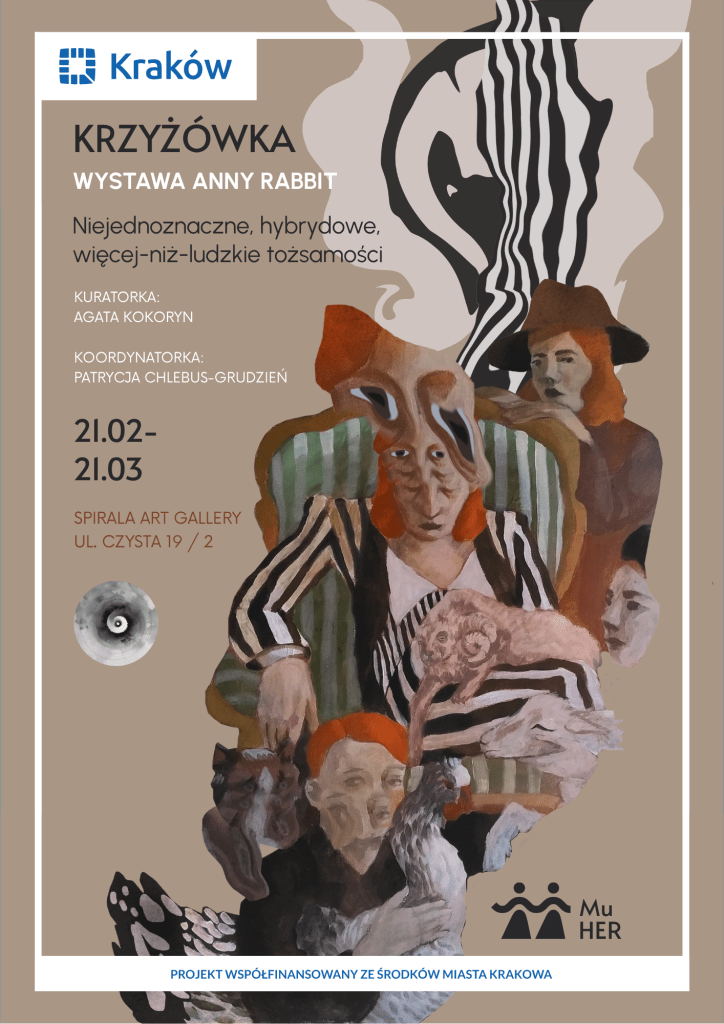
Below you can see most of the artwork shown at Anna Rabbit’s exhibit, co-organized by MuHer and co-founded by the city of Kraków – February-March ’26
Księga potwora – kurtka / The Creature Book – jacket
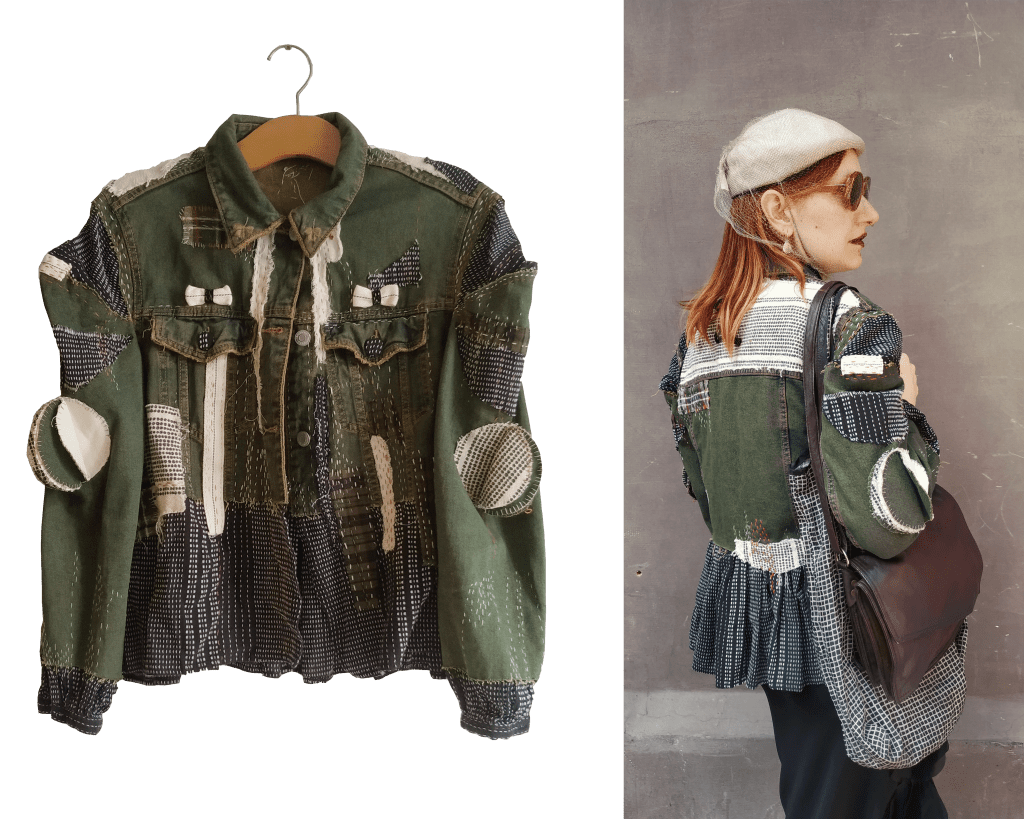
Rozmiar dorosły L, odpady tekstylne, 2025.
Jeśli płótno jest tkaniną, czy dzieło sztuki może zostać zdjęte z ramy i uszyte w kształt kurtki? Czy przez to przestaje być dziełem? Czy coś traci, kiedy nie wisi już na ścianie, lecz okrywa człowieka?
Praca odsłania swoją konstrukcję: różne tkaniny zostają sklejone i zszyte w jedną całość, a szwy i łączenia – to, co zazwyczaj ukryte – stają się widoczne. Złożoność i fragmentaryczność nie są tu maskowane, lecz ujawnione. Szew, zwykle umieszczony „pomiędzy” i schowany po to, by wygładzić powierzchnię, tutaj przejmuje główną rolę. Jest śladem łączenia, ale też raną, pęknięciem, miejscem naprężenia.
To, co zwykle próbujemy ukryć, dziury, rozdarcia, brak, uszkodzenie, nie zostało zaszyte tak, by zniknęło. Przeciwnie: zostaje wyeksponowane jako najważniejsza część opowieści.
Kurtka stanowi kontynuację obrazu Księga potwora – jego kolejną odsłonę i przesunięcie: z przestrzeni ekspozycyjnej w stronę ciała. Warto obejść ją dookoła, przyjrzeć się detalom, pozwolić, by prowadziły wzrok jak mapa: po szwach, zszyciach i śladach.
Adult size L, textile waste, 2025.
If canvas is a fabric, can a work of art be taken out of its frame and sewn into the shape of a jacket? Does it cease to be a work because of that? Does it lose something when it no longer hangs on a wall, but instead covers a human body?
The work reveals its construction: different textiles are glued and stitched into a single whole, and the seams and joints—what is usually hidden—become visible. Complexity and fragmentation are not concealed here, but exposed. The seam, typically placed “in between” and hidden to smooth the surface, takes on the main role. It is a trace of connection, but also a wound, a rupture, a site of tension.
What we usually try to hide—holes, tears, absence, damage—has not been mended so as to disappear. On the contrary, it is exposed as the most important part of the narrative.
The jacket continues the painting The Creature Book—its next iteration and a shift: from exhibition space toward the body. It is worth walking around it, looking closely at the details, allowing them to guide the gaze like a map—across seams, stitches, and traces.
Text by Agata Kokoryn.
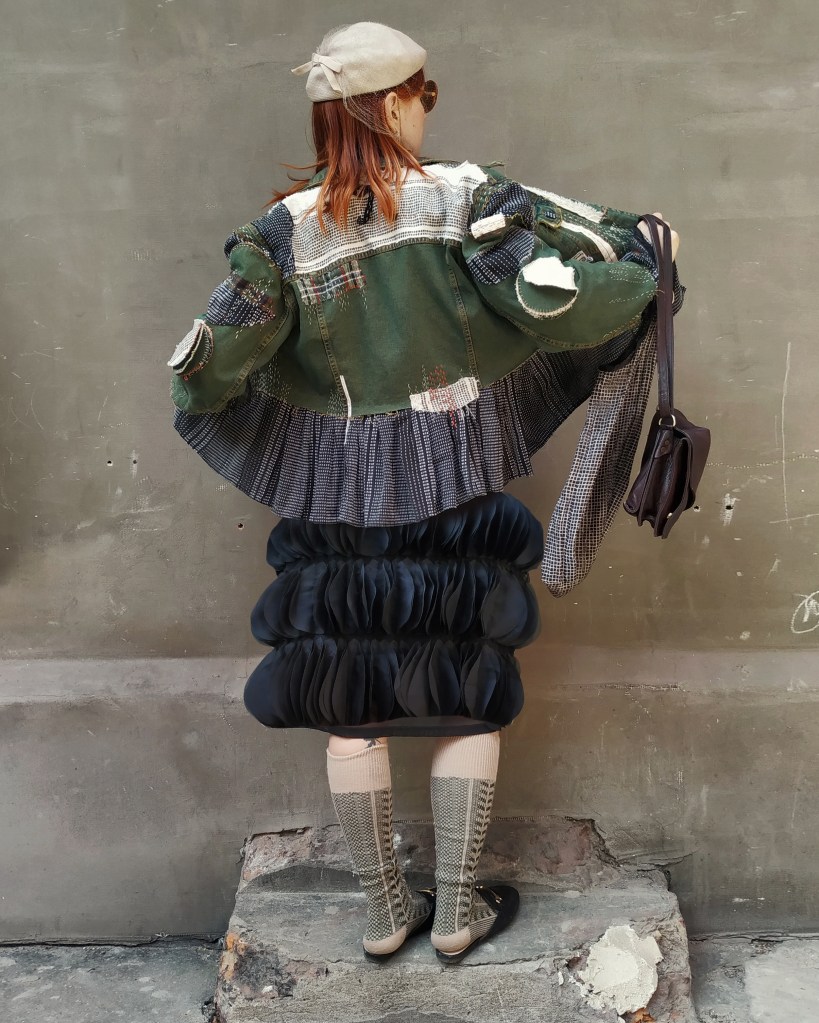
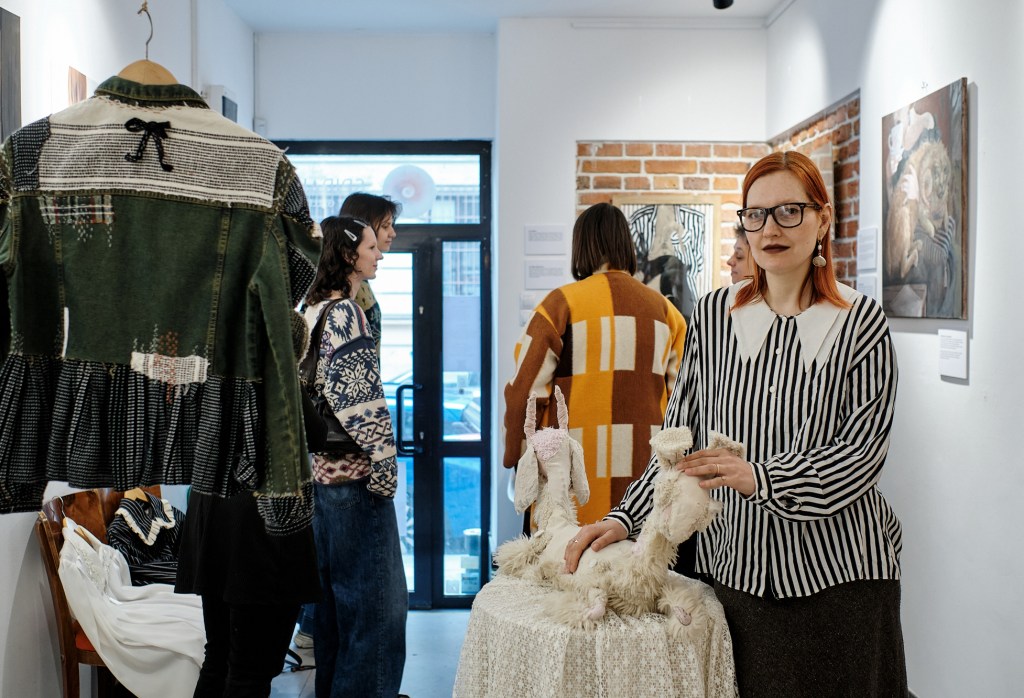
Zdjęcie: zdjęcie: Tomasz Karwowski @darkgraystudio.
Księga potwora (obraz(?)) / The Creature Book (painting(?))
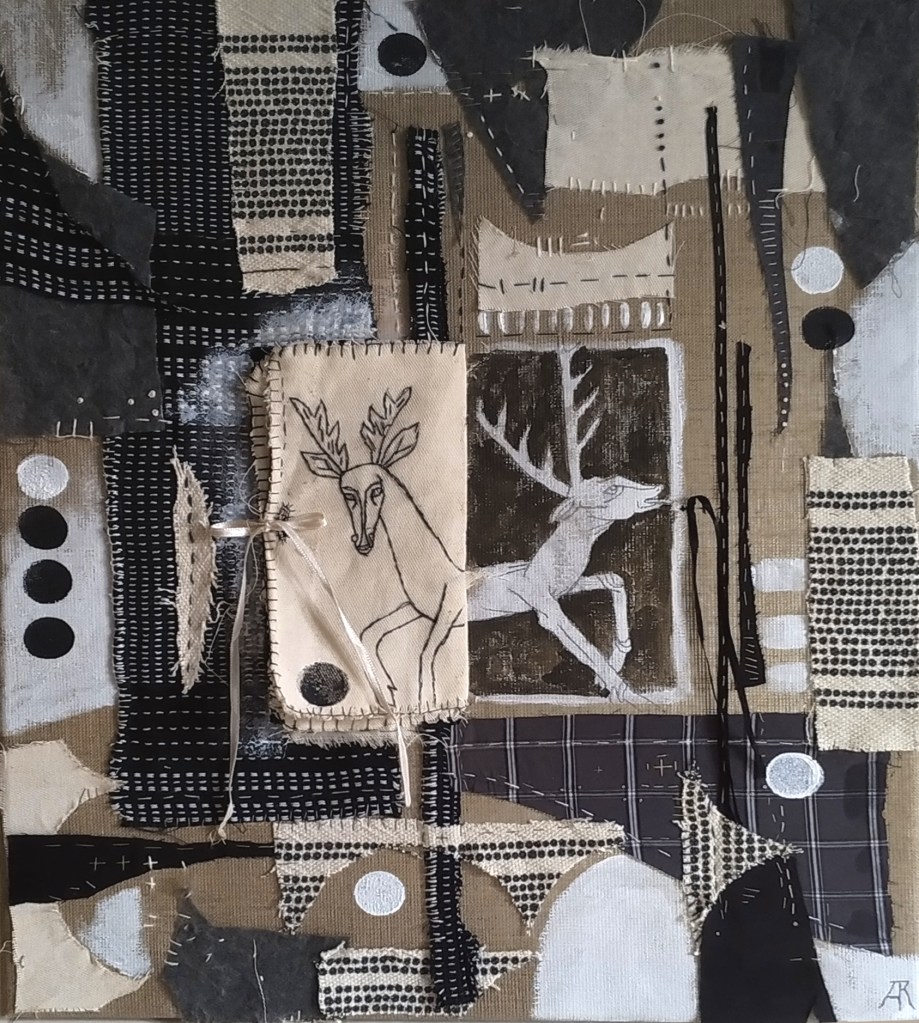
40x50cm, technika własna: płótno, farby akrylowe, tekstylia.
Co czujemy, kiedy podchodzimy bliżej do obrazu? Czy pojawia się pragnienie dotyku, potrzeba sprawdzenia faktury, materii, śladu nici? Co się dzieje, gdy zatrzymujemy wzrok na postaci w centrum i zaczynamy podążać za skomplikowanymi liniami przeszyć? Czy to może być dalej malarstwo? W którym momencie płótno pokryte farbą staje się obrazem?
Z czym kojarzy się to zwierzę? Ze średniowiecznymi ornamentami, bestiariuszami czy może XVII-wieczną ryciną? Wydaje się znajome czy obce? Zszyte materiały i nici tworzą abstrakcyjne formy przypominające kod, którego nie potrafimy odczytać. Jakby praca była fragmentem rytuału, zapisem czegoś magicznego i niedostępnego, językiem pozostającym poza jasnym znaczeniem.
40 × 50 cm, mixed technique: canvas, acrylic paint, textiles.
What do we feel when we move closer to the painting? Does a desire to touch arise, a need to test the texture, the material, the trace of thread? What happens when we fix our gaze on the figure at the center and begin to follow the intricate lines of stitching? Can this still be called painting? At what point does a canvas covered with paint become an image?
What does this animal evoke? Medieval ornament, bestiaries, or perhaps a 17th-century engraving? Does it seem familiar or alien? The stitched materials and threads create abstract forms resembling a code we cannot read. As if the work were a fragment of a ritual, a record of something magical and inaccessible—a language that remains beyond clear meaning.
Text by Agata Kokoryn.
Krzyżówka / Crossbreed
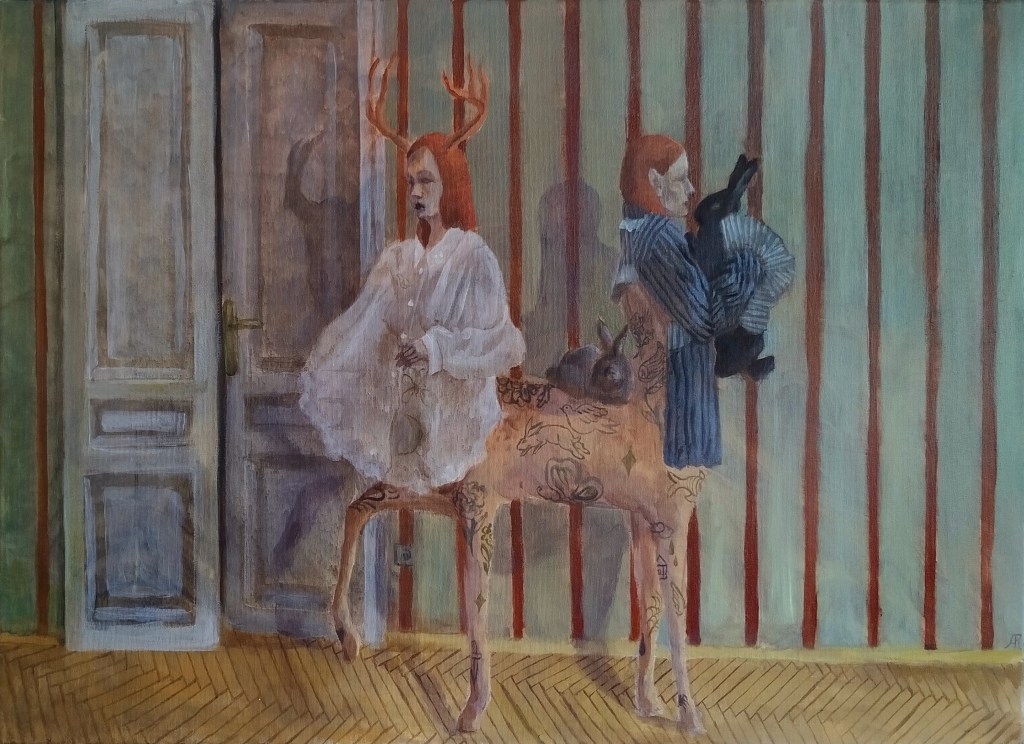
90 × 60 cm, płótno, farby akrylowe.
Artystka przedstawia siebie jako istotę o dwóch głowach – potwora, hybrydę zaczerpniętą z XVII-wiecznej ryciny. Czy niejednoznaczna tożsamość, splątane pochodzenie, doświadczenie (nie)przynależności i inności tworzą potwora?
Dwie głowy ujawniają podwójność: jednoczesne bycie potworem i opiekowanie się nim. Czy bycie potworem oznacza jednocześnie bycie tym, kto odstaje, i tym, kto próbuje się dopasować? Paski tapety zdają się wchłaniać postać, ciało częściowo wtapia się w tło, jakby chciało zniknąć w dekoracji wnętrza. A jednak biała bluzka i poroże wyraźnie odcinają się od przestrzeni, podkreślając odmienność, niemożność pełnego wtopienia się w otoczenie. Wnętrze przypomina gabinet osobliwości – przestrzeń, w której to, co odmienne, bywa wystawiane na widok.
90 × 60 cm, canvas, acrylic paint.
The artist portrays herself as a two-headed being—a monster, a hybrid drawn from a 17th-century engraving. Does an ambiguous identity, entangled origins, and the experience of (not) belonging and otherness create a monster?
The two heads reveal a duality: being the monster while also caring for it. Does being a monster mean at once being the one who stands apart and the one who tries to fit in? The stripes of the wallpaper seem to absorb the figure; the body partially blends into the background, as if it wanted to disappear into the interior’s decoration. And yet the white blouse and the antlers stand out clearly against the space, emphasizing difference—the impossibility of fully merging with the surroundings. The interior resembles a cabinet of curiosities—a space where what is different is put on display.
Text by Agata Kokoryn.
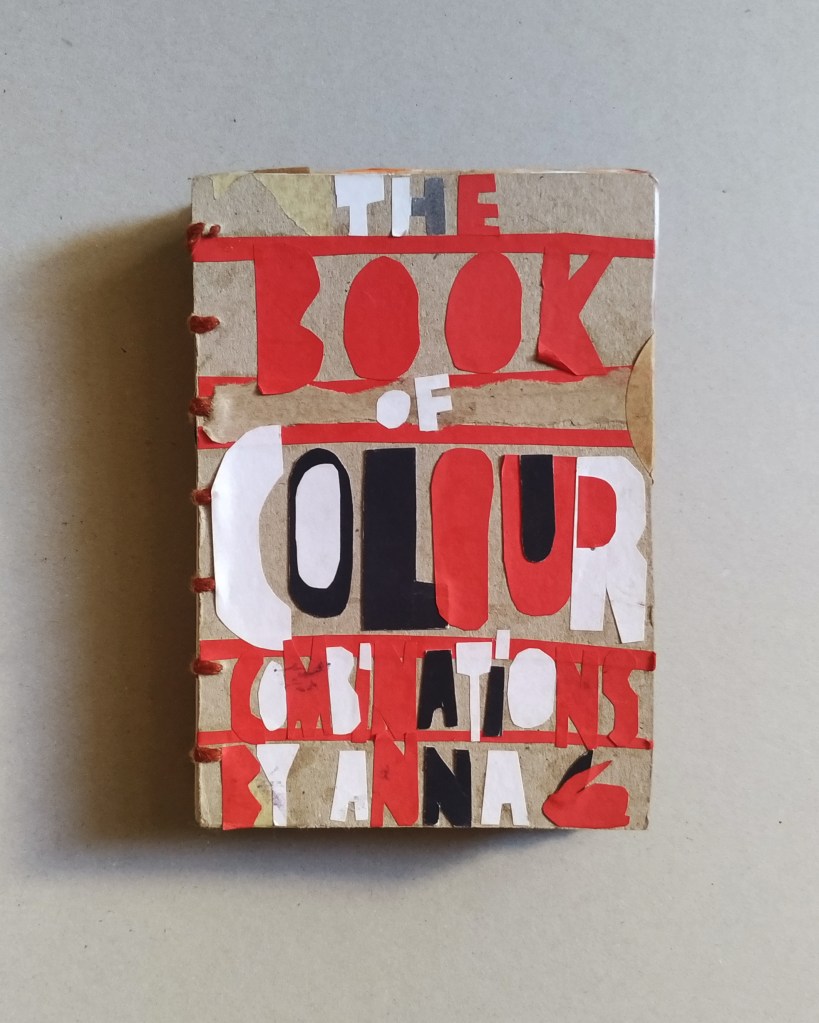
Księga kolorów / The Book Of Colour Combinations
10,5 × 15 cm, 2025 – w trakcie
10,5 × 15 cm, 2025 – ongoing
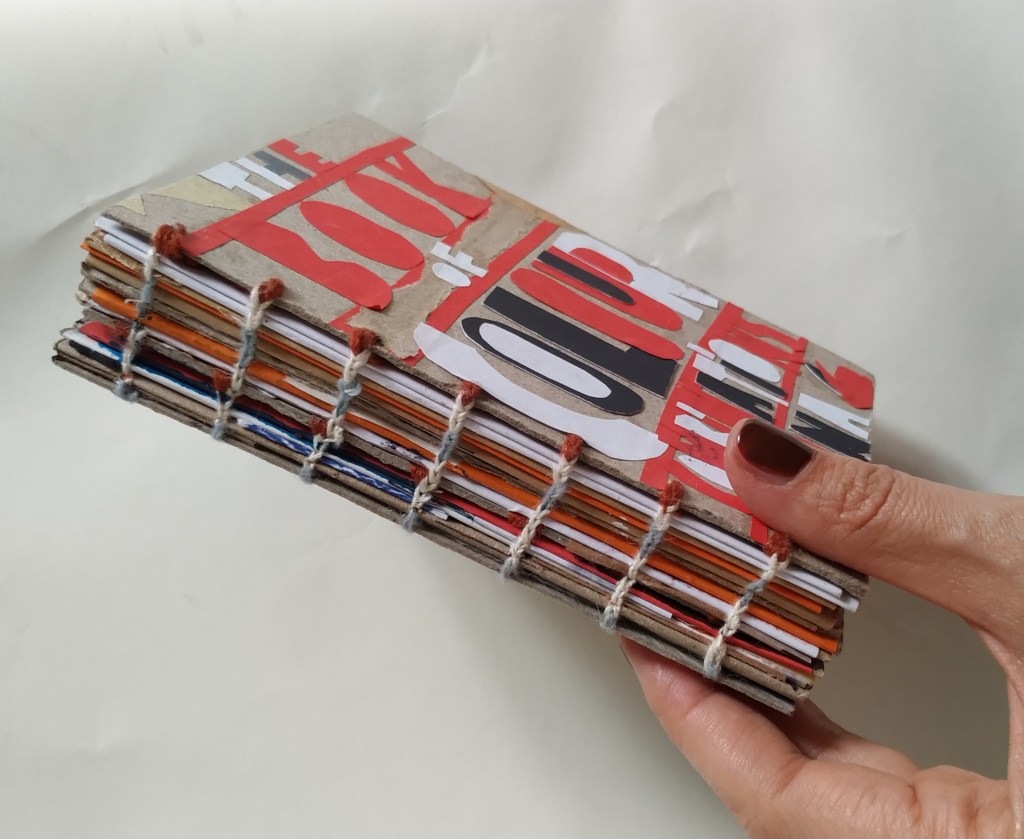
Ta maleńka książeczka zawiera serię abstrakcyjnych mikrokolaży. Każdy z nich powstał z myślą o czymś innym – czasem o obrazie, który miał dopiero powstać, czasem o sztuce innych osób, a czasem nawet o stroju. Kolaże stworzone z myślą o ubraniach później inspirowały obrazy – i odwrotnie: prace malarskie powracały do książki jako układ barw i form.
Warto zatrzymać się przy przenikających się kolorach i spróbować wyobrazić sobie formy, które za nimi stoją.
This tiny book contains a series of abstract micro-collages. Each one was created with something different in mind—sometimes a painting yet to be made, sometimes the work of other artists, and sometimes even an outfit. Collages conceived with clothing in mind later inspired paintings—and, in turn, the paintings returned to the book as arrangements of color and form.
It is worth pausing over the intermingling colors and trying to imagine the forms behind them.
Text by Agata Kokoryn.
W promieniu słońca (aka Dom) / In a Ray of Sunlight (aka Home)
50 × 40 cm, płótno, farby akrylowe, 2025.
50 × 40 cm, canvas, acrylic paint, 2025.
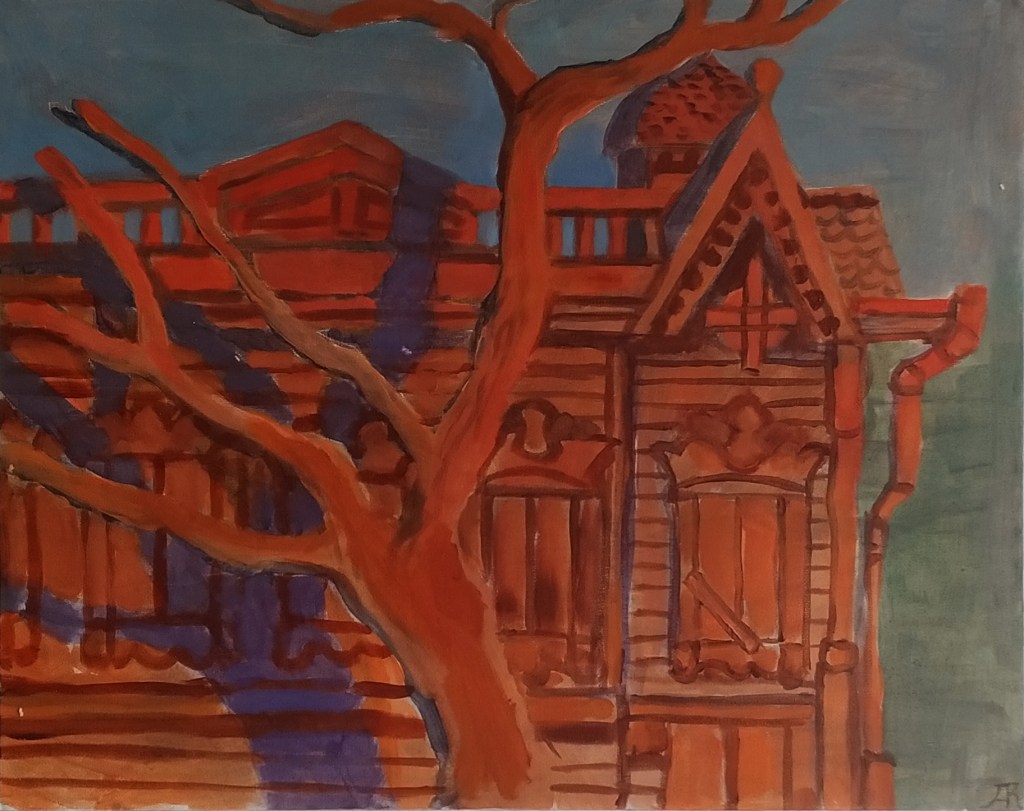
Czy kiedy myślimy o domu, mamy przed oczami jakiś jeden, konkretny budynek? Czy może wrażenie?
Na obrazie dom jest wspomnieniem – cieniem tradycyjnej drewnianej architektury rodzinnego miasta artystki, miejsca, które stopniowo znika. Domów, których jest coraz mniej: wypieranych przez nowe inwestycje, nielegalnie podpalanych przez deweloperów, zamienianych w centra handlowe, poddające się nowym projektom urbanistycznym.
Zachód słońca kładzie się na fasadzie jak blizna, ślad po czymś, co zostało naruszone, ale wciąż trwa w pamięci. Cień nie jest tu tylko efektem światła, lecz znakiem utraty, napięcia pomiędzy tym, co było, a tym, co znika. Wraz z domami znikają drzewa, znika otoczenie, cała więcej-niż-ludzka wspólnota miejsca. Dom i przyroda wydają się jednością – splecioną historią, która rozpada się pod presją zmian.
Może to opowieść o tęsknocie za domem, który nigdy nie był w pełni osiągalny, a jednak pozostaje obecny, jak cień, jak ślad, jak miejsce zapisane w ciele i pamięci.
When we think of home, do we picture a single, specific building? Or rather a feeling?
In the painting, the home is a memory—a shadow of the traditional wooden architecture of the artist’s hometown, a place that is gradually disappearing. Houses that are becoming fewer and fewer: displaced by new developments, illegally set on fire by developers, turned into shopping centers, or yielding to new urban plans.
The sunset falls across the façade like a scar, a trace of something that has been damaged, yet still persists in memory. The shadow here is not merely an effect of light, but a sign of loss—a tension between what once was and what is vanishing. Along with the houses, the trees disappear, the surroundings fade, the entire more-than-human community of the place dissolves. Home and nature seem to be one—a shared history, intertwined, now breaking apart under the pressure of change.
Perhaps it is a story of longing for a home that was never fully attainable, yet remains present—like a shadow, like a trace, like a place inscribed in the body and in memory.
Text by Agata Kokoryn.
Motanka z królikiem / Motanka-doll with rabbit
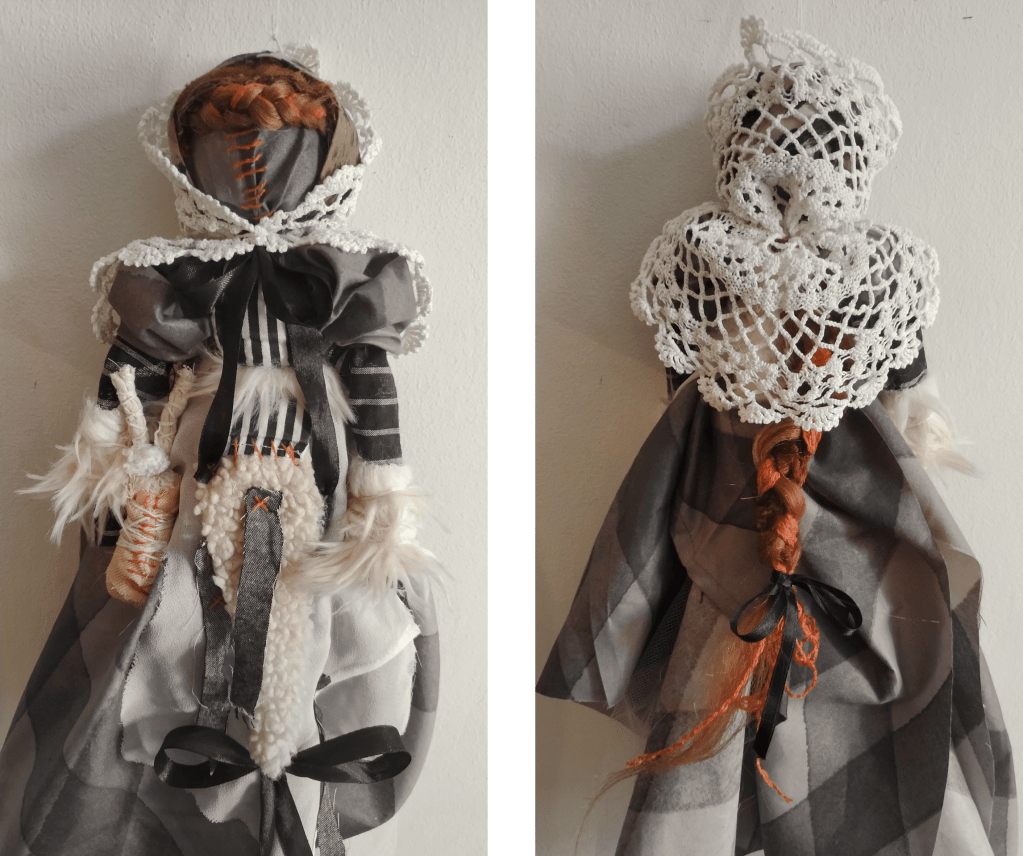
40 × 10 × 7 cm
odpady tekstylne
Lalka została wykonana w tradycyjnej słowiańskiej technice lalek bez szycia (z niewielkimi wyjątkami dekoracyjnych ściegów). Powstała ze skrawków materiałów pozostałych po rzeźbie Creature oraz innych pracach tekstylnych prezentowanych na wystawie (ksiąga Potwora, ksiąga Potwora kurtka oraz ubraniach).
Tworzenie lalek motanek jest istotną częścią praktyki artystycznej Anny Rabbit — to obiekt, który można uformować z dowolnych resztek tkanin pozostających po większych projektach. Reprezentują one ideę zero waste w sztuce oraz szacunek wobec naszej planety.
Lalki motanki często wykonywane są z dzieckiem, jednak ta posiada zamiast niego królika.
40 × 10 × 7 cm
textile waste
The doll is created using a traditional Slavic no-sew technique (with a few decorative stitching exceptions). It is made from scraps of material left over from the Creature sculpture and other textile works presented in the exhibition (the Creature book, the Creature book jacket, and the garments).
The creation of motanka dolls is an essential part of Anna Rabbit’s practice. They are objects that can be shaped from any textile remnants left behind after a larger project, embodying a zero-waste approach in art and a respect for our planet.
Motanka dolls are often made with a child, but this one features a rabbit instead.
Niedzielny poranek / Sunday morning
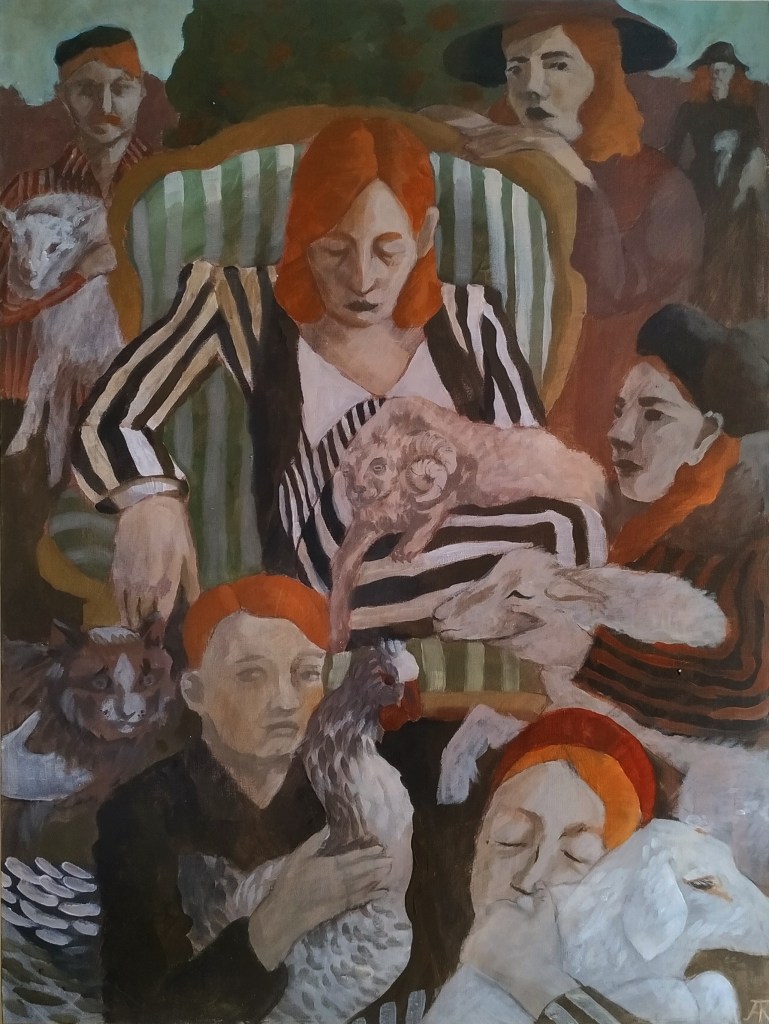
50 × 70 cm, płótno, farby akrylowe.
W opowiadaniu Kafki niedzielny poranek to dzień odwiedzin. Zwierzę siedzi nieruchomo na kolanach człowieka, otoczone przez przybywające dzieci. Przynoszą one zwierzęta i czekają, na co? Czy mają nadzieję, że zwierze odkryje swój gatunek, przynależność? Czy chciałyby, aby stało się konkretne, jakieś, pasujące do konkretnej kategorii? Czy przeszkadza im jego stan pomiędzy?
Choć to jedno zwierzę ma być samotne, inne lgną do ludzi, wtulają się, szukają kontaktu, choć mają wokół siebie przedstawicieli swojego rodzaju – ludzkich i zwierzęcych. Jednak jednoczą się w międzygatunkowej parze.
Czy ludzie należą do tej samej kategorii, jednego stada? Wszystkie osoby mają ten sam kolor włosów, co by się stało, gdyby jedno z nich miało inny? Czy dalej by pasowały?
50 × 70 cm, canvas, acrylic paint.
In Franz Kafka’s story, Sunday morning is a day of visits. The animal sits motionless on a person’s lap, surrounded by arriving children. They bring animals and wait—but for what? Do they hope the animal will reveal its species, its belonging? Would they like it to become something definite, something that fits into a clear category? Does its in-between state disturb them?
Although this one animal is meant to be solitary, others are drawn to humans, nestling against them, seeking contact, even though they are surrounded by members of their own kind—both human and animal. And yet they come together in an interspecies pair.
Do humans belong to the same category, to a single herd? All the figures have the same hair color—what would happen if one of them were different? Would they still fit?
Text by Agata Kokoryn.
Potwór / Creature (aka Familiar)
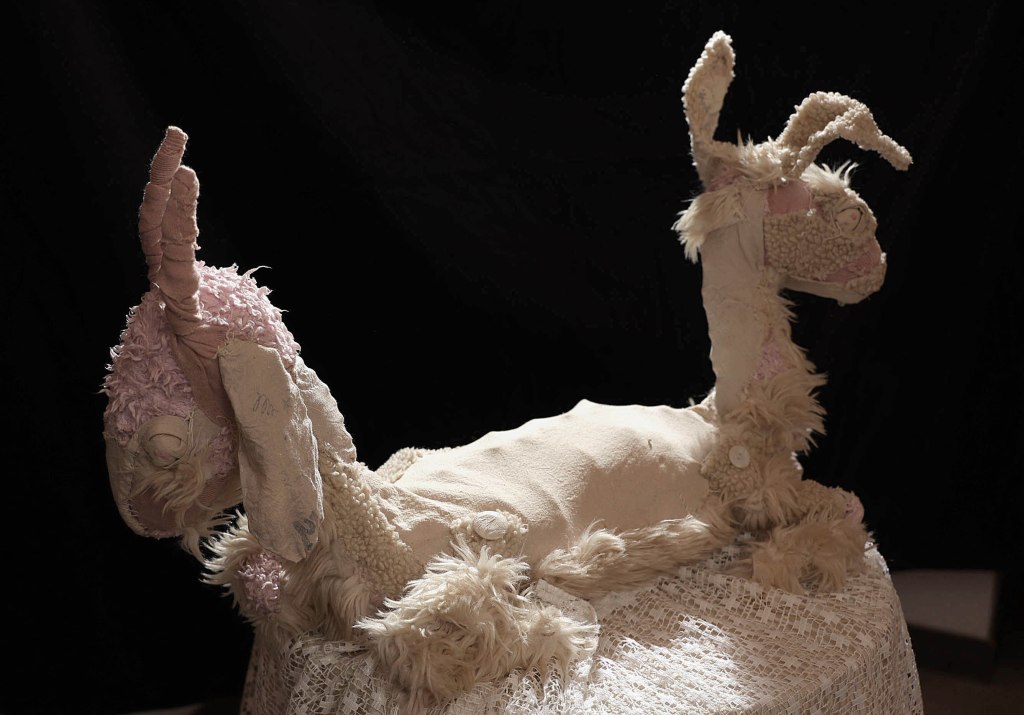
Rzeźba miękka, odpady tekstylne, plastik, drut metalowy, 60 × 40 × 37 cm
2026
Fotografia: Tadeusz Kieć.
Jakie emocje wzbudza w nas to zwierzę? Czy chcemy je dotknąć, pogłaskać czy może raczej odwrócić wzrok?
Potwór zaprasza do kontaktu. Warto go dotknąć, wyczuć pod palcami kręgosłup i żebra, zagłębić dłoń w miękkiej sierści, spróbować spojrzeć mu w dwie pary oczu. Rzeźba została wykonana z materiałów z odzysku: skóra i futro powstały ze starej, dziecięcej piżamy oraz ze swetra. Jej wnętrzności tworzą plastikowe opakowania po żwirku do kuwet królików, żebra – znaleziony na śmietniku drut, a kręgi kręgosłupa to sztuczne perły. Ciało Potwora składa się z fragmentów codzienności i historii milcząco zamkniętych w przedmiotach.
Co czujemy, kiedy dotykamy zwierzęcia, które nie jest żywe, a jednak przypomina żywą istotę? Czy pojawia się intymność, odruch bliskości? Pomysł na tę rzeźbę wyrasta z refleksji nad potrzebą przytulania i dotyku. Czy musi to być kontakt z żywym ciałem, aby gest został rozpoznany jako akt troski? Podobnie jak dzieci nadają osobowość misiom i lalkom, traktując je jak realne istoty, tak i my projektujemy więź tam, gdzie pojawia się forma gotowa do przyjęcia czułości. Interakcja z obiektem staje się lustrem naszego zachowania wobec zwierząt. Sama rzeźba niczego nie czuje – sposób traktowania nie ma dla niej znaczenia. A jednak my możemy coś poczuć, wchodząc z nią w relację.
Zwierzę jest hybrydą królika i kozy: ma dwie głowy i cztery przednie łapy. Łączy w sobie napięcie pomiędzy odwagą a płochliwością i przebojowością a chęcią ucieczki. Dla artystki to właśnie te dwa gatunki są najbliższe. Potwór staje się odbiciem jej własnej osobowości. Gdyby odziedziczyła jakieś zwierzę, wyglądałoby ono właśnie tak. Jakbyśmy się czuli, współdzieląc codzienność z taką hybrydą? Jak wyglądałoby nasze odziedziczone zwierzę?
Na białej sierści widoczne są drobne czerwone kropki. To „podpis” krwią artystki, która podczas szycia wielokrotnie przypadkowo raniła się igłą. Jej ciało staje się częścią procesu, materialnym śladem obecności. To znak zespolenia, ale też przypomnienie, że Potwór nie jest jedynie obiektem, a zapisem pracy, bliskości i ryzyka dotyku.
Soft sculpture, textile waste, plastic, metal wire, 60 x 40 x 37 cm
2026
Photograph by Tadeusz Kieć.
What emotions does this animal evoke in us? Do we want to touch it, to stroke it, or rather to look away?
The Monster invites contact. It is worth touching—feeling its spine and ribs under your fingers, sinking your hand into its soft fur, trying to meet its two pairs of eyes. The sculpture is made from reclaimed materials: the skin and fur come from an old children’s pajama set and a sweater. Its insides are formed from plastic packaging from rabbit litter, its ribs from wire found in the trash, and the vertebrae of its spine are artificial pearls. The body of the Monster is composed of fragments of everyday life and histories silently enclosed within objects.
What do we feel when we touch an animal that is not alive, and yet resembles a living being? Does a sense of intimacy appear, an instinct for closeness? The idea for this sculpture grows out of a reflection on the need for hugging and touch. Must it be contact with a living body for the gesture to be recognized as an act of care? Just as children assign personalities to teddy bears and dolls, treating them as real beings, we too project connection wherever a form appears ready to receive tenderness. Interaction with the object becomes a mirror of our behavior toward animals. The sculpture itself feels nothing—the way it is treated makes no difference to it. And yet we may feel something when we enter into a relationship with it.
The animal is a hybrid of a rabbit and a goat: it has two heads and four front legs. It combines a tension between courage and skittishness, boldness and the urge to flee. For the artist, these two species feel closest. The Monster becomes a reflection of her own personality. If she were to inherit an animal, it would look like this. How would we feel sharing our everyday life with such a hybrid? What would our inherited animal look like?
On the white fur, small red dots are visible. They are a “signature” made from the artist’s blood, as she repeatedly pricked herself with a needle while sewing. Her body becomes part of the process, a material trace of presence. It is a sign of fusion, but also a reminder that the Monster is not merely an object, but a record of labor, closeness, and the risk of touch.
Text by Agata Kokoryn.
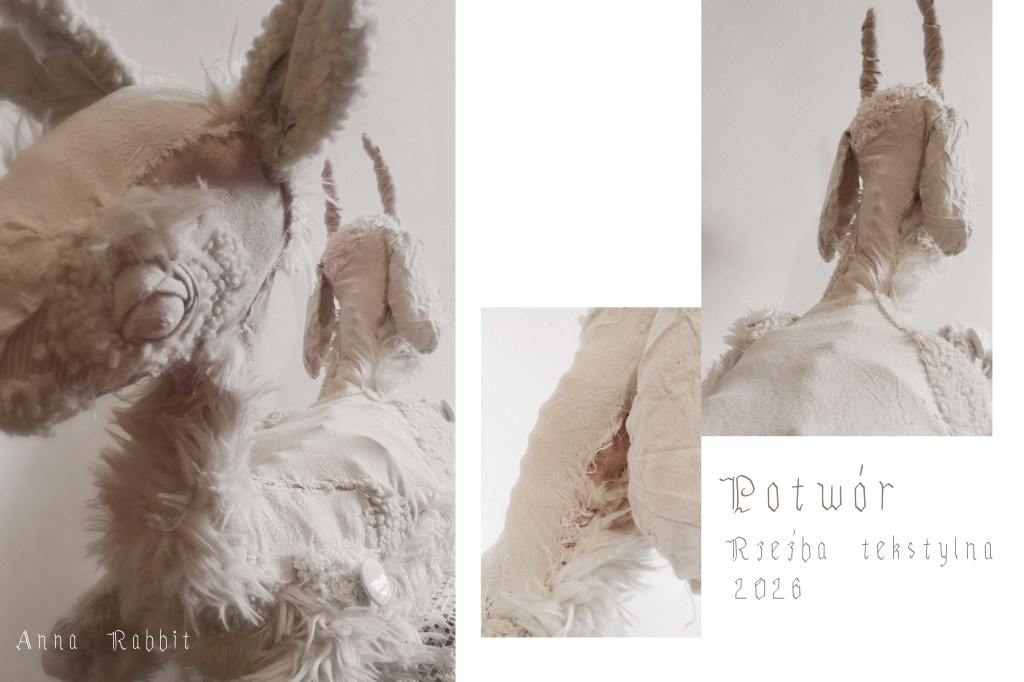
Photographs by Anna Rabbit.
Portret klucza / Portrait of a Key
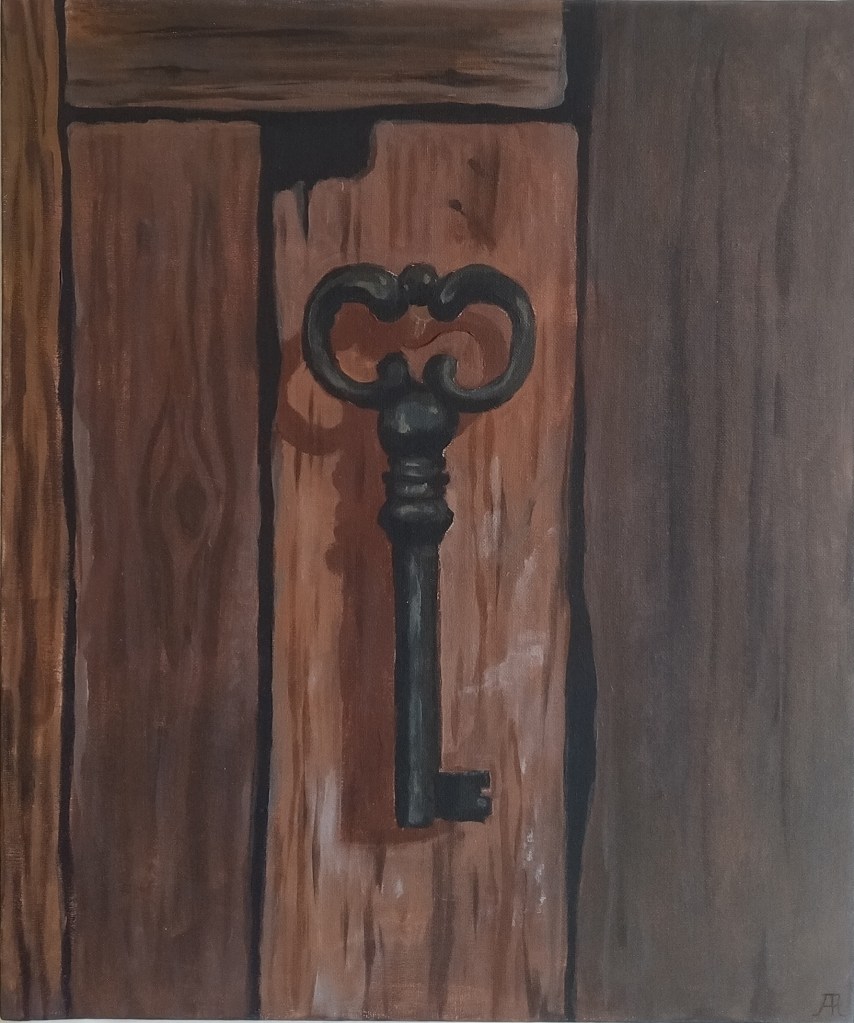
50 × 40 cm, płótno, farby akrylowe, 2025.
Z czym kojarzy się klucz? Co otwiera? Czy daje prawo do wejścia? Stania się częścią tego, co w środku? Czy sprawia, że coś do nas należy?
Ten klucz nie prowadzi do jednego miejsca. Nie ma przypisanego zamka, nie wskazuje konkretnych drzwi. Zawieszony na ścianie staje się raczej pytaniem? Na wystawie wiszą dwa klucze – z pozoru niemal identyczne, w rzeczywistości jednak różne. Co więcej, nie są to klucze do drzwi wejściowe, a do szafy. Artystka tym samym sugeruje, że dom może istnieć w rzeczach, miejscach, meblach, ludziach. Czymś ruchomym i niejednoznacznym.
Klucz jest ważnym symbolem w twórczości artystki, odnosi go do idei dostępu, prawa do bycia częścią jakiejś wspólnoty. Przez długi czas Anna Rabbit uważała, że takim kluczem jest język, w jej przypadku polski. Jednak przekonała się, że sama znajomość języka nie zawsze wystarcza, by poczuć się w pełni akceptowaną i przynależną.
Klucz w Portrecie klucza przypomina zwierzę: ma w sobie coś organicznego, czujnego, nieoczywistego. Staje się hybrydą, przedmiotem i istotą zarazem, symbolem tęsknoty za miejscem, które nie zawsze istnieje jako jednoznaczne „tu”.
50 × 40 cm, canvas, acrylic paint, 2025.
What does a key make us think of? What does it open? Does it grant the right to enter – to become part of what is inside? Does it make something belong to us?
This key does not lead to a single place. It has no assigned lock, it does not point to any specific door. Suspended on the wall, it becomes more of a question. In the exhibition, two keys are displayed – seemingly almost identical, yet in fact different. Moreover, they are not keys to a front door, but to a wardrobe. In this way, the artist suggests that a home can exist in objects, places, furniture, and people – something mobile and ambiguous.
The key is an important symbol in the artist’s practice, relating to the idea of access and the right to belong to a community. For a long time, Anna Rabbit believed that such a key was language – in her case, Polish. However, she came to realise that knowing a language is not always enough to feel fully accepted and to belong.
The key in Portrait of a Key resembles an animal: it has something organic, alert, and elusive about it. It becomes a hybrid – both object and creature – a symbol of longing for a place that does not always exist as a clearly defined “here.”
Text by Agata Kokoryn.
Księga Stworzeń (artbook) / The Book of Creatures (artbook)
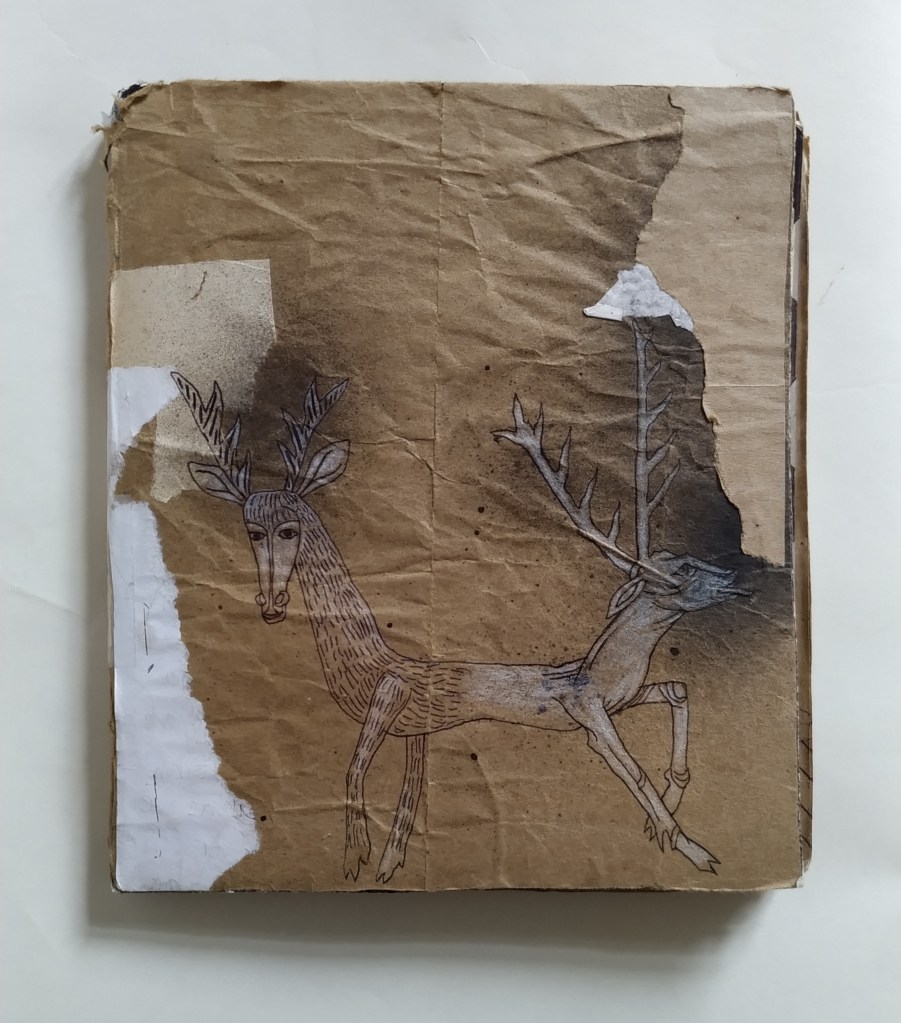
35 × 35 cm, 52 strony, 2024-2025.
Zaglądając do Księgi Stworzeń, wnikamy w świat relacji ludzko-nie-ludzkich. Artystka przygląda się sieci powiązań pomiędzy gatunkami, bada napięcia, bliskości i formy współistnienia. To szkicownik jako bestiariusz: zbiór istot, znaków i hybryd, które nie dają się jednoznacznie nazwać, ale otwierają przestrzeń wspólnego, więcej-niż-ludzkiego, świata.
35 × 35 cm, 52 pages, 2024-2025.
By looking into The Book of Creatures, we enter a world of human–non-human relationships. The artist examines a network of connections between species, exploring tensions, intimacies, and forms of coexistence. It is a sketchbook as a bestiary: a collection of beings, signs, and hybrids that resist clear definition, yet open a space for a shared, more-than-human world.
Text by Agata Kokoryn.
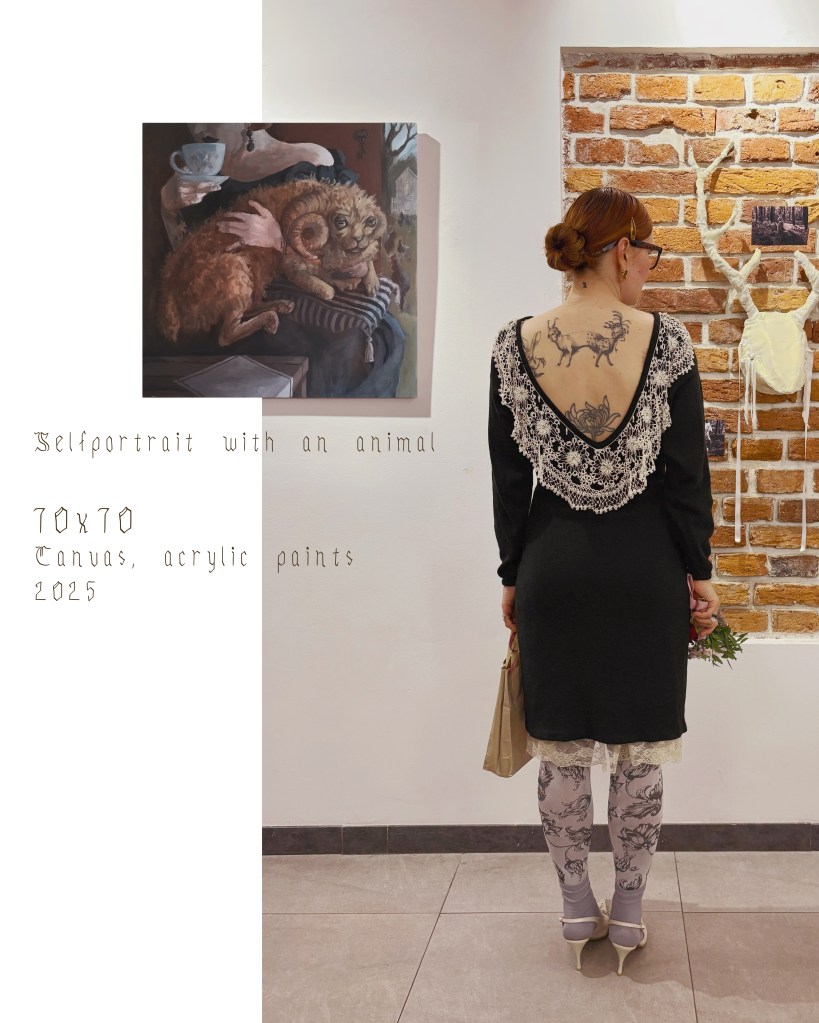
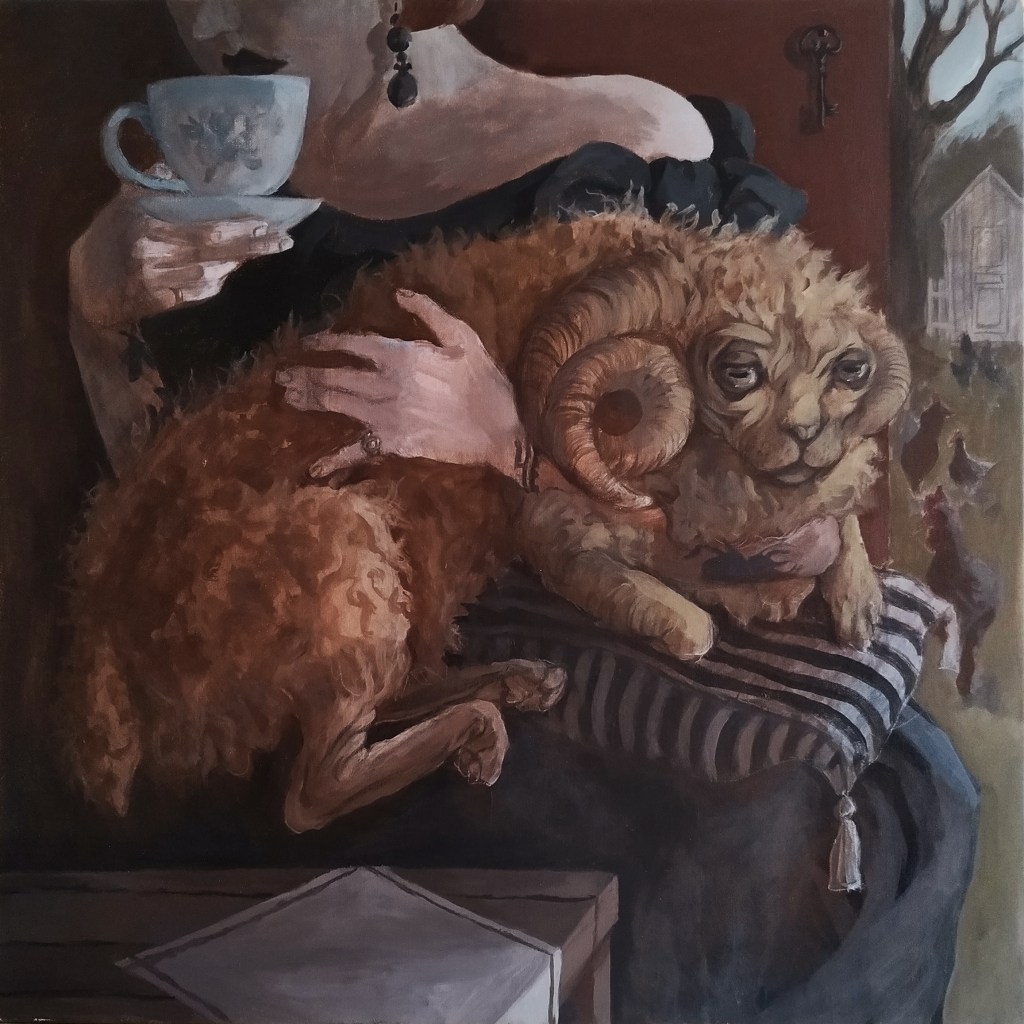
Autoportret ze zwierzęciem / Self-portrait with an animal
70 × 70 cm, płótno, farby akrylowe, 2025
Kim jest osoba opowiadająca historię? W opowiadaniu napisanym w języku niemieckim nie ma wskazania na płeć. Czy mógłby to być każdy z nas? Nie widzimy twarzy autorki, to zwierzę jest głównym bohaterem/bohaterką obrazu, to jego portret. Czy jesteśmy w stanie jednoznacznie zobaczyć, czego to jest krzyżówka?
Zwierzę siedzi na kolanach autorki. Czy jest mu dobrze? Czy kontakt z człowiekiem jest dla niego przyjemnością? Czy może cierpi w bezruchu? Czy trzymająca go ręka jest czuła i przytulająca czy ograniczająca ruch, panująca?
70 × 70 cm, canvas, acrylic paints, 2025
Who is the person telling the story? In the text, written in German, there is no indication of gender. Could it be any of us? We do not see the author’s face; the animal is the main subject of the image — it is its portrait. Are we able to clearly determine what kind of crossbreed it is?
The animal is sitting on the author’s lap. Is it comfortable? Does it enjoy contact with a human? Or perhaps it suffers in stillness? Is the hand holding it gentle and embracing, or restraining, controlling its movement?
Text by Agata Kokoryn.
Textile sculpture by Anna Rabbit, 3 parts. Doll – 43x20x20 cm, textile Carnival squash – 8x8x8 cm, textile. Mini-book – A6, paper. http://www.annarabbit.com Currently in the collection of the Kraków Toy Museum – https://muzeumzabawekrakow.pl/
In a world overflowing with textile waste, I made a promise—to take responsibility for every piece of fabric that comes into my life. Sometimes, I even welcome the discarded scraps of others (more on that in a moment). Donating clothes is no longer the perfect solution—if it ever truly was. Landfills and the coastlines of developing countries are now heavy with the weight of our unwanted garments. I decided to fight back—one doll at a time.
These artworks are now part of the collection of Fundacja Żydowski Lublin and was first presented during the opening event of the project Mój Lublin. The program combines past and present, encouraging people to rediscover ulica Lubartowska and its rich cultural heritage.
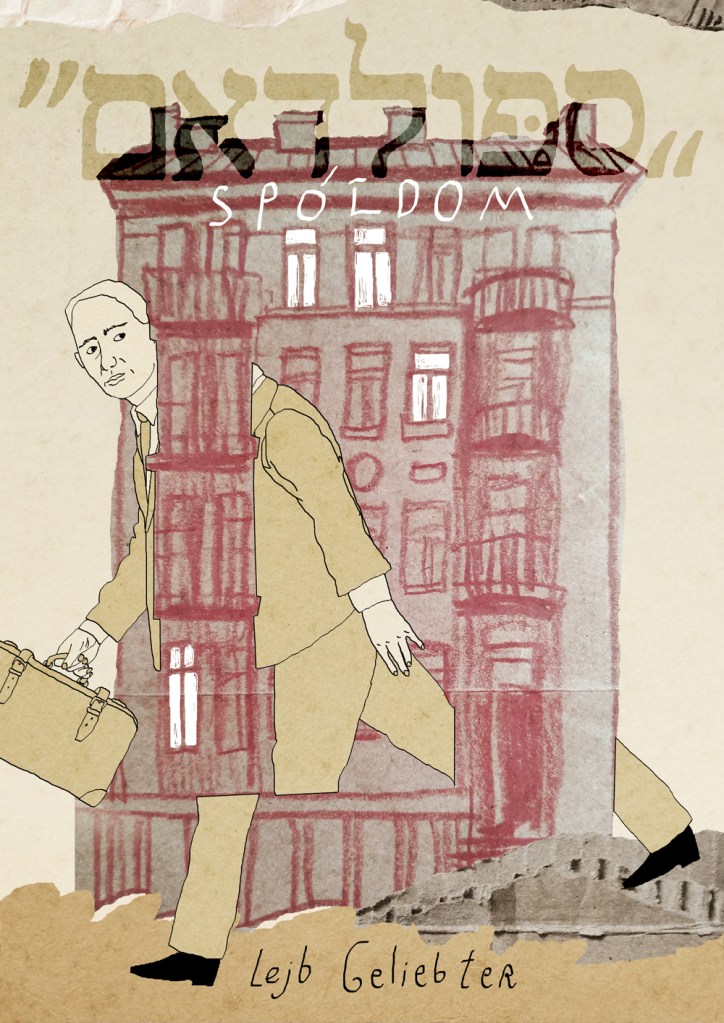
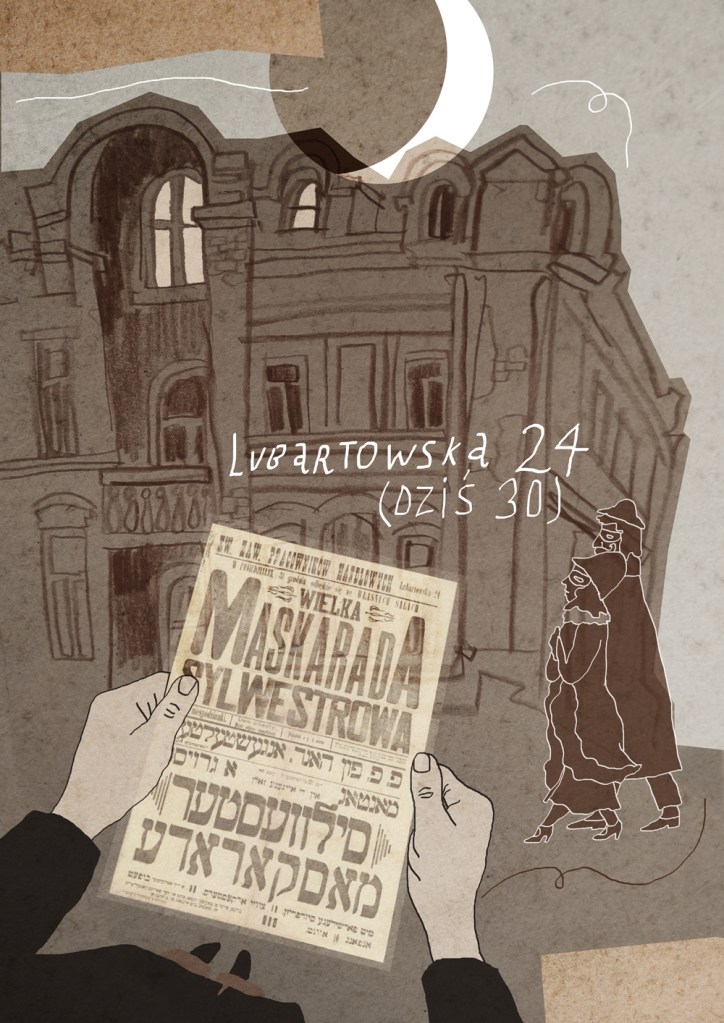


This is another of my “travel” sketchbooks, a short one, only 13 pages, all dedicated to Jewish heritage buildings in Lublin, Poland.
This new sketchbook on Lublin is different: it’s rooted in place and history, but it still carries that sense of traveling through drawing. Every page is focused on the Jewish heritage of the city, a way for me to explore and reinterpret its cultural memory through illustration.
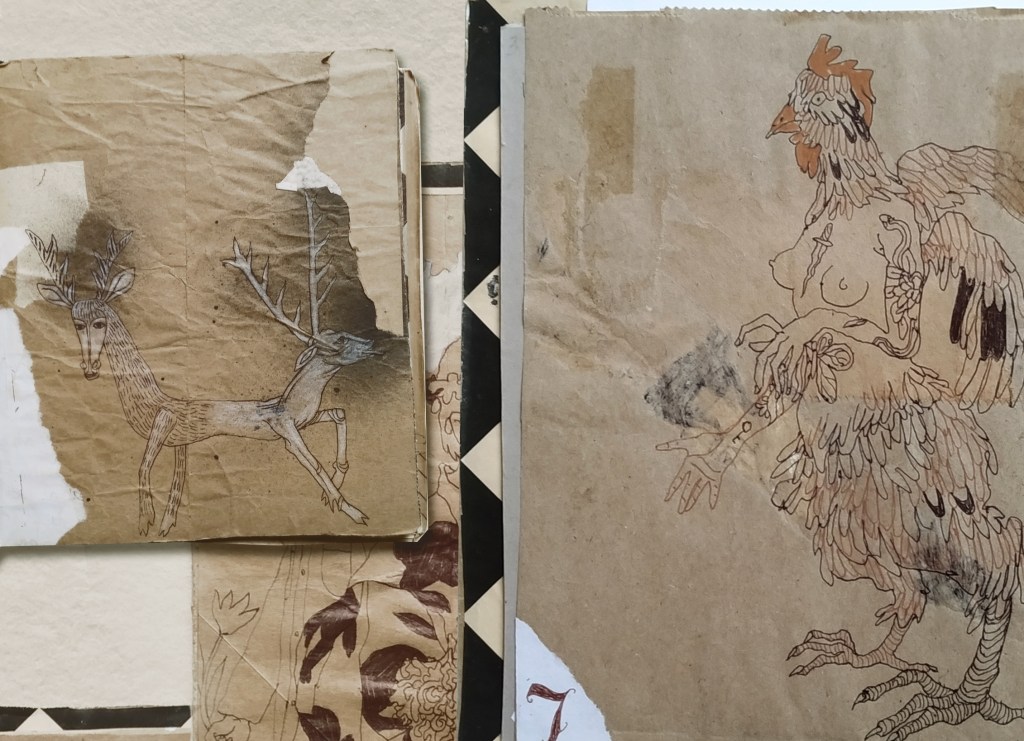
The Creature Book
This sketchbook was created as part of my diploma project at the Jan Matejko Academy of Fine Arts in Kraków
Faculty of Painting, Postgraduate Studies 2023–2025
Diploma supervisor: Prof. Dr. Hab. Grzegorz Sztwiertnia
The Creature Book
This book (18.5 × 21.5 cm) features on its cover a strange creature based on the tattoo on my back — itself inspired by an eighteenth-century engraving. Inside are illustrations exploring the relationship between humans and animals.
Most of these drawings were never developed into larger works, which is why I treat this book as an independent artwork rather than a preparatory sketchbook. This is reinforced by the fact that most of its pages contain fully finished illustrations rather than sketches.
52 pages
“Braciszek i Siostrzyczka”, film by Wojtek Łubianka, Anna Rabbit & Mariusz Szydel.
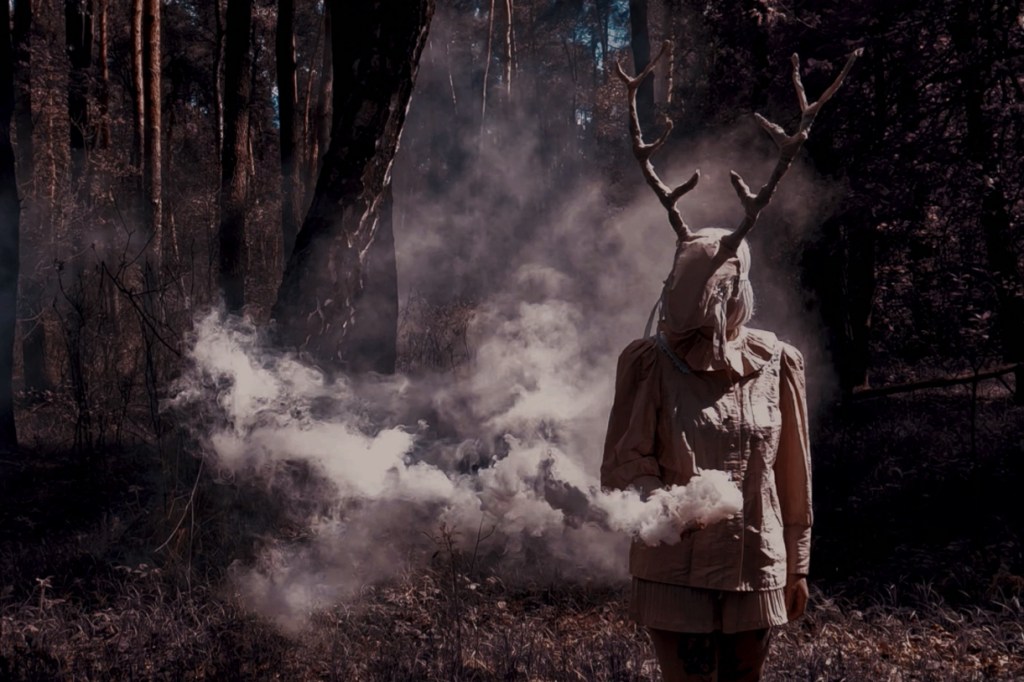
Film zrealizowany w ramach zajęć Pracowni Interdyscyplinarnej pod kierunkiem dr hab. Joanny Kaiser-Plaskowskiej oraz mgr Agnieszki Sajdy na Akademii Sztuk Pięknych w Krakowie. 2025 … Our short film Braciszek i Siostrzyczka is a collaborative experimental work, loosely inspired by the early part of the Brothers Grimm fairytale Brother and Sister. Rather than attempting a faithful adaptation, we approach the narrative as a symbolic framework — a haunted echo — enabling a contemporary exploration of transformation, pursuit, and entanglement within family bonds and forested spaces.
For Anna Rabbit, sketchbooks and artbooks are an essential part of her creative process. They offer a space to experiment, explore ideas, and document her artistic journey. These personal collections allow Anna to work freely, without the constraints of traditional art spaces, capturing raw moments of creativity and transformation.
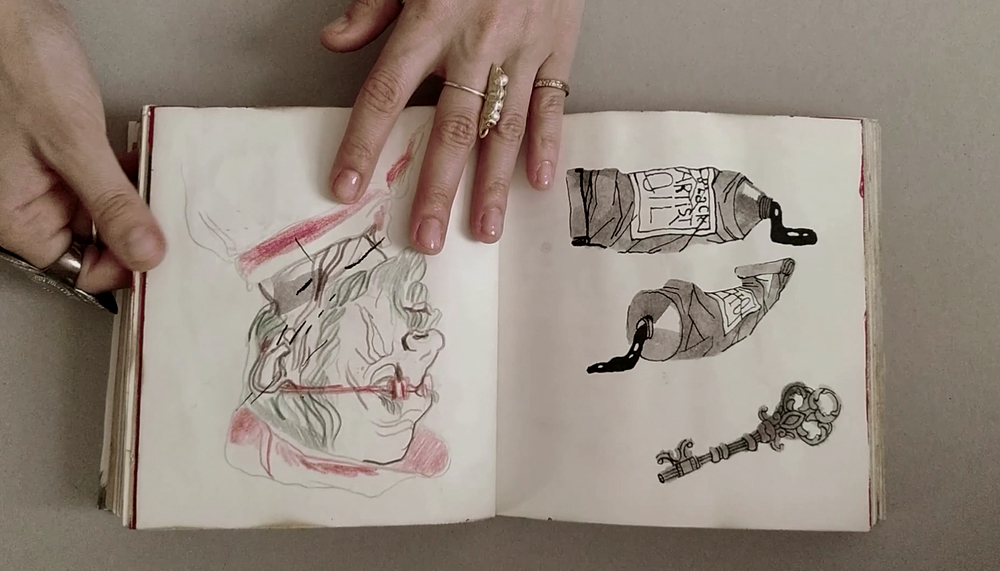
Flipping through this sketchbook, which I worked on between 2023 and 2025, feels a bit like stepping into a fragmented diary—one that doesn’t follow a clear timeline but instead jumps between memories, characters, and fleeting moments. There’s no single theme holding it all together, but a quiet thread runs through: observation, reflection, and imagination. Many of the pages are filled with animal sketches—some drawn from life, others from memory or dreams. There are also dozens of figure drawings, quick and raw, done during model classes at ASP Kraków. One of the more personal pages is a portrait of my mom’s cousin as an adult he never became—someone I never met, someone who died young, before he had the chance to become the adult he might have been. Scattered throughout are quotes from Bulgakov and Dostoevsky—lines that echoed in my head while drawing, or that I scribbled down because they made the world feel more bearable, or stranger, or truer. One spread shows a small moment: me and a friend (who hates umbrellas) walking together beneath one anyway. Another page holds a portrait of a witch with a toad. There’s also work from a book project I illustrated in 2024—Kafka’s A Hunger Artist. The drawings from that series are quieter, more restrained, but still a part of the same universe this sketchbook comes from. Some of these pages feel deeply personal; others are just playful or experimental. It’s not a perfect sketchbook, but it’s honest—and every drawing, even the ones I’d rather hide, is a kind of note to myself.
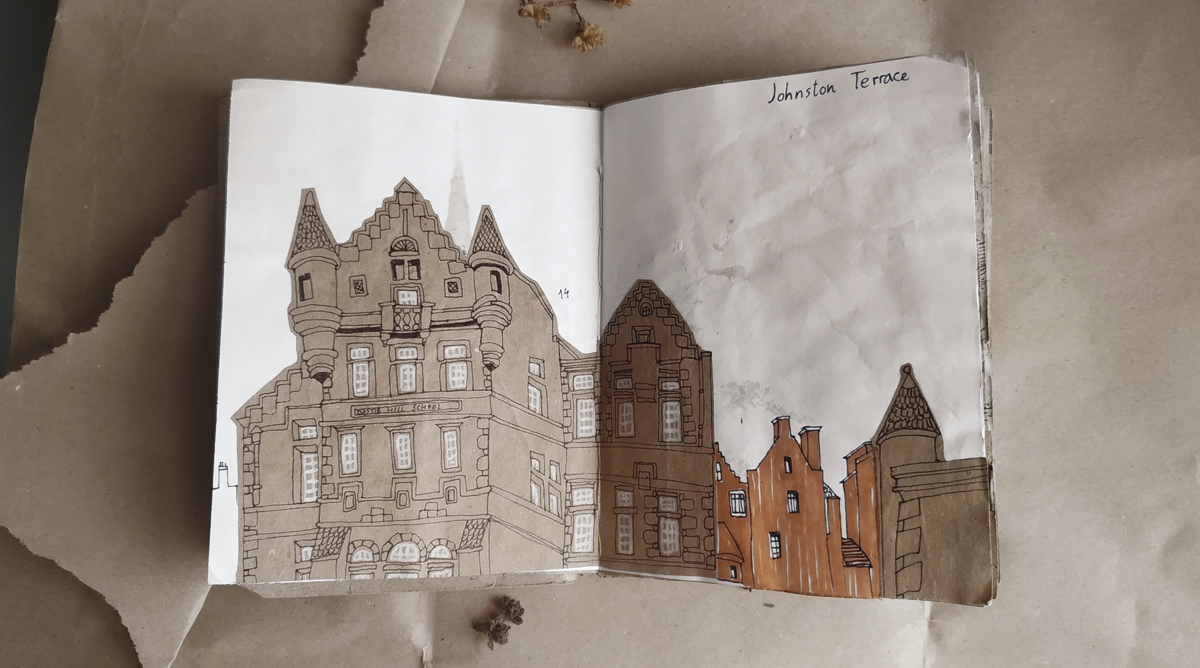
Flipping through my sketchbook, which I started sometime during the pandemic and completed last year. During that time, I struggled with agoraphobia and couldn’t leave the house. To cope, I came up with this little project—choosing Edinburgh at random (I had never been there, but I knew it was beautiful)—where I would create travel sketches by “walking” through an unfamiliar city using Google Street View. I filled about 80% of the notebook during the pandemic but then abandoned it until last year, when I showed it to a relatively new friend—who, coincidentally, is from Edinburgh. When I first started this project, I didn’t know them yet. All of the dried plants are from my pen pal in Edinburgh (someone I met on Instagram but have never met in person), who was kind enough to collect them and send them to me in a letter. Most of them are glued onto the pages with drawings of places where they were originally found. Some of the sketches were added later at the request of my new friend from Edinburgh—depicting the street he grew up on, his high school, and other personal landmarks. To this day, I still struggle greatly with the fear of leaving my house, especially when it comes to traveling. I haven’t left the country since 2020. And I still have never been to Edinburgh.
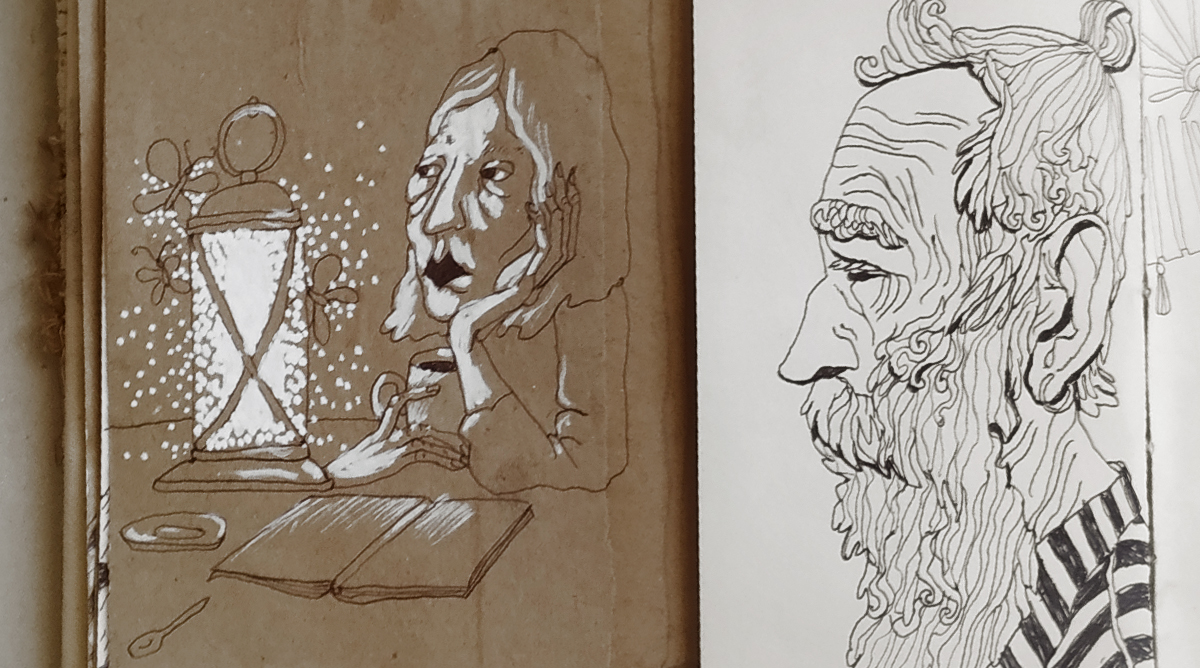
Flipping through my sketchbook, which I started sometime in January 2024 and completed on March 19, 2025. It contains some random illustrations, as well as artwork I created for illustrating The Hunger Artist (a short story by Franz Kafka) and Crossbreed (another short story by Kafka). There’s also a sketch from Massolit bookstore/café in Kraków, Poland, linocut stamps I made for my friends and family, and many other things.
Anna hosts workshops on sketchbook creation; check it out if you are interested in sketchbooks and artbooks.
Curator: Artur Wabik.
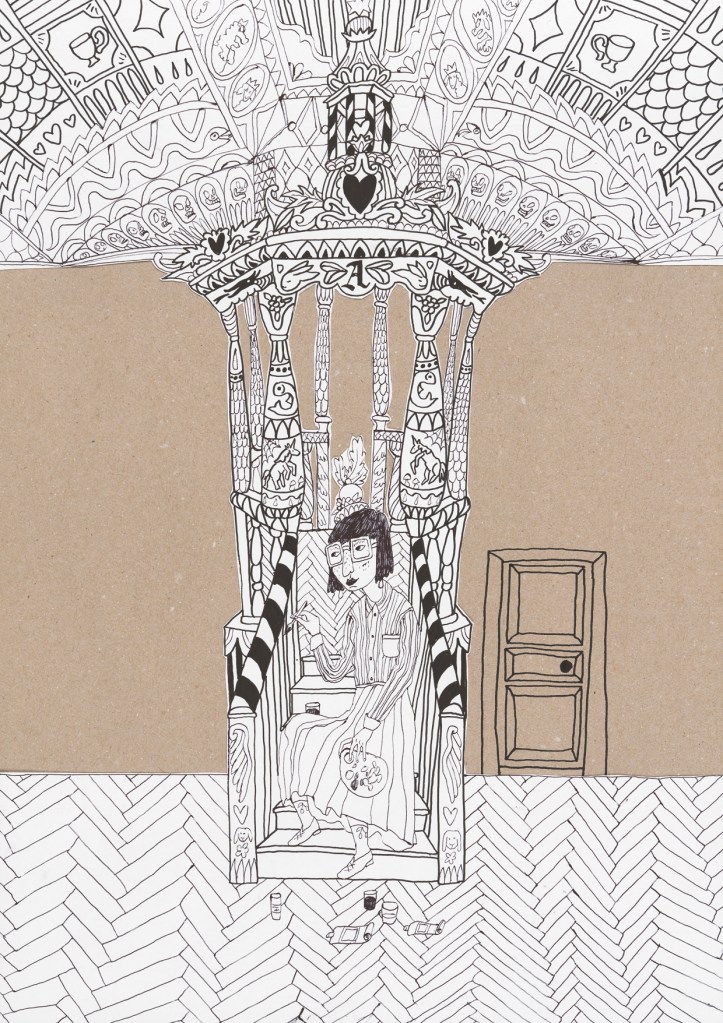
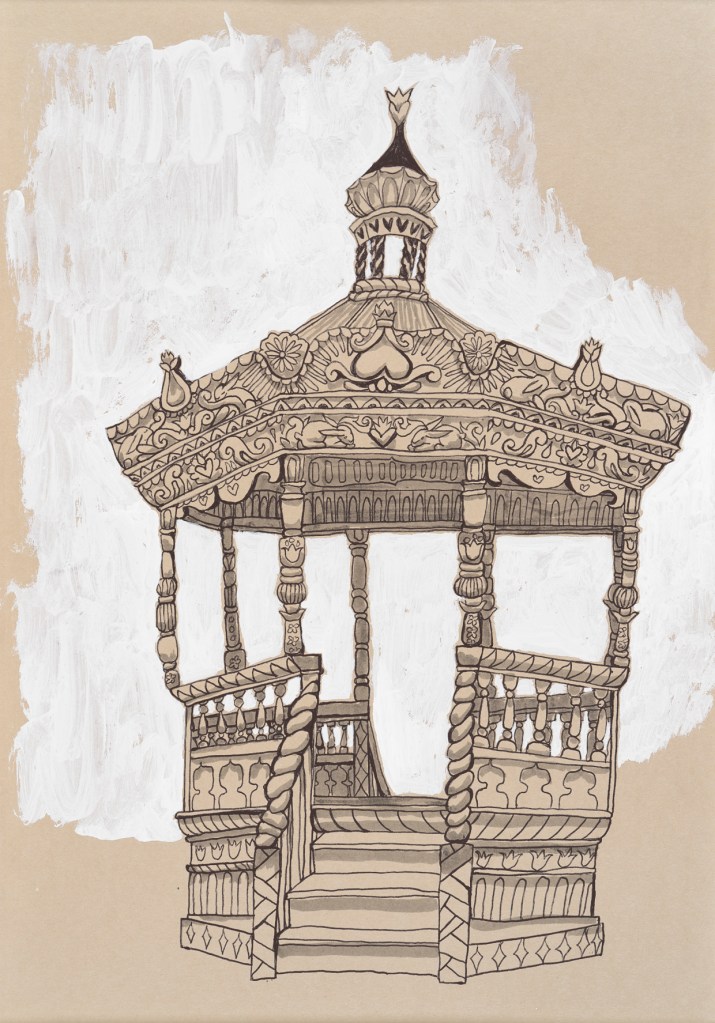
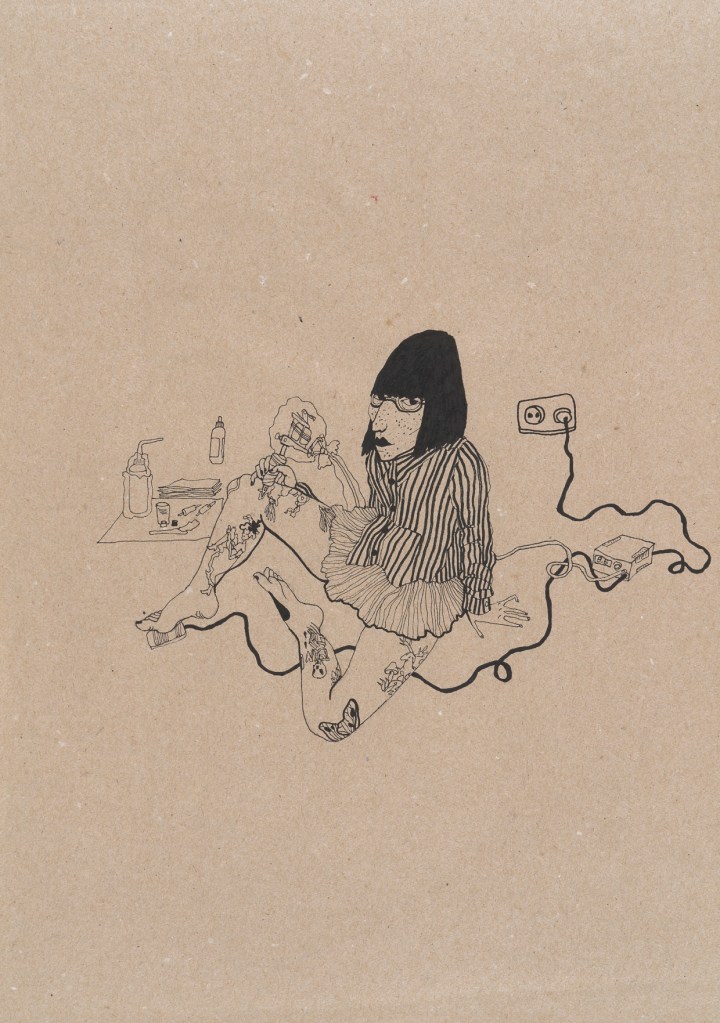
The exhibition features illustrations in which the artist continues her long-standing reflections on her identity.
Inspired by the phrase “my body is my temple,” she has created a series of illustrations where tattoo aesthetics collide with traditional decorations of the bimah – a raised platform in a synagogue, often adorned with a canopy or dome. Carved, polychromed beams, columns, and balustrades are to the artist like clavicles, hips, and feet – elements of a structure whose meaning is revealed only when viewed as a whole. The narrative also includes the artist’s memories of her family home and childhood. The comic-like series was prepared specifically for this occasion.
Some of the works from this exhibit are available for sale to institutions or private collectors. Please send request to annarabbit.contact@gmail.com
The exhibition was open from June 23 to July 7, 2024.
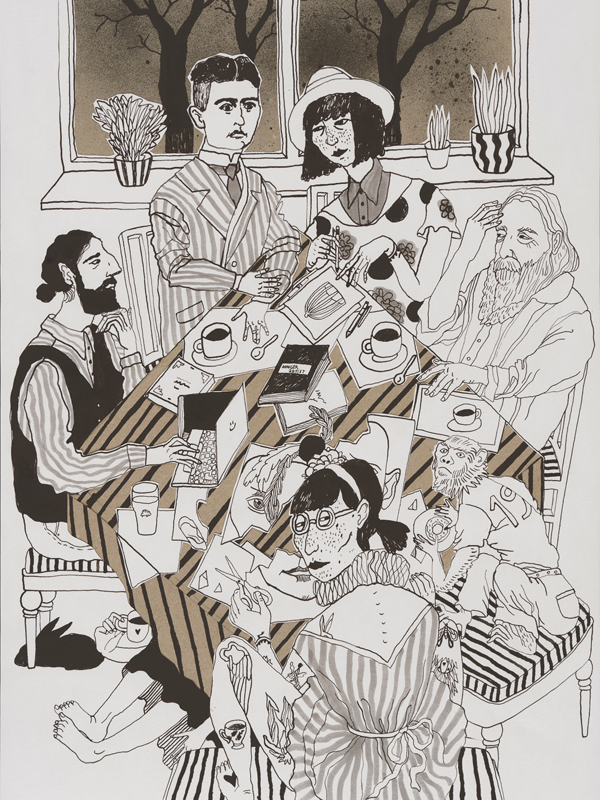
Illustration created for the exhibit “Searching for Myself”, June 2024.
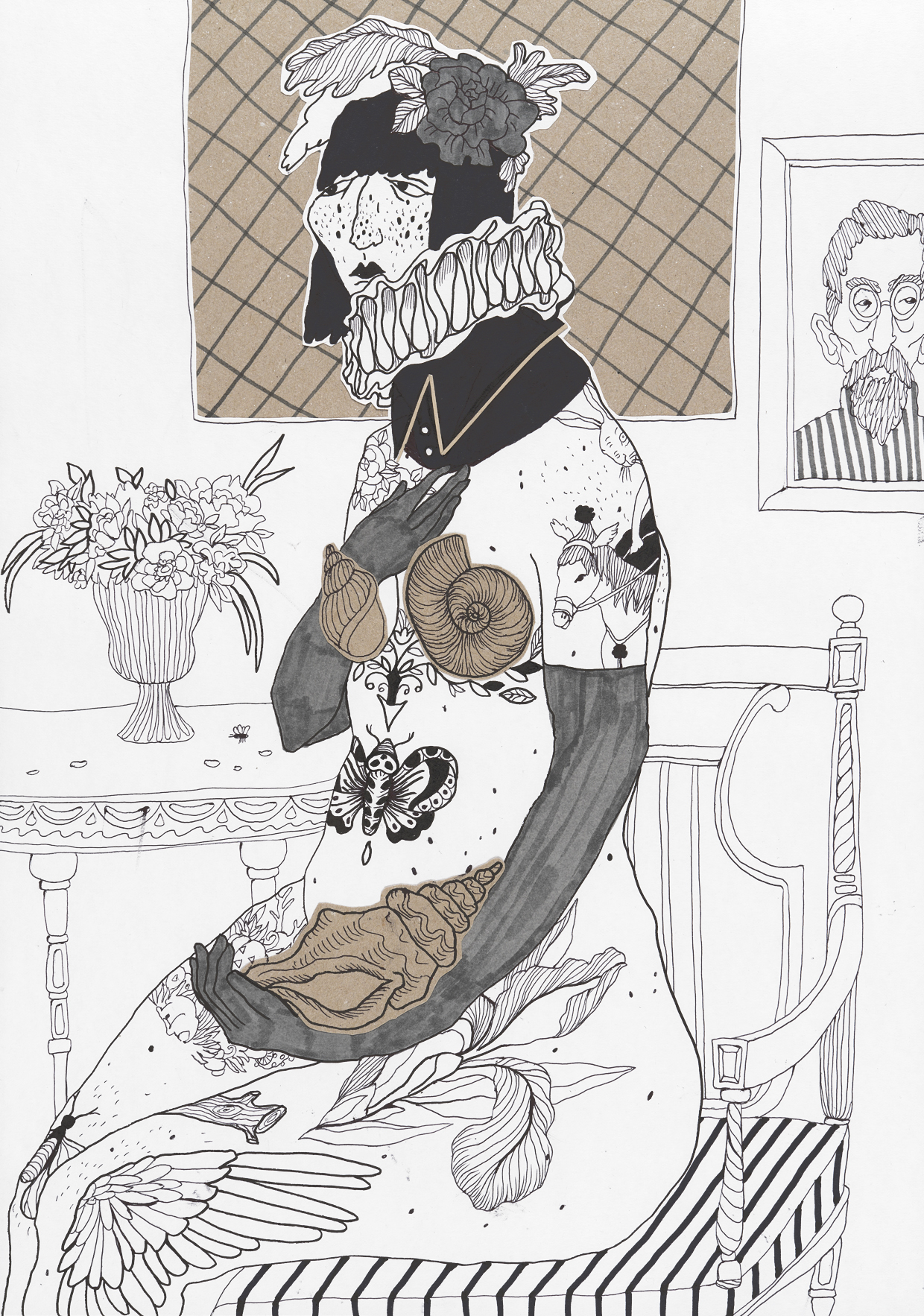
Self-portrait with seashells, paper, ink, pen, A3, 2024.
Created for solo exhibit “Searching for Myself”, June 2024.
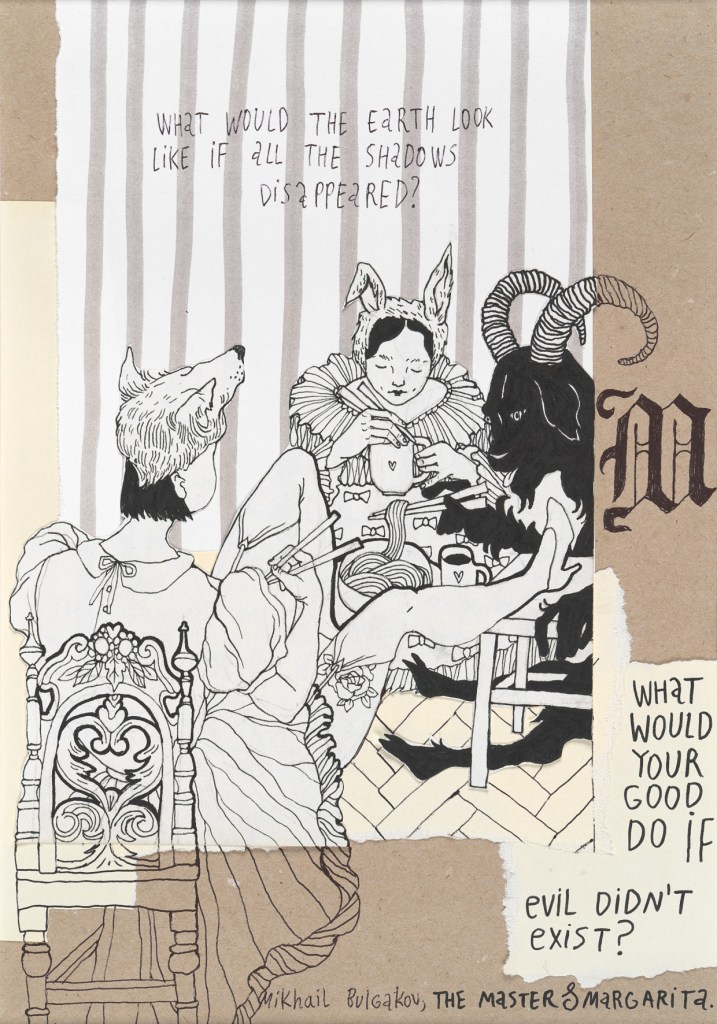
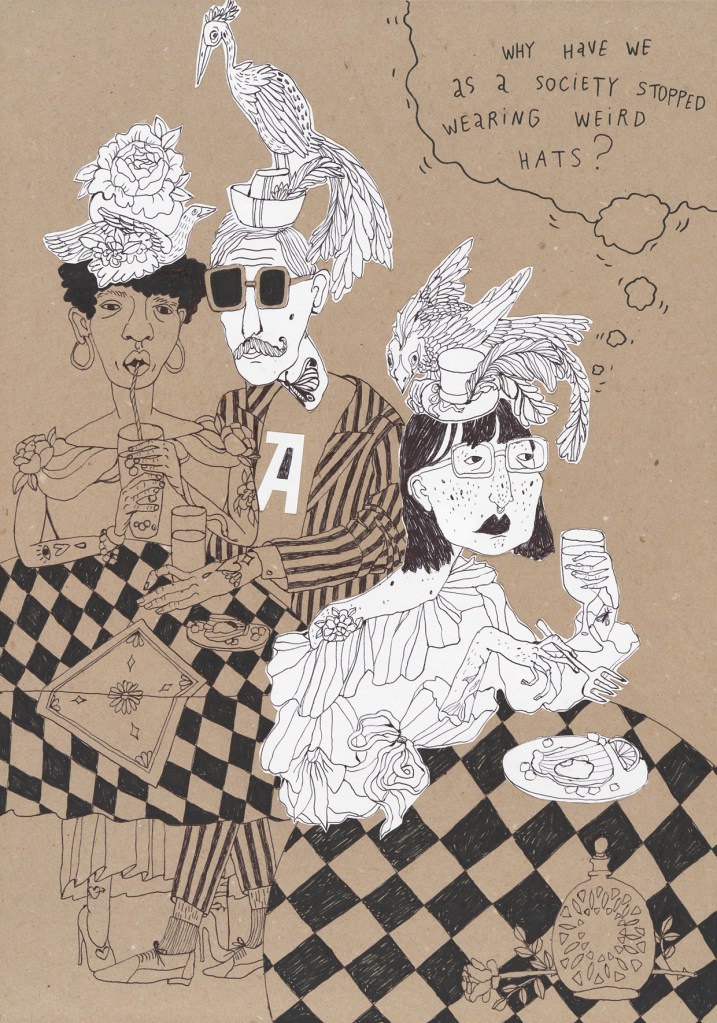
My Academy, short film by Anna Rabbit (2025)
“My Academy” is a short experimental film and a personal reflection on my time at the Academy of Fine Arts in Kraków — a period now coming to an end. The work, 206 seconds in length, corresponds symbolically to the Academy’s 206th anniversary, framing the piece within a temporal container, much like a confined space where something strange and elusive can unfold. The film emerges from my experience of returning to academic life after a seven-year break. It is not only a meditation on the act of studying again, but also an exploration of the profound emotional landscape that accompanied this return — a landscape marked by anxiety, vulnerability, and a persistent sense of unbelonging. Although My Academy is ostensibly about the Academy, it was entirely filmed within the building where I live. Throughout this period, the difficulty of leaving home, of being seen, became central to my daily reality. Thus, the physical site of the film — my apartment — stands in for the broader institution, embodying both its presence and my distance from it. Much of the film draws from the vivid anxiety dreams I experienced during this time: dreams of being back at school, being unprepared, being exposed. These fragmented, disorienting visions informed the structure and atmosphere of the piece. My Academy unfolds like one of these dreams — a collage of feelings, images, and fleeting narratives that resist clear explanation. The project is heavily influenced by David Lynch’s Eraserhead and Twin Peaks, particularly in how they capture the uncanny within the mundane — how a hallway can stretch endlessly, how a whisper can resonate with thunderous intensity. My Academy seeks to find beauty in distortion, intimacy in unease.
This film was created within the Interdisciplinary Studio curated by Prof. Zbigniew Bajek, PhD, and Jędrzej Krzyszkowski, at the Academy of Fine Arts in Kraków during the 2024/2025 academic year.
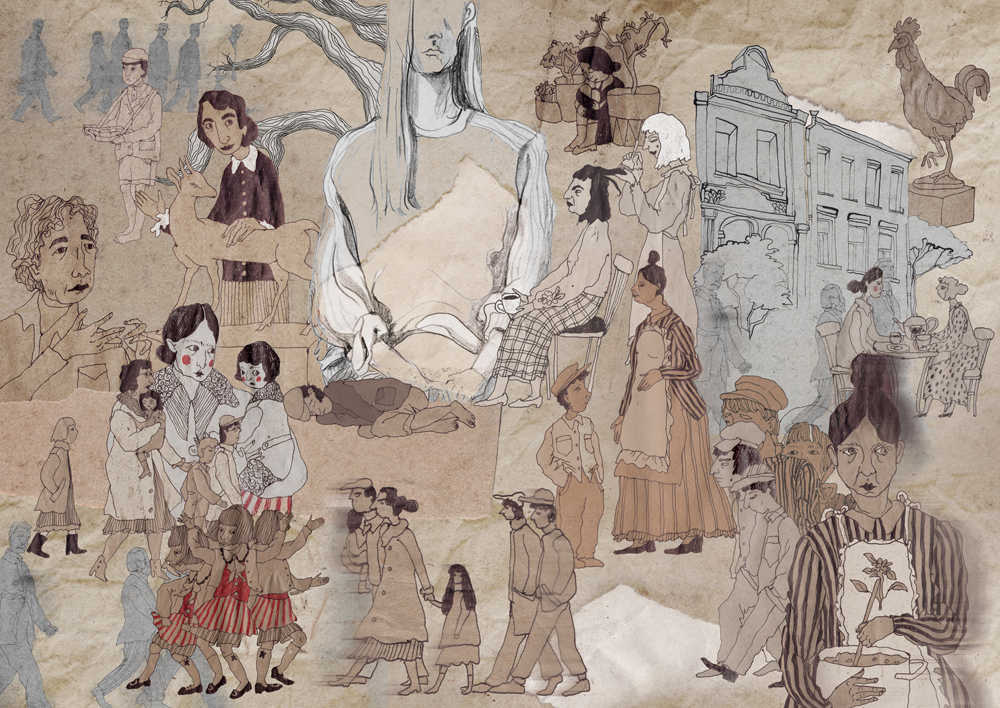
Hiding and Rescuing: Saska Kępa and Grochów during the Holocaust (Spacerownik) – illustrations, 2024.
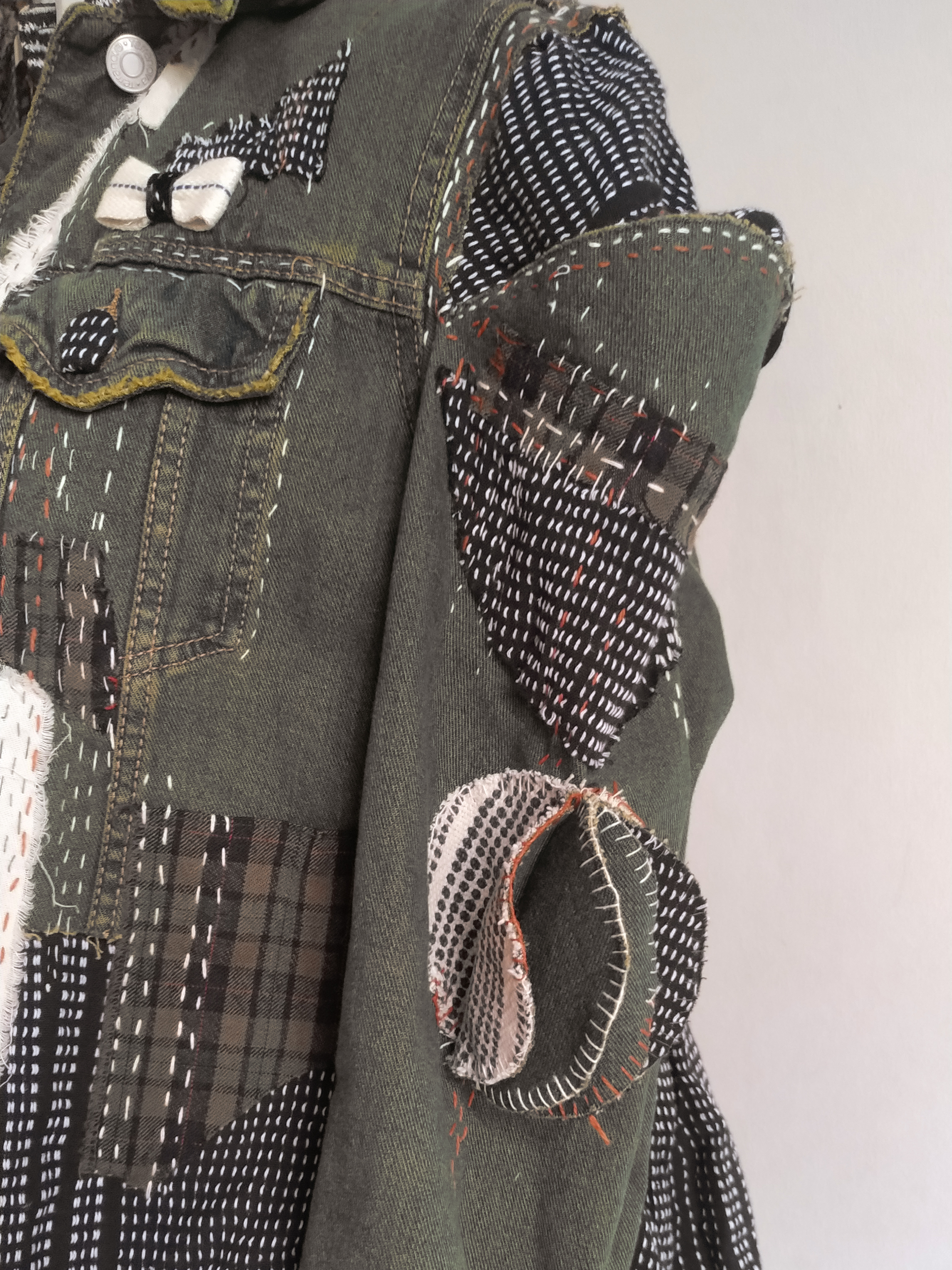
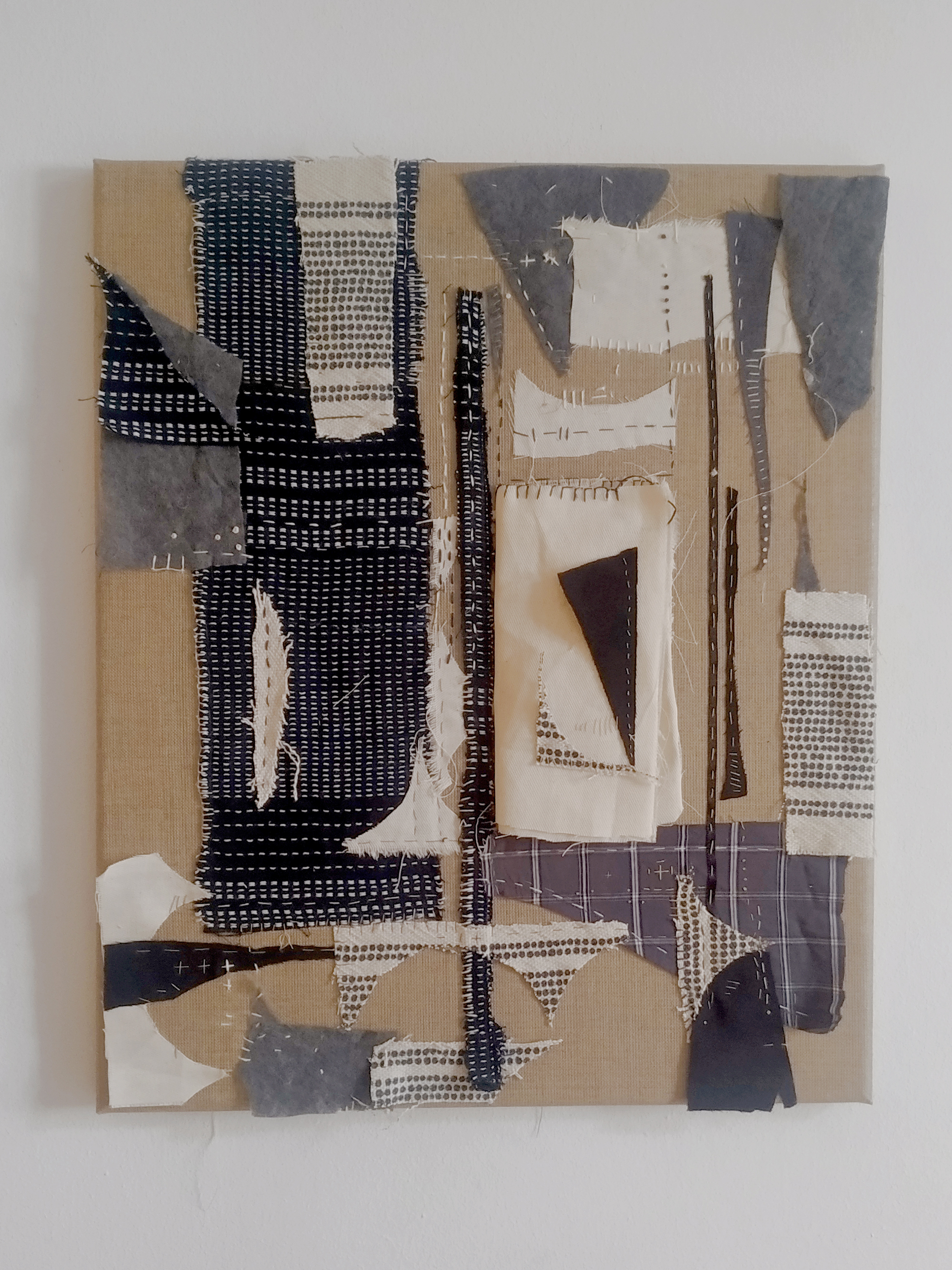
This section showcases Anna Rabbit’s works inspired by sashiko stitching—a traditional Japanese embroidery technique rooted in sustainability and craftsmanship. Combining heritage methods with a modern, zero-waste approach, these pieces transform discarded fabrics into meaningful, wearable art.
Anna also hosts workshops on sashiko, sharing its history, techniques, and creative possibilities with participants of all skill levels.
Objects sewn from textile waste
The objects are created from clothes and textiles that Anna and her family have outgrown, or from items damaged by her pets, rabbits and rats. Some materials have been found or generously donated. Each piece tells a story of reuse and transformation, turning discarded fabrics into unique, meaningful works of art.

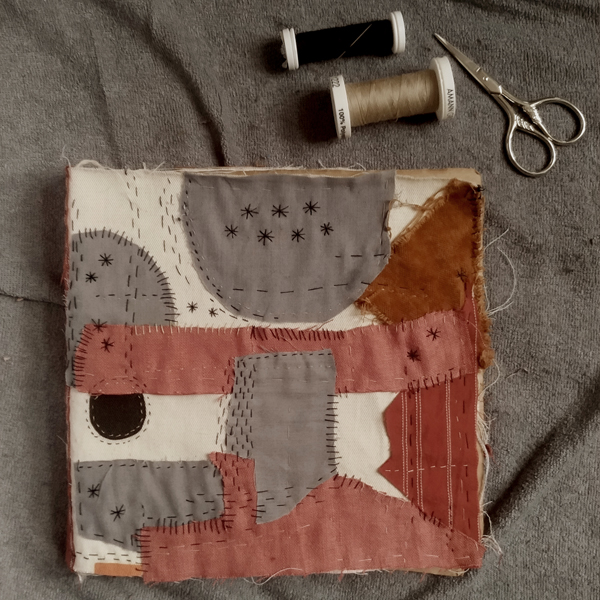
Sketchbook cover, 20×20, 2025.

Becoming Cha U Kao, Artbook (flip-through) Tour 2023/2024
“Becoming Cha-U-Kao” is an introspective art book exploring the experience of living with Borderline Personality Disorder (BPD), focusing on the symptom of shifting identity and the struggle to perceive oneself as a stable, defined person. Inspired by Henri de Toulouse-Lautrec’s portrayals of the performer Cha-U-Kao, the project reimagines her image as a mirror for contemporary identity fragmentation. The book was created as part of a costume design project within the Interdisciplinary Lab at the Academy of Fine Arts in Kraków during the 2023–2024 academic year, under the supervision of Professor Zbigniew Bajek. The project includes original tattoo designs, costume concepts, and fabric prints by Anna Rabbit. The bag featured in the project was sewn by Albina Krut using a fabric designed by Anna. The tattoo on the shoulder was executed by Władysława Goja, while the leg tattoo was both designed and executed by Anna herself.

